Showing posts with label Asian. Show all posts

28 October 2007

Forbidden Rice Pilaf


Every time I walk into New York's Kalustyan's, an international grocery, I'm always entranced by the array of rice displayed along the right side wall. A veritable rainbow of Bhutanese red rice, green Bamboo rice, black japonica, Camargue red, purple jasmine, brown rice, wild rice, basmati, sticky rice, sushi rice, short grain, long grain, oh the possibilities! Of course, I'm always attracted to buy some, but the problem is we aren't really rice eaters. Sure, I stir up a risotto now and again and I'm the first to jump at an invitation for my friend's special Iranian pilaf, but overall we aren't big on the rice front. When my Chinese friend describes the number of rice cookers she has to put into use when her family visits I practically blanch in horror. And yet, everytime I walk into Kalustyan's I'm tempted, which is why I've got four unopened bags of rice in my cabinet.


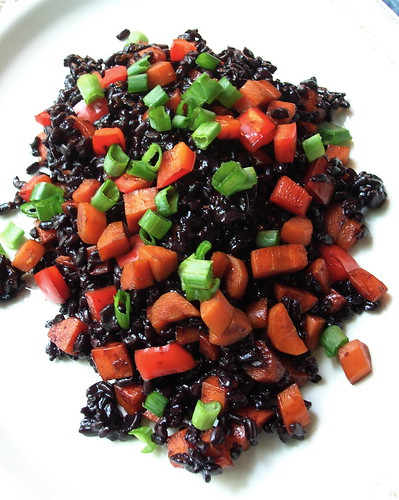
I decided to put some of that rice to good use, "look, this one's called forbidden rice, it says it was prized by Chinese emperors," I said as I pulled it from the cabinet. P. who lived in Hong Kong, just laughs at me, "they call everything in China 'forbidden,' '' he says. Yes, it's probably a marketing ploy, but the fact is this Chinese rice has a lot of other things going for it. The rice is an heirloom Chinese variety whose black color comes from its whole bran exterior. This means it is high in fiber and the deep purple hue it emits hints at a wealth of phytonutrients and iron, another reason you can find it at many health food stores. But most importantly, the rice is delicious, with a deep nutty taste and aroma. I combined it with soy-glazed carrots and red pepper and scallions, not a traditional recipe, but certainly a delicious one. It's one of those dishes that you find yourself shoveling one forkful after another, scooping up soft little grains and salt-edged vegetables in every delectable bite. At dinner there were no jokes about forbidden emperors, only a nice story about traveling in China, told between approving gusty bites. Which was a good beginning, because we still have three and a half bags to go.

With October 31 around the corner, I can't help but think this orange-and-black dish is perfect for the holiday. Happy Halloween!


Forbidden Rice Pilaf
An heirloom variety of Chinese black rice sometimes called forbidden rice, it is available at many health food stores and gourmet markets (do not confuse it with Thai purple sticky rice, which must be handled differently). Serves 4.

1 1/2 cups Chinese black rice
3 cups water
olive oil, salt
1 red bell pepper, diced
2 large carrots, peeled and cut into small dice
3 tbl soy sauce
1/2 cup chopped green onions (scallions)

1. Rinse the rice in three changes of water, until the water begins to run clear (the water will still be a little purple, but should not be cloudy). Bring the three cups of water to a boil with a pinch of salt. Add the rice to the boiling water, cover the pot and simmer over low heat for 35 minutes, until rice is tender and water absorbed.
2. Meanwhile, choose a pan with a tight-fitting lid and heat some olive oil in it. Saute the bell pepper until softened and darkened in a a few spots. Set the pepper aside. Wipe out the pan and heat some more olive oil in it. Add the carrots, stirring to coat them in the oil, then cover the pan with the lid and turn the heat to very low. Sweat the carrots until softened, about 15-20 minutes (you should not need to add any liquid to the pan, but if it looks dry you can add a bit of water). Uncover the pan, raise the heat to medium, add the soy sauce and swirl around so that the sauce reduces a bit and coats the carrots. Remove the pan from the heat and stir in the reserved bell pepper.
3. When the rice is done, combine it with the carrots and pepper and taste for seasoning. You may want to add a bit of red pepper, or a few more drops of soy sauce. Turn rice out onto a platter. Top with the scallions. Serve immediately.

23 October 2007

To Chinatown and Back


Is it possible to be homesick for a place that isn’t home? When I was in college I went off to the Middle East for the first time, to study in Beirut for the summer. I came back to New York, to my usual routine, terribly nostalgic for the world I had discovered. Where were the sidewalks pockmarked by rubble and bomb holes, where were the collapsing Ottoman mansions, the crusader castles, the artichoke fields, the night clubs built into converted bunkers? I missed the markets teeming with gorgeous produce, fish flapping in the market in Tripoli, the array of sweet biscuits in Saida, the call to prayer. Back in the U.S. I wanted desperately to feel like I was somewhere else, in a city that prides itself on anonymity, I wanted to feel like an outsider.


I found what I was looking for on the streets of New York’s Chinatown: sure the culture was different, but there were the bustling street vendors, the piles of unusual vegetables. Everything was written in a different alphabet, people bargained fiercely in a foreign language, and I was the only American around- I felt right at home. A stroll through Chinatown became part of my regular Sunday routine, I even started noticing similarities between the two cuisines, the mooncakes that resembled Middle Eastern date cakes (mamoul). Often, I stopped for a puffy roast pork bun, char siu bao, or did my grocery shopping, stocking up on Chinese buns for the freezer or uber-cheap fresh bok choy and seafood.

Fast forward several years, I was living and working in Damascus, and as much as I love Middle Eastern food, I was craving something different. I missed all the different ethnic eateries New York has to offer. I missed those puffy Chinese-style buns, and with no Dynasty supermarket nearby, I decided to try and make my own. With little access to pork in a Muslim country, I made a simple spinach filling, and I was happy to find that since the buns are steamed I didn’t have to fiddle with my troublesome (fear-of-death inducing) oven.


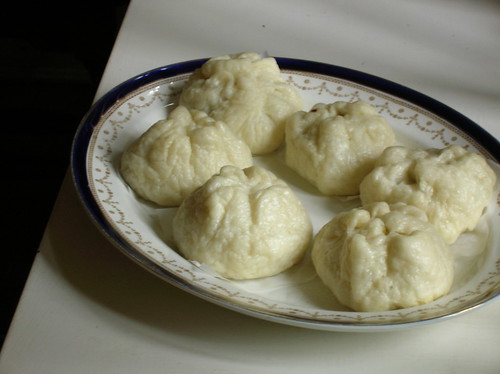
Since that first time I’ve made many batches of Chinese-style buns, and though my bun-shaping skills have improved, they never look like the gorgeous ones of Chinatown (maybe if I got a proper bamboo steamer). It doesn’t matter, because we love the supremely light texture of the bread that comes from their long rise, they’re the perfect partner to soup or something saucy to dip them in. I actually prefer the spinach filling, but you can use any mixed vegtables or shredded meat, I once saw a version that used whole-wheat flour and mushroom-cashew filling. Though these are a bit of a time investment to make, they freeze beautifully, I often keep a bunch in the freezer for those nights when you get home late and want something quick. I had to go half-way around the world more than once to discover these homemade buns, hopefully you’ll discover their joys right at home.


Chinese-Style Spinach Buns

for the dough:
1 cup warm water
1 package dry yeast
3 tbl sugar
3 cups cake flour, plus more for kneading
1 1/2 teaspoons baking powder
for the filling:
12 oz fresh spinach (can substitute frozen)
2 tbl vegetable oil
1 clove garlic, sliced
red pepper, to taste
3 tbl soy sauce

1. Make filling: Wash the spinach and leave some of the water clinging to it. Roughly chop the spinach. Heat the oil in a saute pan and saute the garlic until beginning to soften, about a minute. Add the spinach and toss over moderate heat (you may have to add the spinach in batches to get it all to fit in the pan). Toss the spinach until wilted and dark green, but not completely collapsed, several minutes. Remove the pan from the heat and stir in the soy sauce and season with red pepper. Set aside.
2.Make dough: Place the warm water in a large bowl, add the sugar and yeast and set aside until foamy, about 5 minutes. Add the 3 cups of flour and knead in the bowl until the flour is incorporated (if it is very sticky you can add 1/4 cup more flour). Turn out the dough onto a floured surface and knead for 5 minutes, until elastic and smooth but still soft. Place the dough in an oiled bowl, turning the dough to coat, cover with plastic wrap and let rise until doubled, about 1 1/2 hours.
3. Punch down the dough and flatten it into a disk. Sprinkle the baking powder over the dough, then fold the dough over and knead to incorporate the baking powder. Let rest covered 30 minutes (meanwhile, cut 12 squares of parchment paper).
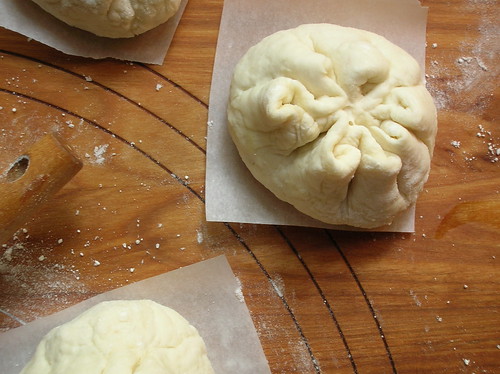
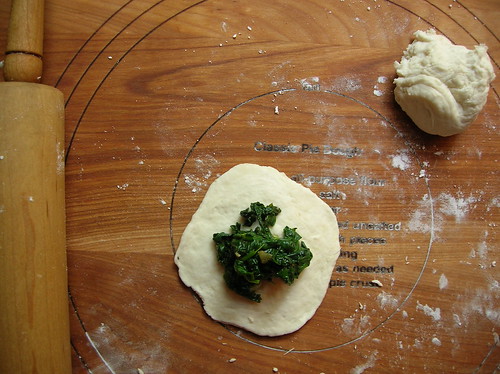
4. Form buns: Form the dough into a log and pinch off 12 equal pieces. Roll the dough pieces into a circle, using the rolling pin to make the edges of the circle thinner than the middle. Fill the dough with a spoonful of spinach. Gather up the edges of the dough, pleating them as you gather, then form a circle with your thumb and forefinger and squeeze the pleats closed. Place on a parchment square. Repeat to form remaining buns. Let the buns rest, covered, for 20 minutes, until puffed. Meanwhile, prepare a vegetable steamer.
5. Place the buns (on their parchment squares) in a steamer. Cover and steam 10-15 minutes, until puffed and heated through. Serve immediately.
________________________________