20 April 2007

Shaved Asparagus Salad


It's spring and asparagus season is in full swing. I'm pleased to report asparagus has been gracing our table almost every night for the past couple weeks, primarily simply roasted with a bit of garlic and salt, a form which has become practically an addiction for us. The other night, as I hungrily waited for dinner to be ready, I found myself munching on some raw asparagus tips that were lying on the counter. Now, I generally liked my vegetables cooked (I had a friend once that liked to nibble on raw potatoes, which is just weird) but these asparagus were delightfully crunchy and full of flavor. It got raw asparagus on my mind, and when I came across a recipe for a shaved asparagus salad, I knew I had to try it.

Crunchy and brightly flavorful, the shaved asparagus is twirled with chunks of orange and toasted hazelnuts. I completely forgot the cheese in the picture, but please remember it because it adds a nice soft salty note. The original recipe directions called for the asparagus tips as well, but I set them aside and later cooked them with some lemon-pepper fettucine, so we had two asparagus dishes for dinner, each very different. I think it's a good use for asparagus stalks, often over-looked for their feathery tips, and generally a good new thing to try in the height of the season.


Shaved Asparagus Salad with Orange and Pecorino
Shaved asparagus has a wonderful crunchy, fresh taste. I like to reserve the tips for another dish, but you could also blanch them briefly in some boiling water and add them to the salad. Inspired by Food and WIne.

1 navel orange
1 large bunch of thick asparagus, bottoms trimmed and tips removed
One 1 1/2-ounce piece of Pecorino Romano cheese
1 1/2 teaspoons Champagne vinegar or white wine vinegar
1/4 cup hazelnut oil or extra virgin olive oil
Kosher salt and freshly ground white pepper
2 tablespoons toasted hazelnuts, roughly chopped

1. Working over a bowl, peel the orange and cut between the membrane to separate the segments. Set the segments aside, leave the juice in the bowl. Zest a bit of the peel into the bowl, discard the remaining peel. Whisk in the vinegar and oil with the orange juice and season with a touch of salt and pepper.
2. Using a mandoline or a sturdy vegetable peeler, shave the asparagus lengthwise into the bowl. Toss the asparagus with the dressing and let sit for about five minutes to soften.
3. Shave the Pecorino Romano cheese into the bowl. Add the orange sections to the asparagus. Mound the salad on a large platter, garnish with the hazelnuts and serve.

__

18 April 2007

A Recipe for Optimism


My mother has a cookbook in which she has written in the margin, “made Nov. 1968, lamb chops $.80/lb.” I love this note, and in fact my mother’s cookbooks are littered with similar ones, scribblings of when and where she made the dishes, noting substitutions and alterations, cakes made for birthdays and cookies perfect for Christmas decorating. Like Billy Collins’ Marginalia, the white space on the side of the page is there for our seizing, and it is also an insight into the thoughts of others.

I like knowing what made someone choose a particular recipe, what made them think it would be good, why it piqued their interest. Maybe they happened to have all the ingredients in their pantry, maybe they are searching for their grandmother’s
version of coconut cake. Me, I have a tendency to look for unusual combinations or techniques, something different or new.

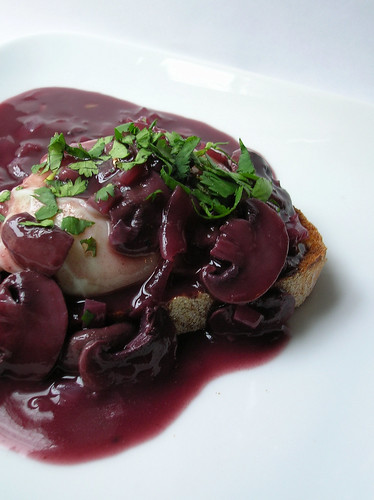
Over a year ago, I bookmarked a recipe for oeufs en meurette, or eggs in red wine sauce. The fact that I folded down the page corner is a testament of true optimism, an optimism of time, an optimism of finances. When would I have the time to make a recipe which involved multiple pots and pans and delicate poaching operations? When would I have the finances to use an entire bottle of red wine on something which is essentially a dressed-up version of eggs on toast? And did I mention I’m not a big fan of poached eggs?

But for some reason, this recipe called out to me, and each time I opened the cookbook it faced me with with it’s little tabbed page. As I confronted it again and again, the guilt grew. Why haven’t you made me, the recipe asked insolently, what are you waiting for?

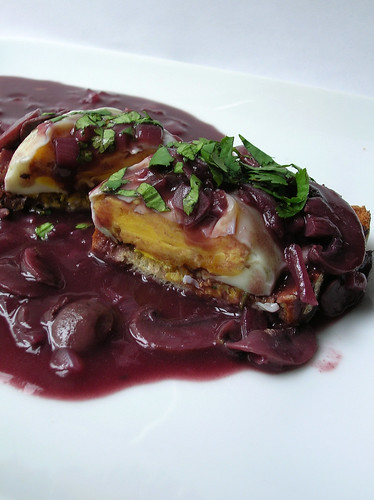
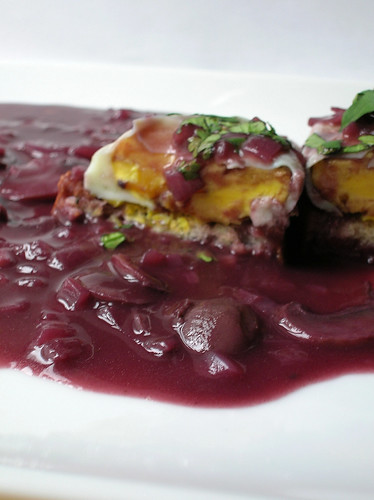
Finally, in part so that I wouldn’t feel guilty everytime I glimpsed the book on the shelf, I went out and made the thing. And you know what? It was the best damn thing to come out of my kitchen in a long time. It was worth every little bit of extra effort, and even those dirty pots and pans. I realize I spend a lot of time advocating recipes which are simple or uncomplicated; this one is neither of those, but it is also really good. The earthy mushrooms, the red wine sauce, the soft egg, all melting into a warm crunchy hunk of toast. You’ll be happy to know all the components can be assembled ahead of time, making this the perfect dish for an impressive brunch or lunch. I'd even make it for dinner, optimistically speaking.


Oeufs en Meurette
This classic bistro dish is based on meurette, a red wine sauce used to accompany eggs or fish. It takes a bit of time and concentration, but it is worth the effort and can be prepared ahead of time. If you make it with white wine it is known as oeufs en meursault. Adapted from Cooking with Wine and Saveur Cooks Authentic French. Serves four.

4-8 eggs (depending on if you want one or two eggs per serving)
- for the sauce:
1 bottle French Burgundy
2 cups beef stock
1 shallot, chopped
1 carrot, sliced
1 garlic clove, crushed
1 bay leaf
a few thyme sprigs
- for the garnish:
1/4 lb slab bacon, diced
1/2 lb mushrooms, sliced
- for the toasts:
4 thick slices of bread, crusts removed
- for finishing:
2 tbl butter
2 tbl flour
parsley sprigs

1. Place the wine and stock in a large pan. Bring to a boil, then lower the heat so the mixture is just simmering. Break an egg into a ramekin, then slide the egg into the simmering wine. Repeat with the remaining eggs, poaching until the whites are firm and the yolks are just beginning to set . Using a slotted spoon, transfer eggs to a plate. Trim any stringy whites, then set aside.
2. Add the shallot, carrot, garlic, bay leaf, and thyme to the red wine mixture, raise the heat slightly, and simmer until reduced by half, about 25 minutes.
3. Meanwhile, place the bacon in a skillet over medium heat and cook until the bacon is browned and crisp, about 5 minutes. Move the bacon to paper towels and drain off all but 1 tablespoon of the fat from the skillet. Add the mushrooms to the skillet,
season with salt and pepper, and sauté them until brown and tender, 10-15 minutes. Set the mushrooms aside with the bacon.
4. Make the toasts: the traditional way is to sauté the toasts in some butter until browned on both sides, but you can toast them under the broiler or toaster if you prefer.
5. Finish the sauce: In a small bowl, smash together the 2 tbl butter with the flour to form a paste. Strain the red wine mixture through a fine meshed sieve into a medium saucepan. Discard the vegetables. Put the sauce pan with the wine mixture over low heat and whisk the paste into the sauce a little bit at a time, so that the sauce thickens.
6. Stir the mushrooms and bacon into the red wine sauce. Taste for seasoning. Keep sauce warm.
7. To serve: Place a toast on each plate. Top the toast with one or two eggs. Spoon the sauce over the eggs. Garnish with parsley sprigs.

To make ahead: Make all the components ahead of time: store the poached eggs in some water in the refrigerator, store the strained sauce and mushroom-bacon garnish separately in the refrigerator. Reheat the eggs briefly in simmering water, reheat the sauce and garnish on the stovetop, and rewarm the toasts in the oven. Assemble and serve.

__

16 April 2007

Brownies: Simple, Sublime

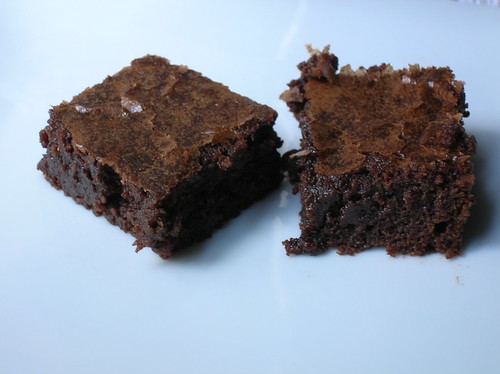
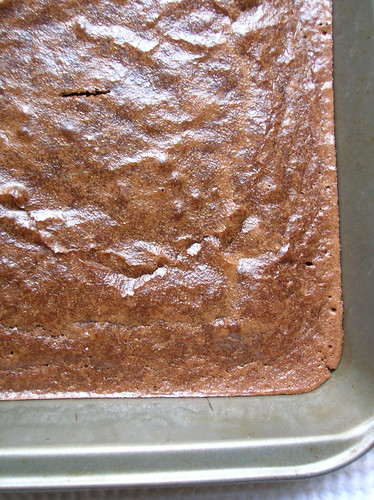
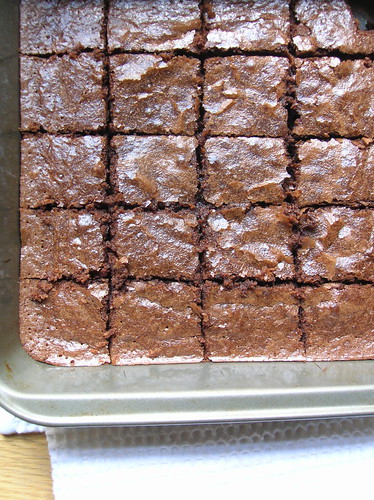
brownies 4

Brownies have to be one of the quintessential American recipes. Right up there with apple pie and chocolate chip cookies, they are an internationally recognized contribution to the culinary landscape, and one of the easiest and tastiest things you can make. Yet, unfortunately, there are a lot of bad brownies out there, especially outside the U.S. borders. I have been in French patisseries with the most beautiful napoleons and perfect tartlets, yet “le brownie” is crumbly, dry and oversalted. In Argentina, a brownie becomes a chocolate-coated cookie, and all too often it takes the form of chocolate cake cut into squares. In Damascus, my colleagues turn out beautifully arranged platters of sweets, artfully decorated with green crushed pistachios and rose petals, but when I show up with a plate of brownies, they are shocked I made them in my own kitchen. They go crazy over them, which isn’t surprising since they are very good, but what is surprising is that they act as if it is the most difficult and exotic thing, these brownies. Dare I tell them I stirred them up in one bowl in a matter of minutes?


In a recent article in the New York Times, Julia Moskin also expounded the simple delight of brownies, and provided two great recipes (there’s a third which looks good too, but I haven’t tried it yet). I know, since I’ve made both recipes numerous times- back in college I went on a quest to find the best brownie recipe. It was a quest I later came to regret, as my friends would always request I bring my brownies to any sort of gathering. What Moskin doesn’t mention is that these two recipes are extremely similar, one is just double the other, with a tiny variation in the sugars and temperature. Since brownies are so forgiving, both versions turn out excellent specimens. Like Moskin, I adore Nick Malgieri’s Supernatural Brownies, which is the one I reach for most often when brownies are called for. Over the years, I’ve tinkered with the recipe ever so slightly, mainly because I prefer a smaller pan. I’ve also added a little bit of cocoa, which I think enhances the chocolate flavor. I hope you’ll believe me when I say these are the best brownies I can think of, and if not, know that several years later, my college friends still request them at parties.


Best Brownies
Moist, rich, and supremely chocolate-y, these treats are also a cinch to make. They’ll be just as welcome at a fancy dinner party as at a bake sale.

1 stick (8 tbl, 4 oz) butter
4 oz bittersweet chocolate
1 cup sugar (all white sugar, or half white/half brown sugar)
1 tsp vanilla
pinch salt
2 eggs
1/2 cup flour
1/4 cup cocoa powder

- Preheat the oven to 350, grease an 8” square baking pan. In the top of a double boiler, or in the microwave, melt together the butter and the chocolate. Let the mixture cool slightly, stir in the sugar, vanilla and salt. Beat in the eggs one at a time, then fold in the flour and cocoa powder. Scrape into prepared pan and bake in the oven 18-20 minutes. The top should be dry and shiny, but the interior should remain very moist. Immediately move the pan to the freezer or to an ice bath for about five minutes to stop the cooking, then transfer to a wire rack to cool completely.

For a crowd: double the recipe and bake in a 9x13" pan for 35-40 minutes.

Ideas for variations: stir in 1/2 cup walnuts, add some heat with a bit of red pepper, or make a mocha with 2 tbl of espresso powder.

__

13 April 2007

Mastering Labaniyya, Questions of Origin Aside


A debate broke out in my office break-room one afternoon; it was heated, I remember voices were raised. It was not about politics or religion, it was about food. Get seven Syrians together talking about the origins of different Arab dishes, and you’re sure to have some lively reparte. The cuisine throughout Syria, Lebanon, Jordan, and Egypt is very similar, relying on many shared dishes, but also with regional varieties and local specialties. There was tension over whose za’atar is better, hairs bristled over baba ganoush. However, we generally agreed Palestinians could claim sayadieh, a fish dish, while Jordanians laid claim to mansaf, Lebanon had moghrabbieh, and Aleppo had its own repertory of spicy dishes.

“So what is particular to al-Sham (the Damascus area)?” Afraa asked. The labaniyya dishes, someone ventured, referring to dishes cooked in a warm yogurt sauce. These dishes, which can actually be found throughout the region, include the classic kibbe labaniyya, meatballs in a warm yogurt sauce, but they can also be made with chicken, lamb, even with pumpkin-bulgur dumplings.

I love these dishes, they have an unusual tangy warmth to them, and I always look for them on the menu in an Arab or Turkish restaurant. Unfortunately, I rarely find them and they are unknown to many Western audiences. The key is knowing how to cook the yogurt (aka laban) so that it is stabilized.

Later that week, I asked my friend Mahmoud about making cooked laban. Mahmoud not only loves to cook, but is also good at explaining things clearly. “Aha,” he exclaimed, jumping up from the couch, “there is a secret!” He proceeded to explain the method in precise detail, and then, so excited at the thought of it, dashed out the door to buy some ingredients so he could show me. The door had already closed behind him before I could even process what was going on.

It turns out, stabilizing the yogurt isn’t too difficult, and for once I was happy to have a crazy Syrian taking over my kitchen. A little egg white and cornstarch are beaten into the yogurt and then gradually heated until very warm, stirring all the while. You can actually cook the sauce all the way to boiling this way, if you stir all the while. This is the most traditional way to make yogurt sauce, bringing it to a boil, but I will admit I find it very stressful. Instead, I like to heat the yogurt until just steaming but not boiling - you don't have to worry about stirring constantly and this way it's one of the easiest and fastest soup bases you can make.

This version is a classic Lebanese one with chicken and little pearl onions that gets lots of flavor from a homemade stock. I really urge people to try this, even the shortcut version, especially if they haven’t had this kind of dish before. Once you’ve mastered the yogurt sauce, you can experiment with all kinds of fillings and additions, I often make just the stabilized yogurt sauce and stir in some cooked chickpeas and broth and serve it as a soup. Sahtain!


Chicken in Yogurt Sauce
This comforting dish is warm with tangy yogurt and homemade chicken broth. Please note the two different versions of making the yogurt sauce. To make the traditional stabilized the yogurt, it must be stirred constantly throughout the heating process, however, once the yogurt has boiled without curdling, you can consider it stabilized and relax the stirring.

1 chicken (about 3 lb), cut into 8 pieces
1 tbl sea salt
16 baby onions. peeled
1/2 bunch coriander or parsley, chopped
6 garlic cloves, smashed
for yogurt sauce:
4 cups (1 quart) plain yogurt*
1 fresh egg white
1 tbl cornstarch (or flour)

1. Put the chicken in a large pot and add water to cover. Bring to a boil, skim the surface, then add the salt and lower the heat. Simmer 45 minutes, skimming the surface occasionally. Add the onions and simmer another 15-20 minutes. Remove the chicken and onions, separate the meat, dice it and set aside with the onions. At this point, I like to to return the bones to the pot, toss in a bay leaf, and let the stock continue to simmer while I prepare the rest of the dish, though you don’t have to do this.
2. Saute the garlic cloves in a bit of olive oil until just softened, add the coriander and saute until soft and vibrant green (do not let it brown). Set garlic and coriander aside.
3. Combine the yogurt, egg white, and cornstarch in a pan off the heat and beat with a wooden spoon until very smooth and creamy, it should look glossy, almost like whipped cream. Have all your ingredients nearby (i.e. the chicken and onions, warm broth, and garlic/coriander).
4. Option One: Place the pan over medium heat and stir the yogurt mixture constantly in the same direction so it does not curdle. Let the yogurt mixture come to a boil (stirring), reduce the heat and simmer (still stirring!), about 3 minutes.
Option Two: Place the pan on the heat and heat until just steaming, stirring occiaisionally, do not let the mixture come to a boil.
5. Add the coriander, garlic, the chicken meat and the onions to the thickened yogurt sauce. Stir in about 2 cups of the warm stock and simmer the mixture, stirring occasionally, another three minutes. The sauce should be thick and combined. Serve immediately, with rice.

Shortcut version: Use leftover chicken meat (or meatballs, kibbe, or lamb) and purchased low-sodium stock. Prepare the yogurt sauce and the coriander, then stir in the meat and stock.

*A note on the yogurt: This calls for plain yogurt, not the thickened strained yogurt known as labneh or Greek yogurt. Low-fat yogurt is fine, but whole-milk yogurt will be richer. I do recommend using the freshest yogurt you can find, you want one with lots of flavor.

__

11 April 2007

The Color Purple


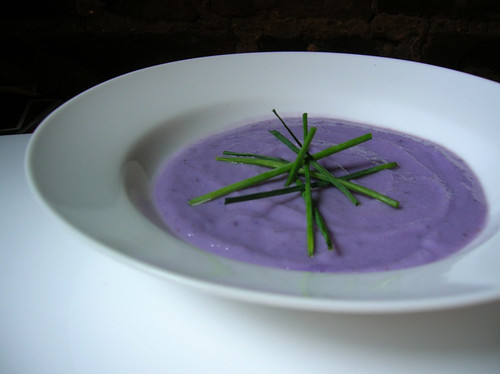
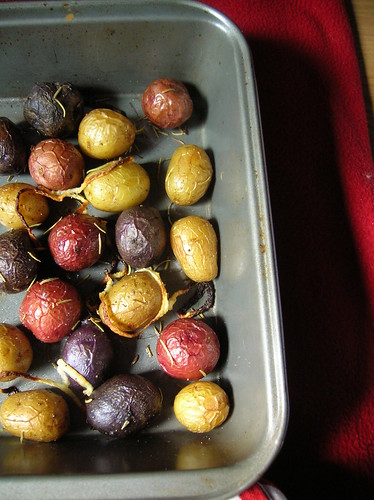
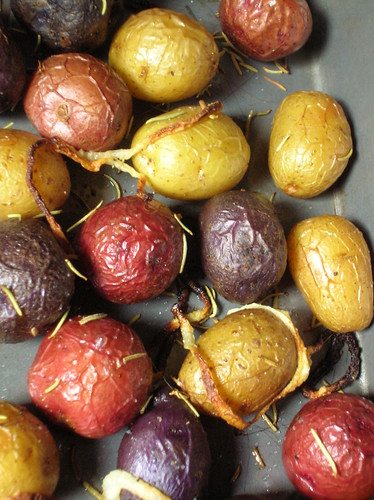
I cannot think of a better tribute to spring, and to the kind-faced man who sells potatoes at the market, than this beautiful soup. The man with the potatoes presides over several bins, each with tiny specimens in different hues: buttery yellow fingerlings, creamers, Russian bananas, ruby-colored rose ones, and purple Peruvians. His hands are thick and rough and I imagine he has dug these potatoes himself, leaving those little bits of dirt under his fingernails. He kindly gives out suggestions: since peeling the tiny buggers is a pain, just give them a good scrub with a vegetable brush, then simply saute or roast them. I buy a bag of multi-colored and a bag of purples, because I will fully admit to judging a book by its cover, or color, as the case may be.


Multicoloreds, simply roasted with olive oil, rosemary.

About a month ago, I was similarly infatuated with a big head of purple cauliflower. I wanted to come up with a recipe that featured the cauliflower’s color and I even boiled down the cooking liquid to incorporate into a bright purple sauce for a gratin. The results were tasty, but who really wants their gratin to be purple colored?

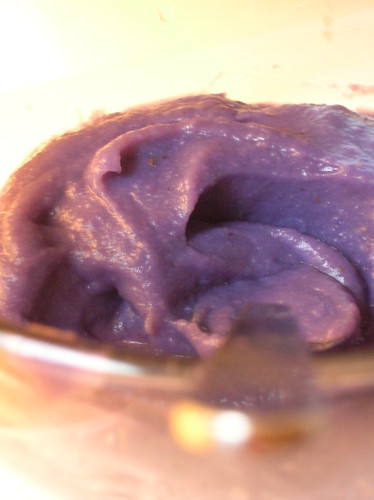
This time I took a simpler route, going back to my mom's old staple, Vichyssoise. I love the sweet, smooth taste of this chilled potato leek soup, and serving it I felt a bit like an Impressionist, Picasso in his blue period. You don't have to go quite so sculptural with your chives, but do use them, as they add a nice accent.

I should note that the best thing I did make with the purple cauliflower was a salad with romaine and chopped egg. Make sure to add some lemon juice or vinegar to the water you cook the cauliflower in, otherwise all it's color will seep out. No such issue with the potatoes, which will keep their color, though this soup is good no matter what color you use.


Purple Potato Vichyssoise
In my opinion, this classic recipe is best in its simplest form, allowing the clean sweet flavors of the leeks to come through. I suppose you could use stock instead of water, and by all means add more cream or some milk to your taste.

1-2 tbl butter
4 cups sliced leeks, white and light green parts only
4 cups diced peeled purple potatoes
6-7 cups water
1 tsp salt
1/2 cup heavy cream
chives, for serving

Melt the butter in a saucepan and saute the leeks over very low heat until just golden. Add the potatoes, salt and water in a pan and bring to a boil. Simmer 30 minutes, until the vegetables are tender. Let cool slightly, add the cream, and puree until smooth. Chill thoroughly. Taste for seasoning. Serve chilled, with chives sprinkled on top.

__

09 April 2007

Memories, Reinterpretted in Miniature


Remember when I said last week that I had the idea of angel food cake sort of stuck in my head? Well, I wasn't kidding. See, growing up, angel food cake was always synonymous with the Fourth of July: every year, we would pile into the car and drive to a friend's house, where besides the barbeque and the fireworks, the star of the evening was an angel food cake made by this friend's mother, Mary. Even late into her eighties, Mary didn't disappoint, her stooped frame whipping those egg whites to produce a fluffy tower of a cake crowned with peaks of shiny meringue frosting and usually with little paper American flags stuck in the top. Heck, I don't think we would have drivern those two hours if that cake wasn't part of the deal.

For various reasons, that tradition ended when I was about 13, and with it went any occaision to eat angel food cake. In fact, until I made it the other day, we had been on an over ten year hiatus. But then angel food cake got stuck in my head and, like a version of the Macarena, it just won't go away.

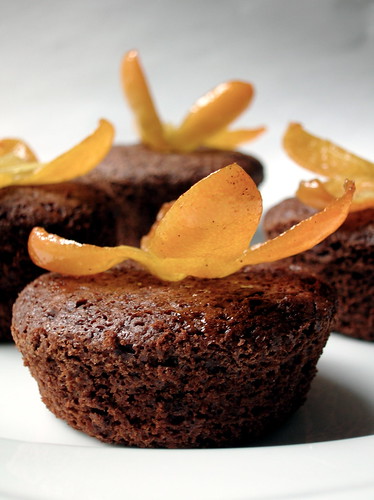
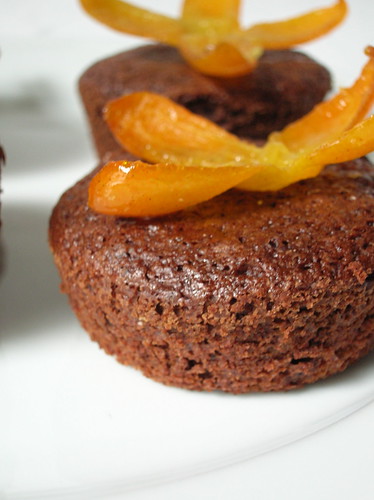
This time, the version is chocolate, baked in tiny baby cake form, topped with kumquats cut in the shape of flowers. I've been munching on kumquats since they first appeared in January, eating them out of hand and making compotes with cranberries that were tangy compliments to my morning oatmeal. When I spied a cake with kumquat flowers, I was just waiting for an excuse to make them, and they ended up as sweet citrusy toppings to my little cakes, making them perfect moist morsels for popping anytime.


Chocolate Angel Food Cakelets with Kumquat Flowers
Make sure not to overbake the cakelets, or they will dry out, you want the insides to stay nice and moist. The flowers would make lovely toppings for all sorts of desserts, but this citrus-chocolate pairing is a classic.

for the angel food cakelets:
1 3/4 cups superfine sugar
1/4 tsp salt
1 cup cake flour, sifted
1/4 cup cocoa powder
1/4 cup hot water
10 egg whites, at room temperature
1 tsp vanilla
1 1/2 tsp cream of tartar

1. Preheat the oven to 350, have cupcake tins ready.
2. Sift together 3/4 cup of the sugar, the salt, and flour into a bowl. In a small bowl, combine the cocoa and the hot water, stir until smooth, then stir in the vanilla. In a clean bowl, combine the egg whites and cream of tartar. Beat the egg whites with an electric mixer until they begin to hold soft peaks. Gradually add the remaining 1 cup of sugar, a few tablespoons at a time, while beating, until the whites hold stiff peaks. Fold the cocoa mixture into the egg whites, then gently fold the flour mixture into the whites in two additions.
3. Fill the cupcakes 2/3 of the way full and bake 14-16 minutes, until the tops are cracked and dry and springy to the touch. Run a knife around the edges, cool on a wire rack. Top each cake with one kumquat.

for the kumquat flowers:
12 kumquats
1 cup white wine
1/2 cup sugar
3 tbl honey
1 tsp ground star anise or cloves

Starting at rounded end, cut cross into each kumquat to within 1/4 inch of stem end. Bring wine, sugar, honey, and star anise to boil in heavy large saucepan, stirring until sugar dissolves. Add kumquats; simmer until just tender, about 8 minutes. Using slotted spoon, transfer kumquats to a plate until cool enough to handle. Gently remove seeds from kumquats. Meanwhil, continue simmering kumquat syrup until reduced to about 3/4 cup. Return kumquat flowers to syrup to coat, store in syrup until ready to use.
__

05 April 2007

One Family, Two Easters


“Which Easter do you celebrate,” Umm Hana asked, “Catholic or Orthodox?” I’m not at all religious, but in Syria, it’s best to chose from the acceptable options, so I went with Catholic. “Ah, good, like me,” Umm Hana said proudly. “But Abu Hana, he is Syrian Orthodox, so the children go to that church,” she reminded me. “So which Easter will you celebrate,” I asked, knowing Easter is a major festivity in the Syrian minority community. I had heard the bands practicing for weeks, beating drums at all hours of the day as they practiced marching-band style formations in the Old City.

“We celebrate both,” Umm Hana assured me, “you’ll be here, right?” Of course I would be there, and of course I would want to help her prepare the feast. Over the next week, we prepped vegetables and chopped parsley. We sliced thick rounds of beef and pounded them out into 6 inch circles. A mixture of garlic and herbs was placed in the middle of the beef, then rolled up, and sewed closed with needle and thread. Hundreds of sewn beef rolls later, we seared them in clarified butter, then made a tomato sauce and simmered the rolls for over an hour. When I asked her what she called the dish, Umm Hana said “laziza,” which simply means tasty. She shrugged, “it doesn’t really have a name, so I just call it laziza.”

Easter morning came, and my friend Sara and I arrived early to help prepare. Soon the family and many friends arrived and toasts of Irish creme liqueur were passed around. I took one sip and nearly gagged, it was before noon and I was drinking something that tasted like rubbing alcohol. Having alcohol in small amounts is a matter of distinction in Christian households, to set themselves apart from the Muslim majority, but the most of the stuff tastes like it was made in someone’s bathtub. Sara and I tried to discreetly hide our glasses.


Liqueur, eggs, and a close up of the "laziza" beef rolls.

Soon, dishes were ferried to the table, and the feast began: steaming platters of saffron rice, stuffed vegetables, roast spicy chicken, salads, bulgur pilafs, stewed okra. The “laziza” truly lived up to its name. There was coffee and tea, then there were chocolate eggs with trinkets inside, and little cakes. By the time the date-filled biscuits were passed around, I was stuffed, but they were so good I found myself reaching for one after another anyway.

Several hours later, as Sara and I were about ready to roll our way home Umm Hana said, “so you’ll be here next week right?” Right next week, another Easter. As we tried to walk off the effects of our meal, I really thought I couldn’t do it again. “What if I say I’m sick next week?” Yet the next week, there I was again, newly ironed tablecloths, baskets of dyed eggs, carrying dishes from kitchen to table.


This year, Umm Hana caught a break, because both Easters happen to fall on the same day. I’ll be cooking for my own family, and in the interest of simplicity I’ll be cooking just one of the dishes Umm Hana taught me, albeit one of my favorites. Djaj ala Freekia, or chicken with roasted green wheat, is simple to prepare, but it ranks among my most coveted of homely Arabic foods. If you have never had freekiah, which most people haven’t, I urge you to go now, and search it out. It is green wheat which is harvested young and then immediately toasted over fires in the fields, which both preserves it and imparts a nutty, deep flavor. It can be a bit hard to find, but check your local Middle Eastern market, or it can be ordered from Kalustyans, it is sometimes labeled “Frik.” The traditional way of serving is to put the wheat on one big platter, the poached chicken on another platter, and pass a bowl of the broth alongside. You can moisten the dish with the broth, as you can see in the photo I like my freekiah a little more moist or soupy than most people.

On a final note, those absolutely addictive date-filled cookies are very similar to ma’moul, and are called kaak bi ajweh. I adore them, and Umm Hana gave me two big boxes, a few of which still remain in my freezer. If you want to try making them yourself, there’s an excellent recipe and article here. كل عام وأنتم بخير (Kul aam wa intom bi kheir), and happy holidays to all!
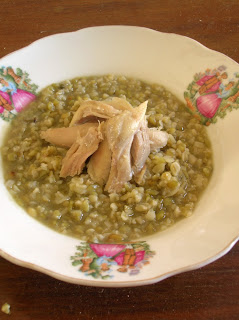

Djaj ala Freekia (Chicken with Roast Green Wheat)
Freekia is a roasted green wheat with a wonderful nutty flavor, it is available in Middle Eastern markets. For extra flavor, we like to poach the chicken in a light low-sodium broth, but water is traditional.

1 medium chicken, about 3 lb
6-7 cups water or stock
1 medium onion, diced
3 cinnamon sticks
1 bay leaf
1 tbl sea salt
2 tbl unsalted butter
1 cup freekia
1/2 tsp ground cinnamon
1/2 tsp ground allspice

1. Rinse the chicken, place it in a pot, and add the water or stock to cover. Place over high heat and bring to a boil. Skim the surface, add the onion, cinnamon, bay leaf, and salt. Reduce the heat, and simmer, covered, for one hour.
2. After half an hour of the chicken cooking, remove 3 cups of the cooking water and set aside. Let the chicken go on cooking, covered, for the remaining half hour.
3. Meanwhile, melt the butter in a saucepan over medium heat. Add the freekia and stir until well coated with butter. Pour in the reserved chicken stock and season with the cinnamon and allspice. Bring to a boil, then reduce the heat and simmer until the liquid is absorbed, about 25-30 minutes. Check the freekia, is should be tender but still slightly chewy, like barley. If you want it more cooked, add more stock and simmer until done to your liking.
4. Transfer the chicken to a cutting board, remove and discard the skin, and separate into pieces. Spoon the freekia into a platter. Place the chicken on another platter, and place some of the broth in a bowl. Serve, passing the platters, with extra salt for seasoning.

_