Showing posts with label Citrus. Show all posts

19 May 2010

Blood Orange Creamsicle Pie


Moving in together is a funny thing. No matter how much time you've spent together before, there's always an adjustment to be made. You'll argue over whose bed stays or goes, discover his secret stash of books on game theory (I'm not kidding people). You learn things like never, never disturb Paul while he's napping. Trust me, a man awoken from a nap prematurely is not a good thing for anyone involved. I want to hide under the covers just thinking about it. But at the end of it all, if you're lucky, you'll discover that you get to come home to that person everyday, and that in itself is pretty awesome.

With Paul, I discovered that all of a sudden there is this person here who wants to cook with me, and whom I can cook for. Cooking for two is way more fun than cooking for one, and Paul is always asking questions like, "why is this considered a ragu," and "what's the difference between fennel and anise." I like this because it challenges some of my assumptions about cooking.


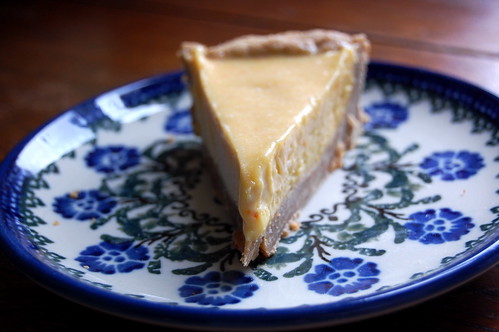
We were discussing key lime pie, and how you could make it with any citrus, say lemon or blood orange or yuzu. I like doing this a lot, taking a base recipe and changing the flavoring ingredients. So I decided to try the blood orange version, only using a classic French technique, and made a lose custard that could be turned into a frozen pie. And it's delicious, it cool and creamy and a little bit tangy. It's almost as good as a nap, just don't disturb me while I'm eating it.
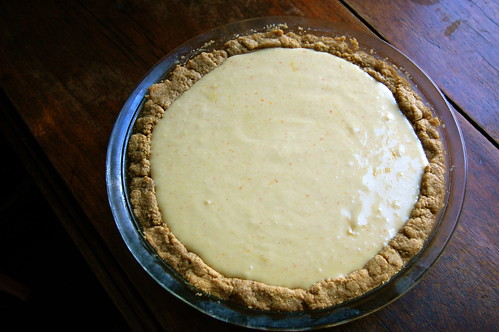

Blood Orange Creamsicle Pie

1 graham cracker crust, baked
1 cup sugar
finely grated zest of 2 blood oranges
4 large eggs
3/4 cup freshly squeezed blood orange juice
1 1/2 sticks (12 tablespoons) unsalted butter, at room temperature and cut into tablespoon-sized pieces

1. Put the sugar and zest in a large metal bowl that can be fitted into the pan of simmering water. Off heat, work the sugar and zest together between your fingers until the sugar is moist, grainy and very aromatic. Whisk in the eggs followed by the juice.
2. Set a pan of water to boil. Fit the bowl into the pan (make certain the water doesn’t touch the bottom of the bowl) and cook, stirring with the whisk as soon as the mixture feels tepid to the touch. (if you're using a thermometer 180°F). As you whisk the cream over heat—and you must whisk constantly to keep the eggs from scrambling—you’ll see that the cream will start out light and foamy, then the bubbles will get bigger, and then it will start to thicken and the whisk will leave tracks. Heads up at this point—the tracks mean the cream is almost ready. Don’t stop whisking and don’t stop checking the temperature. And have patience—depending on how much heat you’re giving the cream, getting to temp can take as long as 10 minutes.
3. As soon as you reach 180°F, pull the cream from the heat and transfer it into the container of a blender (or food processor); discard the zest. Let the cream rest at room temperature, stirring occasionally, for about 10 minutes.
4. Turn the blender to high and, with the machine going, add about 5 pieces of butter at a time. Scrape down the sides of the container as needed while you’re incorporating the butter. Once the butter is in, keep the machine going—to get the perfect light, airy texture you must continue to beat the cream for another 3 minutes. If your machine protests and gets a bit too hot, work in 1-minute intervals, giving the machine a little rest between beats.
5. Transfer the orange cream to the refrigerator and let cool completely. It should set up considerably in the fridge. Pour until the crust and place in the freezer for several hours, until frozen.
6. To serve, remove the pie from the freezer about 15 minutes before you want to serve it (depending on the outdoor temperature, more or less time may be needed). Serve in wedges, store in the freezer.

12 January 2008

The Onslaught


This isn't supposed to happen. Around the holidays your counter is supposed to be filled with tins of cookies and your refrigerator should abound with roasts and braised cabbage and all sorts of homemade goodies both sweet and savory. And then the holidays pass and we clean the house for New Years and after all that indulgence we settle into a January of salads and asceticism. So could someone please explain to me why, in the second week of January, I am so besotted by produce, our kitchen overflowing??

First, my aunt sent us home laden with a caramel cake and a pie and all sorts of commestibles (sorghum molasses! beans! fruit!), some of which have been relegated to the pantry and the freezer, some of which (ahem, cake) were consumed with alarming alacrity. Second, there is the issue of the crate of ruby red grapefruit my uncle sends every year, don't get me wrong, we love them, but eighteen of them, EIGHTEEN is quite a lot. And then, then, only a few days after the grapefruit arrived, a whole box of pears from our neighbor. Did I mention the leftover soup that's packing our freezer from a soup party we had? I'm drowning in the onslaught.

grapefruit box

The pears have slowly, lackadaisically ripened themselves into possibly the best pears I've ever eaten, but I feel as if I've eaten a gallon of them, sliced alongside my breakfast or in a pear and blue cheese tart. As for the grapefruit: six went to the postman who delivered them, another two into the Christmas salad, a few went to breakfasts, but that still leaves seven grapefruits piled haphazardly on the counter. Since the grapefruits are an annual event I am pretty familiar with just about every grapefruit recipe out there: salads, sorbets, compotes, candied rinds, I even made a grapefruit and Riesling terrine once. But the one thing I usually end up making is pink grapefruit marmalade.


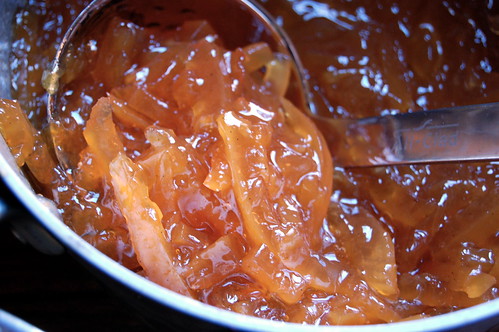
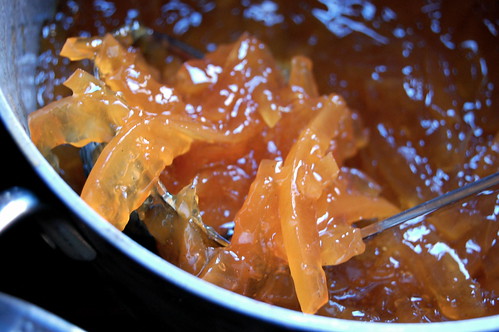
This year, as I padded about the kitchen in the quiet dark, slicing grapefruit peels and blanching them twice to remove any bitterness, adding the fruit and sugar to the pot, I did a couple things differently that made this the best marmalade I have ever produced. First, I added a touch too much water to the pot, which meant I had to set the marmalade to a long slow simmer in order to cook it down. It took over an hour in the end, but that long cooking gently caramelized the grapefruit pieces into sweet translucent slices, with only the slightest hint of bitterness. Second, I scraped in the seeds from a vanilla bean, which not only speckled the pink jam with pleasing black flecks but added to the subtly sweet scent.

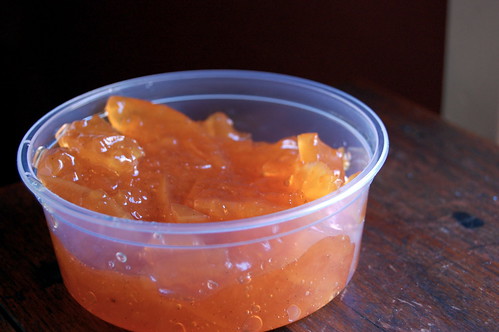
When I say that this is the best marmalade I've ever made, I mean it's the best marmalade I've ever eaten or tasted. The kind of jam you want to eat straight out of the jar, standing by the fridge door, almost like spoonable candy, except with a pleasant hint of bitterness. The only problem is that it uses just three of my grapefruits and produces a rather large amount of marmalade- four jars, which doesn't really help me with the onslaught around here. Not that I'm complaining, mind you.


Pink Grapefruit Marmalade with Vanilla

3 large ruby red grapefruits
3 cups water
4 cups sugar
1 vanilla bean, seeds scraped
2 tablespoons rose water or lemon juice

1. Set a large pot of water to boil. Cut off the peel of the grapefruits, working to get good thick slices, but leaving the inner white pith closest to the fruit still attached to the fruit. Cut the peels into strips. Blanch the peels by submersing them in boiling water for about three minutes. Drain in a colander and rinse under running water. Bring a fresh pot of water to a boil and repeat the blanching process again, this removes any bitterness. Drain and rinse again.
2. Place the peels in a large pot. Cut off all the white pith from the remaining fruits then, working over the pot, cut between the grapefruit membranes so that the fruit sections fall into the pot. Squeeze juice from the membranes and discard them. repeat with remaining fruits.
3. Add the water and sugar to the pot and bring to a boil, stirring to combine. Lower the heat to a very low simmer. Simmer until the marmalade is thick and translucent, about one hour. The marmalade may still appear a touch watery- keep in mind it will thicken as it cools.
4. Add the vanilla bean seeds and simmer another five minutes. Remove from the heat, stir in the rose water (or lemon) and set aside to cool. You could can this and process in a hot water bath or simply store in jars in the fridge.