Showing posts with label Vegetables. Show all posts

14 April 2012

Easy Weeknight Dinner

DSC_0020

-- Bulgur Salad with Ramps, Cilantro, and Pecans
-- Roast Beets with Orange Dressing
-- Black Bean Cakes (pictured before frying)

Here's an easy weeknight dinner we made recently that makes good use of those early spring ramps. Just slice the ramps (white and green parts) and saute until softened and use in a grain salad. Our market hasn't yet had asparagus or artichokes or morels or any of those harbingers of spring, but ramps at least are here.

For salad: cooked bulgur, sauteed ramps, chopped cilantro (could also use parsley), sliced scallions (light and dark green parts), toasted pecans or almonds, olive oil, lemon juice, salt and pepper

For beets: roast and peel with beets, toss with olive oil, orange juice, orange zest, and salt

For black bean cakes: one drained can of black beans - mash the beans with a fork, mix in one egg white, a handful of panko breadcrumbs, season with salt, Aleppo pepper, diced cilantro. Form into cakes- if you have time, refrigerate the cakes to firm up. Pan fry in vegetable oil until crispy on both sides. Tasty with a yogurt dipping sauce.

11 March 2012

Rutabaga Caponata

rutabaga caponata

By about March most people, particularly die-hard farmer's market shoppers, are getting pretty tired of root vegetables. Even I'm ready for some new things, and I can eat sweet potatoes, braised red cabbage, and baked apples ad infintum. One of the nice things about our local year-round farmer's market is that the root vegetable selection is very broad-- different kinds of beets, sunchokes, kohlrabi, celeriac, turnips, radishes, purple potatoes, parsnips, and rutabagas are available.

I do like those more unusual root vegetables, they're a great way to mix up your weekly starch intake, and they usually take nicely to being roasted or sliced into a gratin or pureed into a potato mash.

However, I'm often at a loss on how to use rutabaga and kohlrabi in particular. Turnips have a certain bitter profile that stands up nicely to richness (alongside duck and apples) or sweetness (roasted with a maple glaze). Celeriac has a celery-ness that's familiar and works awesomely pureed into soups, sunchokes are one of my favorite roast vegetable side dishes, and cook quickly to boot.

But a rutabaga? Well, it's just sort of very hard and reminds of a turnip. So when I happened upon a recipe for Rutabaga Caponata is was excited to try it out. Plus, the recipe is from DC's Komi Restaurant, where I took Paul for his birthday when we'd just begun dating. And the recipe? It's pretty great, it has a nice sweet-sour balance going on, with the heft of a roast root vegetable at it's base. I've tweaked the recipe a bit, but don't be put off by the unusual ingredients, they really work.

rutabaga caponata

Rutabaga Caponata
Adapted from Komi Restaurant. Don't be alarmed by the cocoa powder, it is not distinguishable and merely adds a bit of depth a earthiness to the mixture (see here for more info on the classic caponata). This is a great winter side dish.

2 small rutabagas, peeled and cut into 1/2" dice
olive oil, salt, pepper
1 onion, finely diced
1 clove garlic, minced
1/4 cup diced prunes
1 tablespoon golden raisins
1/4 cup balsamic vinegar
2 tablespoons toasted pine nuts
1 teaspoon red pepper flakes or Aleppo pepper
1-2 tablespoons sugar (to taste)
1-1 1/2 teaspoons ground cinnamon
1/8 teaspoon ground nutmeg
1 tablespoon grated bittersweet chocolate or cocoa powder

1. Preheat the oven to 415 F. Line a baking sheet with aluminum foil, place the diced rutabagas on the sheet and toss with olive oil and salt to coat. Roast for about 40 minutes or until they are tender and lightly browned on the outside. Set aside to cool.

2. In a large pan over medium heat, heat some olive oil, add the onion and cook, stirring, until it is soft and beginning to caramelize, about 15 minutes. Then add the garlic, raisins, and prunes, stirring to mix.

3. Add the balsamic vinegar, scraping the pan to deglaze it and incorporate the addition. Add the roasted rutabaga, pine nuts, red pepper flakes, sugar to taste, cinnamon, nutmeg and chocolate or cocoa powder. Season with salt and pepper to taste. Serve warm or at room temperature.

03 September 2011

Eggplants Stuffed with Cheese and Walnuts

DSC_0006
(We are currently traveling, and apparently in a country that randomly blocks blogging sites. It took me awhile, but I eventually figured out why I couldn't access anything. I've got a work around for the time being, here's hoping it continues to work. Cheers to free speech everyone!)

I couldn't resist buying these eggplants the other day, they were so firm and slender and fresh looking. But then I came home and got busy, and realized that most of the things I'd do with them- making stuffed eggplants with rice and meat, or makdous, or fettat makdous, were all pretty labor intensive, and I was quite a bit lazy.

DSC_0003DSC_0005

So instead, inspired by the most popular of Lebanese bloggers, I made this simplified version. First, you fry the eggplants lightly in olive oil until their outsides are well seared. Then you saute a diced onion in the same pan. While the onion is softening you slit the eggplants and stuff them with a mixture of seasoned goat cheese and walnuts. You add tomatoes to the pan, making a simple tomato sauce, and then you nestle the eggplants in the pan, cover and cook until done.

It sounds like it has quite a few steps, but really all you need is one cutting board, one bowl, and one pan to do this whole thing. Plus it's a one dish meal, some rice or bread and you're good to go.

DSC_0015
Eggplants Stuffed with Cheese and Walnuts

6-12 small slim eggplants, peeled in stripes
6 oz goat cheese
1/2 cup walnut pieces
1 pinch each cumin and cinnamon
1 small onion, diced
3 cups chopped tomatoes (fresh or canned)
1 small garlic clove, sliced
salt, black pepper, olive oil

1.Mix together the goat cheese, walnuts, cumin, cinnamon, and black pepper in a bowl.
2. In a large wide sauce pan, heat a generous amount of olive oil (around 1/2 to 1 cup). Saute the eggplants until browned on all sides - they will not be cooked all the way through. Remove the eggplants to paper towels.
3. Add the onion to the pan with the remaining oil and saute until softened and translucent. Add the tomatoes and sliced garlic to the pan and season with salt. Bring tomatoes to a simmer.
4. Meanwhile, cut a slit lengthwise down each eggplant. Stuff each eggplant with the goat cheese mixture.
5. When the tomatoes are no longer watery, nestle the eggplants in the tomato mixture, with the slit facing up so the stuffing does not spill out. Cover the pan and simmer over low heat for about 20 minutes. Check on the pan occasionally to make sure the tomato sauce does not become too dry. The dish is done when the eggplants are tender all the way through. Season again with salt and pepper.

27 August 2011

Corn, Poblano, and Black Eyed Pea Sauté


It seems that, like the rest of the Middle East, the blog has taken a little bit of a Ramadan break. Perhaps I've gotten a case of what people call "Ramadan brain," a general blurriness that comes not from lack of food, but from the complete lack of sleep people endure during Ramadan. Thanks to everyone for all the comments and questions in my absence, I hope you all had plenty of time to dig into some frozen yogurt. Here's a few things that have caught my eye over the past few weeks:

--Overnight cooking star Ghalia Mahmoud in Egypt. (Watch a full episode here, if you're like me Egyptian Arabic always takes some getting used to :)

--The best kunafe for Ramadan, or anytime.

--Did you say challapeno?

--Anissa gives an awesome version of hummus (with pomegranate and red pepper)

I was making a bunch of these summer sautés this past month. They are almost always based on sweet summer corn sliced off the cob and sauteed with onion and beans and whatever else strikes my fancy. One week it's onion, corn, baby lima beans, cherry tomatoes, and chives. Another week it's black beans instead of limas and some very finely chopped turnips. Basically, it's whatever you think looks good at the market.

Corn, Poblano, and Black Eyed Pea Sauté
The staples here are onion, corn, and some sort of legume, other than that you can substitute vegetables as desired. Make sure to cut your vegetables into relatively similar size pieces so that they cook evenly.

1 small onion, finely diced
1 large poblano pepper
1 cup cooked black eyed peas
1 cup very finely sliced and diced carrots
3 ears of sweet white corn, corn cut from the cob
salt to taste
pinch of Aleppo pepper or black pepper
squeeze of lime juice, optional

1. Roast poblano pepper over gas flame or grill until blackened on all sides. Transfer to a bowl and cover with plastic wrap, let steam 10-15 minutes. Scrape blackened skin off pepper, remove the core of the pepper and dice the flesh. Reserve some of the poblano seeds if you want your saute to be spicy.
2. Heat a good glug of olive oil in a wide skilled. Add diced onion and a bit of salt and cook over medium heat until very soft and starting to caramelize, 15 minutes.
2. Add in the carrots and poblano and allow to cook until carrots are soft, about 10 minutes. Add the corn and black eyed peas, season with salt and pepper and cook until the corn is tender, about 3 minutes.
3. Taste for seasoning, adjust salt/pepper/add lime, serve warm.

27 March 2011

Artichokes with Meat and Tahini Sauce

DSC_0241
This is my quick and dirty version of a more classic stuffed artichoke dish. The traditional version takes artichoke bottoms and stuffs them with a rice, meat, and herb stuffing. The artichokes would then be layered in a dish, topped with broth or a bechamel type sauce and baked.
DSC_0233DSC_0235

Pre-prepared artichoke bottoms are very common in the Middle East and readily available frozen in a Middle Eastern grocery. They are, in my opinion, the best way to enjoy artichokes, much meatier and richer than those stringy artichoke hearts. My simple version just involves sauteeing a bit of ground meat or lamb and tossing it on top of the artichokes with a tahini sauce and toasted pine nuts and herbs. You can eat it with a knife and fork, or if the artichokes are small enough, you can eat them with your hands. This dish makes for a great quick lunch, along with some good pita bread, or you could serve it as part of a larger mezze meal.

DSC_0239


Artichokes with Meat and Tahini Sauce


8-10 prepared artichoke bottoms, frozen or fresh
1/2 lb ground lamb or beef
salt and fresh black pepper to taste
1/4 teaspoon each cumin, allspice
1/4 cup tahini
2 lemons
2 tablespoons thick yogurt (labne)
1/4 cup pine nuts, toasted
scallions or chives, diced

1. Place tahini in a bowl and add in a pinch of salt and the juice of 1 lemon. Stir to combine, the mixture will become very thick. Gradually add water to the tahini, stirring, until it is a thick but pourable consistency. Add in the yogurt. Taste to see if it needs more salt r lemon.
2. Bring a pot of water to boil with the juice of 1 lemon. Boil the artichokes until tender (just a few minutes for frozen, 15-20 minutes for fresh).
3. Meanwhile. Saute the ground meat in the pan with salt, pepper, cumin, and allspice until nicely browned.
4. Arrange the artichokes on a platter. Sprinkle the meat over top, trying to get the meat in the artichoke cups. Drizzle the tahini sauce over. Sprinkle the toasted pine nuts and scallions over top. Serve while still warm.

09 February 2011

Basic Technique: Red Pepper Paste

DSC_0195

In Lebanon and Syria there is a preserving tradition known as mouneh. These traditional preserves were made throughout the summer and into the fall, and were a way of preserving food to eat in the winter. Some of these are ingredients that are very familiar to you - jams and fruits preserved in syrup, concentrated tomato pastes, while others may be unknown in much of the West. Things like carob and grape molasses, kishik (a powdery mixture made from fermented dried yogurt and bulgur), or qawarma, rich lamb meat preserved in its own fat (not unlike duck confit).

DSC_0163

Then there is pepper paste, which is so ubiquitous one might not even consider it a mouneh, but a constant staple. There is a strong Armenian influence in the Levant, and many give credit to the spicy pepper pastes in the region to the Armenian influence. (Generally, Levantine people dislike fiery spicy foods, and so anything with a bit of bite to it is often influenced by Armenian cuisine or Aleppian influences).

I would say that every culture has their pepper paste, whether fiery gochuchang or sweet ajvar, and so it's not worth arguing over origins. The pepper paste I make is made in a traditional way and is very easy. Traditionally this would be dried in the sun but I choose to just cook it a bit longer (it can happily simmer undisturbed for a few hours), and you could also try drying it out in a low oven. The paste is sweet and only barely spicy. I found myself spreading it on bread and in sandwiches and just eating it straight out of a jar. Next time I'm going to talk about a very special kibbeh recipe that uses this pepper paste.

DSC_0166


Red Pepper Paste

Use your judgement with the chili. The chili I used, despite my incorporating the seeds, wasn't very spicy, so I added a pinch of Aleppo pepper flakes at the end.

3 large meaty red bell peppers, seeded and sliced into strips
1 small red chili, flesh sliced and a few seeds reserved
1/2 teaspoon salt
1/2 teaspoon sugar
1 teaspoon olive oil

1. Place the ingredients in a food processor and process until smooth.
2. Place a skillet over medium heat. Add the pepper puree and let bubble over medium heat, stirring occasionally until most of the moisture is evaporated.
3. As the pepper paste starts to concentrate, reduce the heat so that it is cooking more and more slowly. Let the mixture cook down until it is very thick, this can take up to 2 to 2 1/2 hours. Check on the mixture frequently to make sure it is not burning, but it really shouldn't need much stirring or other attention. Toward the end of cooking taste for seasoning, see if it needs more salt or spice.
4. Scrape the paste into a jar. Pour a film of oil over it if you plan to keep it for a while. Store in the refrigerator.

26 January 2011

Potato Kibbeh

DSC_0146
I'm trying to up my kibbeh quotient on this site, and given that there are a myriad types of kibbeh that shouldn't be so hard to do. (For a review on kibbeh 101, check out this post.) Though the dumpling-shape type of kibbeh is the most famous, I thought it would be good to share one of the types of kibbeh made in a tray (kibbeh b'il sayniayah). Kibbeh in a tray can be made with meat or in several vegetarian variations including pumpkin, lentil, and potato. Today we're making the potato version, which I've heard referred to as the Middle Eastern equivalent of shepherd's pie, a comparison not undeserved.

DSC_0149DSC_0144

Potato kibbeh is basically a mashed potato casserole stuffed with caramelized onions and pine nuts. Meat can be added, but I often leave it out because I like to use the potato kibbeh as a side dish, especially for roast meats. The potatoes are made unique by the addition of traditional kibbeh spices and the use of bulgur, which gives the potatoes a slight nubby texture. It is very important to use the finest grade bulgur (it looks almost as fine as couscous or semolina), you may need to visit a Middle Eastern grocery for that. Potato kibbeh is a remarkably comforting dish, and unlike many kibbeh dishes that can seem delicate, fussy, or heavy with meat, it's one that you want on your table often, especially in these cold dark winter months.

DSC_0151DSC_0150

Potato Kibbeh
For some extra luxury, top the dish with pats of butter before baking. Many stores sell a kibbeh spice mix but you can mix your own spices per the instructions below.

1 cup of fine grade bulgur
boiling water
4 medium size potatoes (should equal 3 to 3 1/2 cups cooked mashed potato)
2 tablespoons butter
a splash of milk, cream, or ashta if available
salt
1 teaspoon kibbeh spices or baharat

2 large onions, halved and thinly sliced
1 teaspoon sugar
1/4 cup pine nuts
1 tablespoon butter
1/2 lb ground beef or lamb (optional)

For filling:
1. Heat some olive oil in a saute pan, add the onions and a pinch of salt and saute over medium-low heat. Cook they onions until they are well caramelized, this could take as long as 45 minutes. Add the sugar towards the end to enhance the onions' sweetness. Set aside.
2. If using, saute the ground meat in the pan until well-browned, add to the onions.
3. Saute the pine nuts in the butter until golden brown (watch them carefully). Add the pine nuts to the onion mixture.

For outer shell:
1. Peel and cube potatoes and set to boil in salted water until tender. Meanwhile, pour boiling water over blgur until it is just saturated (you don't want the bulgur to be drowning). Let bulgur sit for 10 minutes, then fluff with a fork, if it still feels dry you can add a bit more boiling water.
2. Drain the potatoes well and put them back in the pot. Add the butter, salt and spices and mash until roughly mashed. Add the bulgur (drained of any excess liquid) and mix together. Gradually add the milk/cream until the texture is like that of firm mashed potatoes.

Bake:
1. Preheat oven the 350 F. Spread half the potato mixture evenly in an 8x8 inch baking dish. Spread the onion mixture evenly over top. Spread the remaining potato mixture over top. Use a wet spatula to press out the potato mixture evenly. If desired, use a sharp damp knife the score a decorative cross watch pattern on the surface. Place the dish in the oven and bake until warmed through and just a tiny bit golden on the top, about 20 minutes. Serve immediately.

20 January 2011

Lebanese Style Stuffed Squash (Koosa Mehshi)

DSC_0159
My uncle tells this fantastic story of an acquaintance of his, a lady from Louisiana but of Lebanese descent. She was famous for her kibbeh, and was asked one time for her recipe. "Well, first," she explained, "you have to take off all your gold," she said gesturing to her fingers and wrist covered in gold baubles. Maybe you had to be there, but I love that story, how it's so Lebanese and so Southern at the same time.

In the early 1900's there was a wave of Lebanese immigrants who settled in the U.S., mainly in the South. Many were of Christian descent, and I can't help but think they found something of kindred spirits in the South, the traditional seasonal cooking, the emphasis on etiquette, gentility, and appearance. The Southern Foodways Alliance has done a nice job of collecting some of their stories here.

DSC_0154DSC_0156

They also brought with them their foods, primarily kibbeh and pita and stuffed vegetables. Stuffed vegetables can be made with both vegetarian and meat stuffings, and is traditionally made with zucchini, eggplant, and bell peppers, though technically any vegetable can be stuffed, including tomatoes, potatoes, and even really fat carrots.

For a festive dinner usually several different types of vegetables are stuffed with meat stuffing and cooked in a simple tomato sauce (though they can also be served in a yogurt sauce). Traditionally, a cook would buy a whole piece of bone-in meat, then dice and grind the meat themselves, and reserve the bones for putting in the pot. Many Levantine meat dishes are made using the bones this way, including grape leaves and stews, and I don't know of a home that doesn't own their own meat grinder. However, these days, it's much easier to just buy ground beef or lamb.

I always thought this was a difficult dish to make, but the coring is actually really easy (so long as you have a good corer) and there's really very little active work time. It's a nice one pot dish, with meat, vegetables, and rice. Serve it with extra rice pilaf on the side for soaking up the sauce.

DSC_0160

Lebanese Style Stuffed Squash (Koosa Mehshi)

12-14 small thin zucchini (or small thin eggplant or bell peppers)
1 cup medium grain rice
1/2 lb ground beef or lamb, at least 85% lean
1/4 cup chopped flat leaf parsley
1 sprig mint, leaves finely minced
1/2 teaspoon baharat*
salt, pepper
olive oil
4-5 cups diced tomatoes with their juices, fresh or canned
1 small onion, diced
meat bones (optional)
yogurt and rice pilaf for serving (optional)

1. Using a corer, core the zucchini, being careful not to pierce the outer shell. Discard cores.
2. Mix together the rice, ground meat, parsley, mint, baharat, and season with salt and pepper. Smush together to mix well.
3. Stuff the squash 3/4 full with the meat mixture (no more, the rice needs space to expand!).
4. Heat some olive oil in a large pan. Add the onion and saute briefly, until translucent. Place the bones in the bottom of the pot, if using, then pour the tomatoes over top. Nestle the stuffed squash in the pan, so that they are about 3/4 covered in the liquid. Try to arrange them so that the open ends stick up and the stuffing won't fall out of them. Bring to a simmer, partially cover the pot, and simmer for 40-45 minutes. Turn the squashes half-way through so that they cook evenly. Test the rice for doneness before serving.
5. Serve warm, with rice pilaf and some thick yogurt on the side.

09 January 2011

Iranian Herb Stew for the New Year

DSC_0063

The longer I stay away from this space, the harder it seems to return. Not because I've stopped cooking or because I've stopped writing, but because I've stopped doing this thing called blogging, which turns out to be a whole different animal altogether. But I must return, just like I have to keep cooking, because there's always a new recipe to try, because people are hungry, because I like what this space, this blog, brings to my life.

It probably didn't help that our fridge broke in December, with horrible rattling sounds and leaking water. And what should have been an easy fix, because we rent from an absentee landlord, became a nearly twenty-day saga of fridge-less-ness. One can only live off their favorite local pizza place for so long, but thankfully it was fixed just in time to host our annual Christmas party (latkes with caviar, mini pulled pork sandwiches, stuffed grape leaves).

DSC_0064DSC_0065

In better news, I received a tagine for Christmas (!!!!!), and can't wait to delve into more Moroccan recipes in the future, and I also received a macaron cookbook which I can't wait to try out.

Probably the best thing we've discovered in the last month are the kifflie cookies Paul made many batches of this holiday. But it seems rather cruel to offer a cookie recipe in January. Instead, we've made ghormeh sabzi, a delicious Iranian stew made of all the green things you can think of. And green things are virtuous, aren't they?

I was introduced to this dish many years ago by Iranian friends of mine, who always swore by it's deliciousness, and though I'd eaten their version I'd never tried it myself. I was surprised to find that other than a lot of chopping, this stew of complex flavors was relatively easy to make. You chop up all the green things you can get your hands on, lots of spinach, but also leeks, parsley, cilantro, dill, and scallions. You cook it with lamb and kidney beans (probably the best use of red kidney beans I've ever come across), for hours until it becomes not unlike a dark green sludge. It's not the prettiest thing, but it's delicious. And if you're feeling too virtuous, you can top your whole bowl with a traditional sizzling of melted clarified butter.

DSC_0067

The recipe does call for one special ingredient: dried limes (also called omani limes, or noumi basra). The dried lime is such an essential flavor in this stew that I would say you really can't make the dish without it. It just won't taste right. But you can get dried limes from most Middle Eastern groceries, or order them online (whole is best, but the powdered form is also acceptable).

Here's to a good start to 2011, and many more recipes to come.

DSC_0069

Ghormeh Sabzi (Persian Herb Stew)
Adapted from my friends and a recipe clipped from the Boston Globe long ago. I've heard you can make this using frozen spinach, but I've never tried it myself.

1/2 pound fresh spinach, stemmed and coarsely chopped
1 bunch fresh dill, stemmed and coarsely chopped
1 bunch fresh Italian parsley, stemmed and coarsely chopped
1 bunch fresh cilantro, stemmed and coarsely chopped
4 leeks, thinly sliced
1 bunch scallions, thinly sliced
4 tablespoons vegetable oil
1 pound beef or lamb stew meat, cut into cubes
Salt and black pepper, to taste
1 medium onion, coarsely chopped
1/2 teaspoon ground turmeric
Generous pinch crushed red pepper or Aleppo pepper
1 dried lime or 1 tablespoon dried lime powder (available at Middle Eastern markets)
4 cups water
1 can (15 ounces) red kidney beans, drained and rinsed
1 tablespoon fresh lemon juice (optional)

1. In a large flameproof casserole, combine the spinach, dill, parsley, cilantro, leeks, and scallions. Cook, stirring constantly, over high heat until the excess water evaporates. (There is no oil added at this point.)
2. Add 2 tablespoons of the oil. Cook, stirring often, for 15 minutes or until the vegetables start to brown. Remove the pot from the heat. With a rubber spatula, remove the mixture from the pan and transfer to a bowl.
3. Wipe out the pan. Heat the remaining 2 tablespoons oil and when it is hot, add the meat, salt, and pepper. Cook, stirring often, for 10 minutes or until it starts to brown. Add the onions, turmeric, and red pepper. Continue cooking, stirring often, for 8 minutes or until softened.
4. With a knife, poke a hole in the dried lime and add them or the powdered lemon to the pot. Add 3 cups of the water and bring to a boil. Let the mixture bubble gently, partially covered, for 15 minutes.
6. Add the spinach mixture, turn the heat to medium-low, and cook, partially covered, for 1 hour. Add the remaining cup of water if the pan seems dry. Stir in the beans and continue cooking for 30 to 60 minutes or until the meat is tender when pierced with a skewer (total cooking time is 1 1/2 to 2 hours). Remove the dried lime from the pot.
7. Taste the mixture for seasoning. Add more salt, red pepper, or the lemon juice, if you like.

28 November 2010

The Difference Between Roasting and Frying

DSC_0037

I've been meaning to write this post for a long time, so long in fact, that this recipe has changed since I originally intended to write about it. That's a good thing, meaning that this recipe is a favorite of ours and that it is quality controlled and tested (another way of saying I ate a lot of it). But the thing I've been meaning to write about is the difference between roasting and frying. If you were to ask a Western chef, say Michael Ruhlman, about the difference, he would probably give you a long answer about heat and molecules and fat absorption. But in the most of the world (that is in the 2nd and 3rd worlds), there is one distinction between frying and roasting: money.

The cost of cooking fuel is a major expense in many households and it costs a whole lot more to heat an oven at a consistent temperature than it does to use a relatively small flame to heat a pot of frying oil. And I'm not talking just about poverty here, for middle class families in places like Iraq and Syria, where people have modern ovens and cooking appliances, the oven is still reserved for use sparingly, for special occasions and big cuts of meat, because of the cost associated. And in many places like China and Japan, ovens aren't even a standard part of the kitchen.

DSC_0040

I say this mainly because there are several Middle Eastern recipes where I adapt frying to roasting. Frankly, I don't want to wrestle a pot of boiling oil, and roasting is a bit more healthful and easier. In the case of this recipe, it started with a simple preparation for cauliflower. The cauliflower is broken into florets, fried in a shallow pan of oil, and served with a squeeze of lemon and maybe a bit of tahini sauce. It's addictive, in a way you never thought cauliflower could be.

I roast the cauliflower in a pan in the oven, which means you can roast the entire head at once. I originally served the cauliflower with just a drizzling of tahini sauce, then I added a few slivered almonds, then some golden raisins, and so on until I arrived at this salad. It's crunchy and creamy and tart and perfect for winter.

DSC_0048

Roast Cauliflowers with Tahini, Almond, and Pomegranate
Don't be surprised if you find you can eat a whole head of roast cauliflower yourself, it's surprisingly addictive. Pine nuts can also be used in place of almonds.

1 large head of cauliflower
olive oil
salt and pepper
1 recipe tahini sauce
1/2 cup golden raisins
1/2 cup slivered almonds
1/2 cup pomegranate seeds
1 cup of chopped parsley and cilantro (mixed)

1. Preheat oven to 410 F. Place head of cauliflower sideways on a large cutting board, and start slicing about 1/2 inch slices across the top. There will be a mess of tiny florets everywhere, that's okay. When you reach the core, slice the sides of the cauliflower in the same manner. Chop any large florets into smaller bits (about 1-2 inch pieces). Discard core.

2. Drizzle olive oil over a large baking sheet. Add all the cauliflower to the baking sheet, drizzle with a bit more olive oil and roll around so that cauliflower is coated in oil. Season well with salt and pepper. Roast cauliflower for 25-35 minutes, until browned in spots and large pieces of cauliflower are tender when poked with a knife.

3. Meanwhile, while cauliflower is roasting, place raisins in a bowl and pour boiling water over the cover. Let sit to plump. Toast almonds in a skillet until lightly browned and fragrant.

4. Transfer cauliflower to a serving bowl. Drain raisins, and add raisins, almonds, and herbs to cauliflower, stirring to mix. Drizzle tahini sauce over top (you may not use all of it). Sprinkle pomegranate seeds over. Serve warm or at room temperature.

08 October 2010

Meatballs in Swiss Chard and Tahini Sauce

swiss chard, tahini, meatballs
I'm going to start this off by saying, I don't think this recipe really worked. In fact, it seems almost cruel to be posting this now - I'm in Paris oggling the beautiful markets, the abundance of fall squashes, and remembering back to this recipe made on a dark night in my poorly-lit kitchen with a recipe that only half-way worked.

swiss chard

This is an uncommon but not unusual recipe in the Levant, pairing a garlicky swiss chard and tahini sauce with meatballs. Sometimes the meatballs are plain, sometimes they are more fancy, made with kibbeh instead of meatballs. And sometimes this dish can be vegetarian, with chickpeas replacing the meatballs.

tomatoes cookingmeatballs

But here's the deal, I love the swiss chard and tahini sauce, it' the bright spot in this recipe. Friends, this part is a "put-it-in-the-recipe-file" keeper, it's garlicky and creamy and crunchy, and best of all good for you. I also like the meatballs, and really, who doesn't love a good meatball? But together, I just think this combination doesn't work. Maybe if you cooked the meatballs together with the chard for longer, maybe then the flavors would blend. But as it stands it's like two clashing armies battling it out for your taste buds.

So take my advice and just make the swiss chard sauce. Add in some chickpeas if you want the heft of a vegetarian main course. Serve it warm or cold, serve it over couscous or bulgur. Make some meatballs another time.

swiss chard, tahini, meatballs

Meatballs in Swiss Chard and Tahini Sauce

Adapted from various sources. Please read the above post for recommendations.
1 lb ground lamb
1 tablespoon salt
1 tablespoon baharat
1 onion, divided in half
olive oil salt
2 cups chopped tomatoes (canned or fresh)
2 gloves garlic, minced
1 bunch swiss chard
1.2 teaspooon Aleppo pepper
1/2 cup walnuts, toasted
1 recipe tahini sauce (see previous)

1. Grate half of the onion on the holes of a box grater. Mix together the meat, onion, salt, and seasoning, kneading the mixture with your hands until it is smooth and sticky. (Alternately, you can grind the onion in the food processor, then add the remaining ingredients, pulsing to combine.) Roll into meatballs about 1 inch in diameter and refrigerate.
2. Dice the remaining onion and mice the garlic. Heat some olive oil in a saute pan, then saute the onion and garlic until softened. Add the tomatoes, season with salt, and cook until slightly broken down and saucey, about 15-20 minutes. Set aside.
3. Meanwhile, set a pot of water to boil. Remove the ribs from the swiss chard and roughly chop. Add to the boiling water and blanch the chard to soften. Remove with a slotted spoon and chop finely. Add the chard and Aleppo pepper to the tomato sauce, return to heat, and cook until the chard is soft and cooked through. Set tomato sauce aside to cool down.
4. Heat up some oil in a very large frying pan, add the meatballs and cook the meatballs until well browned and cooked through (this may take quite a while). Work in batches if necessary.
5. Stir the half the tahini sauce into the now-cool swiss chard, and stir in the walnuts. Place the warm meatballs on top. Sprinkle with cilantro. Serve.

19 August 2010

Moussaka

moussaka

My mother used to make a version of moussaka out of Craig Claiborne's "New York Times International Cookbook," a book she loved dearly. It was a towering affair, filled with lamb and eggplant and tomatoes and topped with a thick bechamel sauce. When my mother made it, it always came out looking a bit like the tower of Pisa, and you wondered which slice would finally send the concoction sliding off, meat in one direction, eggplant in another.

Years later, I discovered that there was a Lebanese version of moussaka, also with eggplant, but very different in composition. Here moussaka, from مسقعة‎ or "chilled," is a simple vegetarian stew of eggplant, tomatoes and chickpeas. Despite the name, it can be served hot or cold, and falls into the category of many Levantine vegetarian dishes often eaten during times of fasting or abstinence, such as Lent.

I can't remember where I learned to make it the way I do, leaving few eggplants whole, and arranging them artfully for presentation, but I like the way it looks. This dish works best if you can find small and slender eggplants.

moussaka

Moussaka

6 small slender Japenese-style egpplants, or 3 larger eggplants, halved
2 onions, diced
2 cloves garlic, minced
4 cups diced tomatoes, preferably fresh but canned is okay
1 1/2 cups cooked chickpeas
olive oil
salt
chopped parsley for serving

1. Peel the eggplants in alternating strips, leaving strips of the black flesh. Trim the tops and bottoms of the eggplants.
2. Choose a large wide skillet, a 9 inch cast iron or ceramic pan is great. Heat a generous amount of olive oil in the skillet. Add the eggplants to the skillet and cook over medium heat until browned in spots, but not cooked through. Work in batches if necessary. Remove to a paper towel to drain.
3. Take 2 of the eggplants (or eggplant halves) and dice.
4. Add more olive oil to the skillet, there should be about a 1/4 cup of olive oil to the skillet. Add the onion and garlic and saute until softened. Add the tomatoes, season with salt and pepper, and let cook down for about 10 minutes.
5. Stir in the chickpeas and the diced eggplant. Nestle the 4 whole eggplants in the skillet and cover with a tight fitting lid. Cook for 25 minutes, flipping the eggplants once halfway through.
6. Test the eggplants for doneness, and add more water if the tomatoes get dry. The dish is done when the eggplant is tender. Sprinkle with parsley before serving.

06 June 2010

Spiced Cherry, Chickpea and Asparagus Salad


There are great things about the boom in the food blogging world, where you can find just about anything from recipes for whole camel to this fantastic guy on barbeque. But the flaws are poorly tested recipes with unclear directions. I recently was reading a recipe for a traditional Lebanese cake (sfoof), which claimed the cake could be made with only molasses as a sweetener. Carob molasses, or molasses made from carob pods, is traditional sweetener in the region, and it sounded plausible that this could be an old school version of the cake. Now, I should have known better, since I've had some of the carob drinks served across the Middle East and carob is very, very bitter. But I went ahead anyway, and let me tell you my friends, when a cake batter tastes bad, you know you have a problem on your hands.

This all brings me to the point that all of the recipes here are tested at least once, and usually twice before they make it on this site. I cook many, many things at home that don't make it onto this site for a variety of reasons. But the reason I often double test things is not just to ensure consistency, but also because I usually have a specific idea in mind, and it may take quite a bit of tinkering to get it right. Take this salad, I had an idea for a salad with cherries and ricotta salata and chickpeas. I knew it needed some more elements though, so I tried several things, frying up the chickpeas in spices, adding chopped arugula and mint, but it still was lackluster. First, the ricotta salata ha to be crumbled into fairly large chunks to stand up to the other ingredients. Second, the cherries needed some more oomph so they got a quick soak in some brandy (bourbon would work nicely too). And finally, the green needed to be more substantial, so I went with asparagus tips, which are in season with the cherries. A balsamic glaze was the final touch, and after about 16 experiments with this salad we were done. Luckily all were tasty enough that we didn't mind eating them.
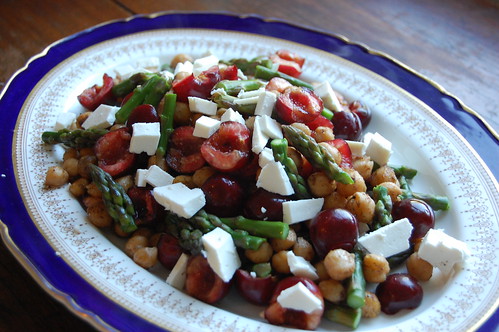
Spiced Cherry, Chickpea and Asparagus Salad
It seems like a lot of elements, but really this doesn't take that much time. The worst part is pitting the cherries.

tips from 2 bunches of asparagus
2 pints of cherries, stemmed, pitted, and halved
2 tablespoons brandy or bourbon
1 1/2 cups of cooked chickpeas
1 teaspoon seven spice mix
olive oil
1 cup ricotta salata in large chunks
3 tablespoons balsamic vinegar
1 tablespoon honey
some chopped chives or mint for garnish, optional

1. Prep the cherries, place in a bowl and toss with the brandy. Set aside to soak.
2. In a skillet, place a very shallow amount of water. Bring to a boil, add the asparagus and cover and let steam for a few minutes, until green and crisp tender. Sprinkle with sat and set aside.
3. Wipe out the skillet and heat a generous amount of olive oil in it. Add the seven spice mix and a small sprinkling of salt, stirring to combine, and then add the chickpeas. Cook over medium-high heat until the chickpeas are coated in the spices and lightly browned. Set aside.
4. Place balsamic vinegar and honey in a very small saucepan, let simmer until the mixture is thick and syrupy.
5. Layer the asparagus, chickpeas, cherries, and ricotta salata in a serving dish. Drizzle the balsamic over top. You may want to put it through a quick turn in the microwave to make sure everything is a little warm. Scatter mint and chives over top if desired. Serve.

12 May 2010

Artichokes with Saffron, Orange, Olives, and Almonds


Orange salads are something unique to Moroccan cuisine, and though it may sound odd to Western ears, the sweet juicy, slightly chewy segments of orange make for a great basis for a salad. They are commonly paired with a sprinkling of hot pepper and salty chopped olives, but you'll also find orange, radish, and cinnamon salad, or oranges with dates and slivered almonds, the varieties go on and on. (For recipes, check out Paula Wolfert's "Couscous and Other Good Food from Morocco.")

This recipe for baby artichokes braised with saffron, oranges, olives, and almonds is one I cobbled together from many sources. It would be at home almost anywhere in the Mediterranean, from Sicily to Cyprus, where all these ingredients are native. I have to say, I hate prepping artichokes, so it has to be a pretty good recipe for me to even go to the trouble. But the nice thing about baby artichokes (besides the fact that they're so cute. Really, just look at those little things). The best part is that baby artichokes really cook all the way through, so you have less concern about tough chewy leaves or spiky centers.

Other than the time it takes to prep the artichokes and the oranges, the recipe is a snap. You do a quick braise of the artichokes with a bit or orange juice, water, and saffron, and when they are tender you sprinkle over them orange segments, olives, almonds, and mint. It's beautiful to serve and full of contrasting sweet/salty/soft/crunchy notes.

Artichokes with Saffron, Orange, Olives, and Almonds

1 lb baby artichokes
a splash of lemon or vinegar
1 large orange or 2 small (I used Mineola)
a pinch of saffron
2 tablespoons chopped black olives
2 tablespoons slivered almonds
a few leaves of mint, slivered

1. Prepare a large bowl of water with a splash of lemon or vinegar. Prep the artichokes (see tutorial here). First slice off about an inch of the top. Then, remove the tough outer leaves. Finally, trim the bottoms and slice the hearts in half. Place prepped artichokes in acidulated water to prevent discoloring.
2. Section the orange by removing the outer pith and then slicing between the membranes to remove the sections (see tutorial here). Squeeze the remaining membrane part over a bowl to extract the juice and set aside the sections.
3. Add the saffron and about 1/2 cup of warm water to the bowl with the orange juice.
4. Heat some olive oil in a pan, drain the artichokes, and saute them briefly over medium heat. After a minute or so, add in the saffron water. Make sure the liquid cover the artichokes halfway up their sides. Cover the pan and let simmer for 15 minutes, or until tender when pierced with a knife.
5. Uncover the pan and let simmer until the sauce reduces to just a glaze. Remove from heat.
6. Meanwhile toast the almonds.
7. Sprinkle orange segments, chopped olives, almonds, and mint over artichokes. Serve slightly warm or at room temperature.

08 May 2010

Watercress Soup


My mother always waxed rhapsodic about watercress, she'd tell tales of how she and my grandmother would gather watercress in the creeks around their home, of the peppery flavor added to tea sandwiches and salads. Now, my grandmother was a tenacious woman, not afraid to get her hands dirty, but somehow I have a hard time picturing my grandmother's Chanel lapel pins tromping around in a stream.

Nonetheless, I always pick up some watercress when it's in season as if compelled by my mother's tales, but I have often found the leaves were thick and tough, or far too peppery to eat as part of a salad. But this year I spied in my grocery a delicate plant of tiny green leaves, with its root ball preserved in a small container of water. Watercress is a fascinating organism- it thrives on the edge of streams, where it has to have constantly flowing water to protect it from parasite and snails. Watercress can quickly become wilted and bitter once removed from fresh water, which explains those many unappetizing specimens I'd had in the past.

After a few pleasing crunchy salads, I turned the rest of the watercress into a pleasingly simple soup, one thickened with potato and a splash of cream, and bright green like a Shrek cartoon. It's simple in the way many good things are, you could serve it cold like a vichysoisse, or I like it warm with a nice hunk of toast.

Watercress Soup

olive oil, salt
1 large bunch watercress, leaves only, discard the stems
1 medium sweet yellow onion, peeled and diced
1 medium russet potato, peeled and roughly chopped
water or vegetable stock, about 4 cups
splash of heavy cream, optional

1. In a large saucepan, heat the olive oil over medium high-heat. Cook the onions, stirring until browned and caramelized, at least 15 minutes.
2. Pour in the water or stock, add the potatoes, season with salt, and bring to a boil. Let simmer until the potatoes are tender when pierced with a fork. If the water level gets low, add some more. When the potatoes are tender, toss in the watercress leaves and stir until wilted and bright green, a few minutes.
3. Remove the pot from the heat and allow to cool slightly. Place in a blender (or using an immersion blender), blend until very smooth. Add the cream if desired, and taste for seasoning. Reheat before serving.

28 February 2010

Beet and Carrot Gratin


I've been planning for the last month or so to host a vegetable-centric dinner party, but it seems I keep getting way-laid. There was a work-trip and then dealing with my mother's estate affairs, and there is nothing like a mountain of paperwork and taxes to make you order a pizza.

But I like the idea of a vegetable-centric party, especially for February when all those resolutions seem to melt away into a box of Valentine chocolates. A vegetable-centric party, not to be confused a vegetarian party, but merely something where all the dishes have vegetables as their primary ingredient. This is as opposed to many vegetarian dishes which are loads of pasta, bread, and cream.

For such a party I might serve delicate vegetable-filled wontons, a Lebanese stew of eggplant, tomato, and chickpeas, a salad of bitter escarole, or a garlicy potato mash. Or I might serve this beet-carrot gratin, which I made on a whim one afternoon. Most gratins are very thin slice of vegetables layered with butter and cream, but this one is a more rustic rough mash of things.

Just like the bright magenta color, this dish is warm and softly comforting. It's good for these last days of winter, when it's still cold and dreary and you're just itching to switch your blacks and browns for a warmer magenta hue.
Beet and Carrot Gratin

1 lb carrots, peeled
2-3 tablespoons olive oil
2 large or 3 medium beets
2 tablespoons butter
1/4 teaspoon ground cumin
1/2 teaspoon salt
1/4 cup grated pecorino romano cheese
1/2 cup fresh breadcrumbs
1 tablespoon butter

1. Preheat oven to 400 F. Place olive oil and carrots in a casserole-type dish and roll the carrots around to coat. Place a lid on the dish or cover tightly with foil. Bake for 30 minutes, shaking the pan occasionally for even cooking.
2. Meanwhile, wrap the beets in foil and place in the oven to roast for 1 hour, or until tender. When done, turn the oven down to 350 F.
3. When the beets are cool enough to handle, peel them and roughly dice them. Place the beets in a food processor and pulse to a rough puree. Add the carrots and the 2 tbl butter and pulse until roughly chopped and combined (don't over do it, you don't want a puree). Stir in the cumin, salt, and cheese, and place in a baking dish.
4. Scatter the breadcrumbs over top and dot with slivers of the remaining tablespoon of butter. Place in the oven for 15 minutes, or until warmed through and the breadcrumbs are browned.

03 February 2010

Kale with Blood Oranges

I'm sitting here watching the snow fall on the kale growing in my backyard. It's pretty deep purple kale, almost black in the night, and it could probably be eaten but I like to let it grow into the spring, when it shoots up 3 feet tall with yellow blossoms.

The kale I'm eating came from the farmer's market, where an entire armful cost on $2. And you know what you should be doing right now? Yes, you, trolling cooking blogs when you should be working, and you, couch sitter, cubicle worker, uninspired cook. You should be cooking kale too. Right now, go on. I'll be here when you get back. Grab a blood orange at the store while you're out. They're in season.

Back yet? Ok, what you're going to do is very simple. It's a saute of kale, cooked just until the kale are vibrant green, when they have a little chew left and nice crunchy brown parts that remind you of a kale potato chip. Sprinkle the kale with salt, toss into a serving dish and top with the sections of a blood orange. That's it!

It's delicious, in season, and a lot better than that cubicle you're stuck in surfing the internet.

Kale with Blood Oranges
The easiest way to remove the ribs of the kale is to fold the leaf in half and then slice off the rib with your knife.

1 bunch green kale, tough ribs removed and torn into small florets
good olive oil
salt
1 blood orange, supremed

1. Heat a generous splash of olive oil in a saute pan over medium high-heat. Add the kale, tossing it constantly as it turns green and softens. I do this with my hands but tongs work nicely too. Sprinkle the kale with a generous amount of salt. Continue tossing the kale until vibrant green and with several brown crunchy spots. Taste the kale for doneness, it will still be chewy.
2. Transfer kale to a plate or serving dish. Top with blood orange sections and eat immediately.

1.