28 December 2008

Rich Roll Cookies

Holiday sugar cookies seem like the simplest thing to make, yet so many versions are disappointing- too thin, too crispy, too fat, overly sugary, not enough flavor. My mom makes the best christmas cookies, the kind you start dreaming about the day after Thanksgiving. Every December she would pull down her copy of the Joy of Cooking, "Mrs Rombaeur," she called it, and open it to the butter and flour stained page marked by a red silk ribbon. Each year we'd make the "rich roll sugar cookies," stamping out stars and trees and snowmen, and frosting them with royal icing.

After I left home I spent many years making Christmas cookies that never matched those rich roll cookies. Sugar cookies are so simple that I always figured any old recipe would do, but after years of experience, I realized that this was not the case. Even my more modern edition of The Joy of Cooking didn't have the rich roll recipe I wanted. So I called my mom, and had her dictate the recipe from her chartreuse-cloth bound, butter stained, ribbon marked "Mrs. Rombauer." The cookies are exactly what I remembered, and exactly what I wanted. The ingredients are simple, but the key is in their proportions, that is, plenty of butter makes everything better. I made one batch, and then another, and another, decorating them for parties and wrapping them for gifts. I realize the time for Christmas cookies is coming to an end, but with recipe as timeless as this, it's good to have around any time of year.

Rich Roll Sugar Cookies

1 cup (2 sticks) butter
2/3 cup sugar
1 egg
1 teaspoon vanilla extract
1 teaspoon salt
2 1/2 cups sifted all-purpose flour

1. Cream the butter until smooth. Cream in the sugar until the mixture is light and fluffy. Beat in the egg and vanilla extract until combined. Add the flour with the salt in two additions, stirring until it forms a smooth dough. Divide the dough into two disks, wrap in plastic wrap and chill in the fridge for at least 15 minutes, and up to overnight.
2. Preheat oven to 350F. If your dough has been refrigerated for over an hour, you will want to let it soften a bit at room temperature before rolling, about 15 minutes. Dust your work surface and rolling pin with flour and roll out cookie dough to 1/4 inch thickness. Do not roll too thin. Cut out shapes with a cookie cutter and transfer them to a lined/greased baking sheet, re-rolling until all the dough is used up.
3. I usually pop my cookie sheets in the fridge for about 10 minutes to chill before baking, while I roll out the second disk of dough, but you don't have to do this.
4. Bake cookies in the center of the oven for 8-12 minutes, depending on the size of your cookies, until just barely golden on the edges. Do not let brown. Transfer to a rack to cool completely before decorating with royal icing.

Royal Icing

3 egg whites
4 cups (1 box, 1 lb) powdered sugar
1 teaspoon vanilla extract or lemon juice
food coloring of choice

Beat together egg whites, flavoring, and sugar until smooth. Divide into batches and add food coloring as desired. Icing can be stored in the fridge with plastic wrap pressed directly against the surface.

20 December 2008

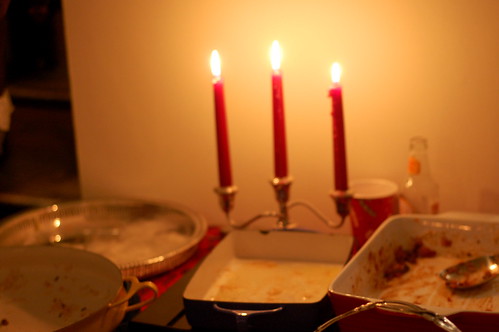
Scenes from the Holiday Party Kitchen

Assorted Caviar, Creme Fraiche, Blini and Rye

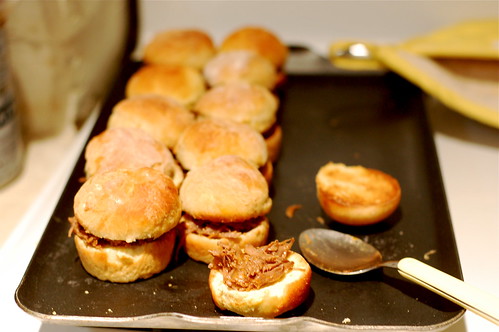
Pulled Beef Barbeque, Homemade Brioche


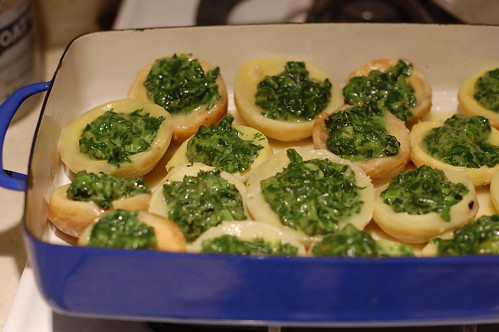
Spinach Stuffed Artichoke Bottoms, before being topped with buttered breadcrumbs and baked (recipe in the comments section)

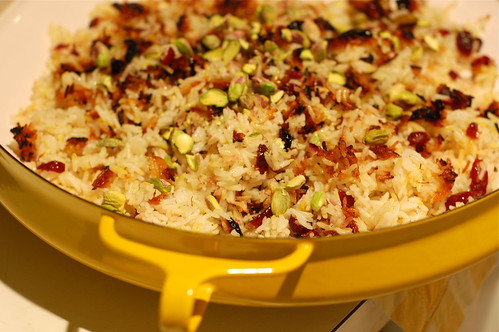
Persian-style jeweled rice


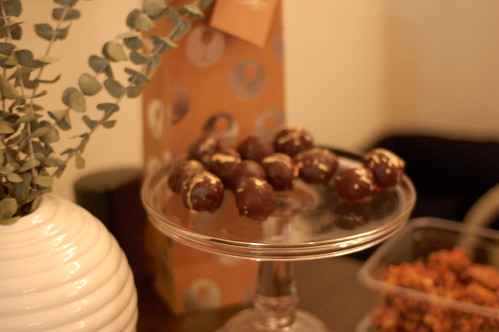
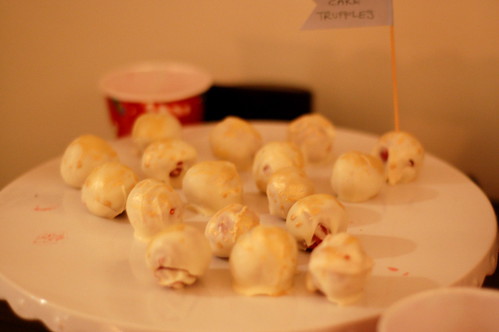
Red Velvet Cake Truffles dusted with edible gold


also on the menu but not pictured:
Devils on Horseback
Curry Deviled Eggs
Homemade Mango Salsa and Homemade Tortilla Chips
Endives filled with Pears and Nuts
Crudites with Pomegranate-Sour Cream Dip
Beet, Goat Cheese, and Olive Tart
Apple, Muenster, and Pecan Butter Squares
Vegetarian Sausage Biscuits
Lamb Meatballs in Prune-Apricot Sauce
Homemade Christmas Cookies
Homemade Eggnog (Craig Claiborne's recipe)
Mulled Wine

Please excuse the lack of posting, obviously I've been busy. Hope you're all having a lovely holiday season!

13 December 2008

Chess Pie

I don't know if I should even talk about this recipe . It could be dangerous. It could foment great family drama. You see, my mother and I have a disagreement about chess pie: she swears by her recipe, I prefer mine. She considers my recipe heretical. It's one of those disagreements that leads to awkward silences and uncomfortable family dinners. But chess pie is also too good not to have, so I'm taking the risk to share the recipe with you all.

First, let me back track for those of you who raised a curious eyebrow when I said "chess pie." A classic of the American South (my mom's from Tennessee), chess pie is a simple custard pie made from dairy (cream or buttermilk), butter, sugar, eggs, and cornmeal. Variations abound, from lemon to chocolate chess pie, but it remains homely, marked by a crackly dark top and a soft pudding-like interior. The first time I had the French tarte au flan, it reminded me of the European version of chess pie.

Of course, that range of recipes for chess pie are where we get into family trouble. My mother swears by "Cousin Bessie's Chess pie," one of those stained yellow index card recipes scribbled in turn of the century handwriting. I don't know who Cousin Bessie was, but she sure knew her way around pie. Her recipe calls for cream, a stick of melted butter, and a heart-attack inducing amount of sugar. To my mom's credit, Cousin Bessie's pie is goooood, but it is also rich. One year at Christmas I made the mistake of helping myself to a second sliver of pie and then proceeded to lay moaning on the coach for the rest of the evening.

My recipe for chess pie calls for buttermilk, slightly less butter, and lemon. While my mother begrudgingly accepts the buttermilk, it's the lemon she can't get over. Absolutely not, she says definitively, Personally, I think the buttermilk and lemon add a tang to the pie, something to keep it from being diabetically sweet and rich. Ironically, when I pulled out Cousin Bessie's recipe, there on the ingredient list is "lemon juice." When I confronted my mother about this seeming contradiction, she simpy said, "oh, we just never added that." Which I think says a lot about taste memory, what we think is authentic, and how we re-remember things.

Chess pie is a Christmas standard, but whose standard recipe will be on the table this year is yet to be fought out. I'll give you both recipes and maybe you can start a holiday pie feud of your own.

Chess Pie
Don't be skeptical of the cornmeal- it adds a distinctive amount of soft texture that is the hallmark of chess pie. If you don't believe in lemon, try substituting vanilla extract.

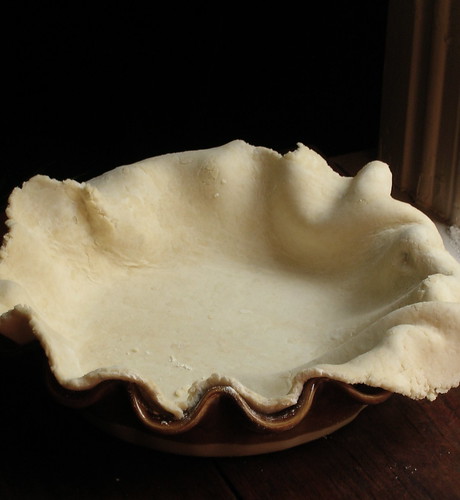
1 unbaked pie crust
1 cup buttermilk
3 eggs
4 tbl melted butter
2 tbl cornmeal
1 1/2 cups sugar
juice of half a lemon and about a teaspoon of its zest

1. Preheat oven to 350 F. Beat the eggs and sugar together until very thick. Add the buttermilk, butter, cornmeal, and lemon. Pour into ie crust. Bake until top is dark brown and jiggles slightly in the center but the edges are set, 40-50 minutes.

As soon as I finagle Cousin Bessie's Chess Pie recipe out of my mom, I'll post it here.

08 December 2008

Pulled Beef Barbeque

Is it wrong that when I got yet another holiday party invitation in the mail I wanted to book the next flight to Cancun and emerge, tanned and rested, in January? Don't get me wrong, I put up lights on the house yesterday, love the smell of pine, and I haven't even gotten sick of Christmas carols in the stores yet. But sometimes the holidays can be a little overwhelming - this party, that open house, presents to buy, cold winds to brave, family jostling and busy airports and train stations.

But if I'm a bit of a grinch about everyone else's holiday party, it's only because I'm so excited about mine. A friend and I are co-hosting a holiday open house, and I'm determined to make everything, from blini to eggnog to triffle, from scratch. Problem is, it's still two weeks away, and we already have over sixty RSVP's. Maybe you're understanding why I'm a grinch now? Luckily, I have multiple spreadsheets and calendar reminders to keep me in line.


Which is why I'm telling you about pulled beef barbeque today. No, not Christmas cookies (recipes coming), or roasts, nor those blini (which will be made the week ahead and frozen), but that most summer-sounding of recipes: beef barbeque. And here's why: it's super easy, this stuff is delicious, and it can feed a huge crowd. And as much as I love good old Carolina-style vinegar 'cue, I have enough Muslim and Jewish friends to make me shy away from serving too much pork.

For our party I've made bite-sized brioche rolls, and I'll be toasting them for slider-style beef barbeque sandwiches. Cute and dainty but rich and comforting as well. The barbeque is also great spooned over tortillas and topped with sour cream or made into big sloppy joe style sandwiches. It's only one of our elaborate menu items I hope to share with you as I work towards the party. And yes, I will be going to those other holiday parties and events, if only in the hopes that everyone will do the same for mine.

Pulled Beef Barbeque
Adapted from Simply Recipes. Makes 12 large sandwiches, can easily be doubled or trippled.

One 3-pound bone-in chuck roast, rinsed and dried
2 medium onions, chopped
1 Tbsp olive oil
1 28-ounce can crushed tomatoes
1 18-ounce bottle of your favorite barbecue sauce (or 2 1/4 cups of your favorite homemade barbecue sauce)
Salt and freshly ground black pepper

1. Place all the ingredients in a large deep pot and bring to a boil. Reduce to a simmer, cover the pot, and slow cook for 3 hours, or until meat is completely tender.
2. Use tongs to remove meat to a cutting board. Meanwhile, use a knife and fork to pull the meat away from the bones and pull apart into small pieces.
3. Increase the heat on the pot to medium/medium-high, uncover, and reduce the liquid until thick. Stir often to prevent burning.
4. Return the meat to the liquid in the pan. Warm both thoroughly. Add salt and pepper to taste.

30 November 2008

Pumpkin Pie

I fully realize that talking about a Thanksgiving recipe the weekend after the grand feast is a bit like predicting Superbowl scores the week after the big game. By now, you've all eaten your turkey and cranberry sandwiches, made turkey soup, and had that leftover slice of pie for breakfast. But if you'll allow me some culinary Monday morning quaterbacking, I think we'll all be Thankful, both this year and next.

You see, a few years ago I found the pecan pie of my dreams, the pecan pie that is requisite at every Thanksgiving henceforth. But that requisite pumpkin pie, well, I just never liked it. The last two years I made a pumpkin cheesecake, but this year I thought I'd give the pumpkin pie a try again. Adapted from Cook's Illustrated recipe, the filling is smooth to the point of creamy, light and just subtly spiced. The only problem was, the filling made enough for two pies. Not one to let things go to waste, I quickly made another crust, this one made of crushed gingersnaps, and baked a second pie.

It was the buttery crumbly gingersnap crust paired with the creamy not-too-sweet pumpkin that won me over. And apparently several other people at dinner, because there was only one sliver left. I may still go for the pecan pie first, but I'll no longer look at pumpkin pie with such skepticism. In fact I'll be saving room, if not for a sliver after dinner, than a good slice, cold from the fridge, the next day for breakfast.

Pumpkin Pie
Make sure to cook the mixture down until it's nice thick, otherwise your pie will risk being soft set. The original recipe had you press the filling through sieve for ultimate smoothness, but I found a blender did the trick just fine.

1 gingersnap crust or crust of choice, prepared and par-baked (see below)

1 cup of half and half
2 large eggs
1/2 teaspoon vanilla extract
3/4 cup pumpkin puree (canned or better yet homemade)
1 cup drained candied yams from 15-ounce can (pack the yams into the measuring cup)
6 tablespoons sugar
3 tablespoons maple syrup
1/2 teaspoon ground ginger
1/4 teaspoon ground cinnamon
1/8 teaspoon ground nutmeg
1/2 teaspoon table salt

1. Preheat oven to 400 F. Whisk cream, milk, eggs, and vanilla together in medium bowl. Combine pumpkin puree, yams, sugar, maple syrup, ginger, cinnamon, nutmeg and salt in large heavy-bottomed saucepan; bring to sputtering simmer over medium heat, 5 to 7 minutes. Continue to simmer pumpkin mixture, stirring constantly and mashing yams against sides of pot, until thick and shiny, 10 to 15 minutes.

2. Remove pan from heat. Whisk in cream mixture until fully incorporated. Pour the mixture into blender in batches and blend until smooth. Re-whisk mixture and transfer to warm pre-baked pie shell. Return pie plate with baking sheet to oven and bake pie for 10 minutes. Reduce heat to 300 degrees. Continue baking until edges are set 30 to 35 minutes longer. Transfer pie to wire rack and cool to room temperature, 2 to 3 hours. (The pie finishes cooking with resident heat; to ensure the filling sets, cool it at room temperature and not in the refrigerator.)

For the crust: Process in a food processor 1 box (16 oz) gingersnap cookies until they are fine crumbs. Slowly drizzle in 1 stick of melted butter, pulsing to combine. Press the mixture into a pie pan. Par-bake at 400 degrees for 5-7 minutes. Set aside.

23 November 2008

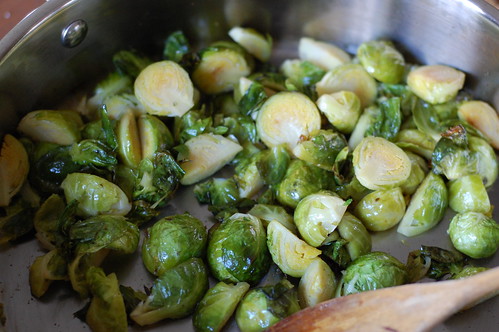
Pan-Roasted Brussels Sprouts

I have a problem. I really like brussels sprouts. I happily eat them, and them alone, for dinner. I like them a multitude of ways, finely shredded and sauteed, braised with bacon, roasted in the oven, even just plain boiled (!). In the winter I eat them so often it's become a household joke. I get excited when I see them in the markets for the first time in the fall, and sad when they disappear in the spring (no matter how much I love brussels sprouts, I'm an avowed seasonal eater).

Poor sprouts, they're so maligned. My friend hates them because her mother always referred to them as "little brains." Bitter when not properly handled and terribly mushy when overcooked, it's easy to go wrong with brussels sprouts. But when right, they are oh-so-good. The best brussels sprouts I've ever had are the teeny-tiny baby ones they sell at Citarella in New York, each one the size of a coin, you can roast them whole and they are almost sweetly vegetal.

That taught me a good lesson about brussels sprouts, pick out the small ones and halve or quarter the larger ones so that they cook quickly without being bitter or over-cooked. My favorite way to cook brussels is to pan roast them: start on the stove-top and then finish them in the oven. These will be on our Thanksgiving table and if they aren't on yours, you've got a long season left to find a time for them.

Pan-Roasted Brussel Sprouts
By all means, saute a little bacon along with the shallot if you want to gild the lily. The brussels sprouts should be just tender in their centers when done (check with a knife tip), and I actually like it when some of the outer edges are crispy deep-brown-black crunchy savory perfection (the above picture, while they were delicious, weren't quite brown enough for my taste).

1 shallot, chopped
2 tablespoons vinegar or lemon juice
1/2 teaspoon (a sprinkling) of sugar
a medium bag of brussels sprouts, larger ones halved or quartered
salt and pepper to taste

1. Preheat the oven to 400 degrees F. In a large oven-proof skillet, heat a splash of olive oil. Add the shallot and cook until soft and translucent. Add the brussels sprouts and saute until the begin to brown on the edges - golden brown is good, but not completely done. Deglaze the pan with the vinegar, scraping up any brown bits, and sprinkle the sugar over, stirring so it melts. Season with salt
2. Transfer the pan to the oven to finish cooking. Check after 5-7 minutes, shaking the pan. Continue roasting, stirring every five minutes, until the brussels sprouts are cooked through and the edges are well browned (some of the stray leaves may blacken, that's totally fine). Check for seasoning, serve.