28 March 2010

Matambre

I'll admit that I made this recipe out of culinary curiosity rather than any desire to eat flank steak. Matambre, a rolled stuffed flank steak is a classic of Argentine cuisine. A friend mentioned that she had made it back in the seventies, when cooking unusual international dishes was all the rage. I realized that I'd never made it myself, and though I'll admit to not adoring matambre, I thought I'd give it a go.

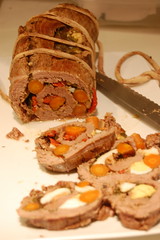
The difficulty with matambre is that flank steak is a tough cut of meat best suited to quick cooking. However, matambre is a lengthy stew, and it's sometimes difficult to identify when it gets tender. I've heard that Argentine butchers cut the steak differently than American butchers, which makes it more suitable to slow cooking. However, when the steak is pounded, marinated, and stewed long enough it can be soft tender and flavorful.


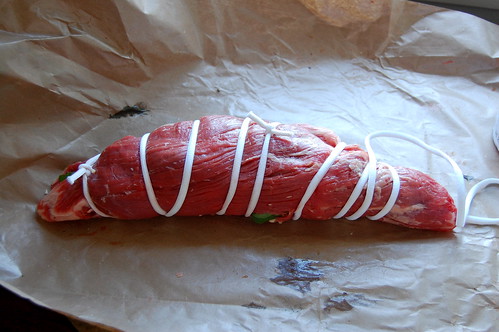
The traditional stuffing for matambre is carrots, spinach, roast red pepper, and hard-boiled eggs. Argentines put hard-boiled eggs into lots of meat dishes, but frankly, I think it's weird and adds nothing here, for the white color feel free to substitute parsnips or turnips instead. Matambre is traditionally served at room temperature or cold with chimichurri sauce. It's a good dish for a buffet since it can be made ahead and looks beautiful on a platter.

Matambre (Stuffed Rolled Flank Steak)
I highly recommend having your butcher butterfly the steak for you- it is difficult to do well, and you don't want to have holes in your steak or the roll may fall apart. The spinach helps the stuffing adhere together.

1 2-pound flank steak, butterflied length-wise
for the marinade: red wine, garlic slivers, a dash of soy sauce and cayenne pepper
a handful of spinach leaves (arugula or watercress also works)
3-4 very skinny carrots
1 roasted red pepper, cut into strips
2 hard-boiled eggs, quartered, or sliver of parsnip or turnip
2 cups beef broth
3 cloves garlic
salt and pepper to taste

1. Pound out the butterflied steak until even and tenderized. Place in a plastic bag or dish with red wine, garlic, soy sauce, and pepper to cover and marinate overnight.
2. Preheat oven to 300 F. Drain steak, discarding marinade, and place on a work surface. Scatter spinach leaves over steak. Align the carrots, red pepper, and eggs/parsnips lengthwise along the steak. Carefully roll up the steak and tie it firmly. Trim any ragged ends from the roll.
3. Heat a nice glug of oil in a dutch oven large enough to hold the roulade. Add the steak and sear on all sides until browned. Add the beef stock, the garlic cloves, and enough water to come 2/3 of the way up the side of the roulade.
4. Place in the oven and roast, covered, for 2 hours, turning the steak occasionally. Test the steak for done-ness starting at the 1.5 hour mark. You may want to slice-off a bit of steak and taste it.
5. Remove the steak from the liquid (don't discard it- strain it and keep as broth). Let cool, then slice the roulade as thinly as possible. Serve slightly warm or at room temperature with chimichurri sauce.

23 March 2010

Sausage and Smoked Cheddar Tartlets

I like to entertain, but when your guest list involves 6 vegetarians, 2 pescatarians, 3 avowed carnivores, 1 semi-religious Jew, 2 Seventh-Day Adventists, and a couple die-hard pork fiends, well, I think you see my challenge? I love my friends and their diversity, but I swear cooking for them can be awfully complicated. This one won't eat this, that one won't eat that. So my goal is always to have a variety of things to satisfy as many people as possible.

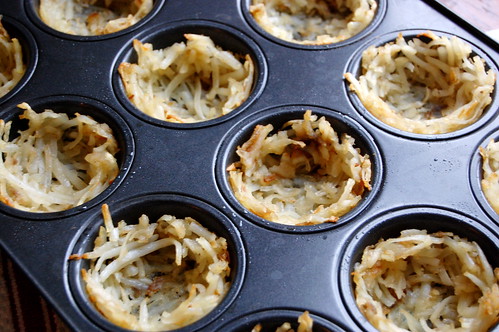
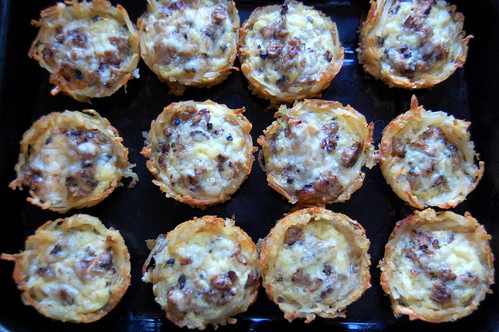
We had a party last week and I thought making sausage and smoked cheddar tartlets might fit my criteria (if you have vegetarian friends that faux sausage stuff works well here and I swear no one will notice the difference). I made a grated potato crust for half the tartlets, and the second batch I made with plain old pastry dough because those potato crusts were awfully time consuming. However, the potato ones were delicious, very much redolent of a breakfast of hash browns and sausage, only in a portable morsel. The smoked cheddar adds meatiness, and there's a bit of kick from red pepper and scallions.

Also like many things I do for parties, this dish has a make-ahead element - the crusts can be done far in advance. Even the tarts themselves can be a made a day or two ahead and reheated. I like to entertain, but I also like to make it as stress-free as possible.


Sausage and Smoked Cheddar Tartlets
Makes 2 dozen. Can also be made with a traditional pastry or phyllo crust.

8 cups grated potato
canola oil
4 eggs
1/4 cup cream or whole milk
16 oz ground sausage
8 oz smoked cheddar cheese, grated
salt and pepper
2 tablespoons diced scallions
pinch of red pepper, depending on how spicy your sausage is

1. Heat the oil in a wide pan. Add the grated potatoes (you may need to do this in batches) and saute until softened and lightly browned in spots. Continue in batches, adding more oil as necessary, until all potatoes are cooked.
2. Grease very well 2 dozen muffin tins. Press the potatoes into the tins to form crusts. Make sure there are no gaps in the crust, and err on the side of making thicker crusts. At this point, crust can be frozen up to one week before proceeding.
3. Preheat oven to 375 F. Heat more oil in a wide saute pan. Add the crumbled sausage and cook, crumbling with a spoon, until cooked through and crispy in some places, but still tender in others. Transfer sausage to a bowl and add salt and pepper to taste, let cool slightly.
4. Add the eggs, cream, scallions and pepper to the sausage. Fold in the cheddar cheese. Use a spoon to fill the potato cups with the sausage/cheese mixture.
5. Bake for 15-20 minutes, until puffed and golden. Let cool 10 minutes before very delicately attempting the remove the tartlets from the pan. Serve warm or at room temperature.

13 March 2010

How To Make Arabic (or Turkish) Coffee


When I lived in Damascus I would sit around on Saturday afternoons with friends, drinking coffee and telling our fortunes with the grounds. I was drinking coffee in a meeting with some Syrian cabinet ministers one afternoon, and out of habit I flipped my cup upside down over the saucer when I was finished. Everyone laughed at how the foreigner was acting like a superstitious housewife. I was horribly embarrassed, but I think they all took it as a sort of compliment, and it certainly broke the ice! Here's how to make strong intense, sludgy-at-the-bottom Arab style coffee.

1. The coffee: the coffee must be ground at the finest possible setting. While you could technically use any coffee, I find those ground specifically for Arabic-style coffee are the best. A popular Arabic brand is Najjar. Some chose to grind cardamom in with their coffee, or add a pinch of cardamom when cooking.

2. The vessel: technically the beak-lipped pot is calleda rakweh or ibrik, but any tall narrow long-handled vessel will do.

3. The sugar: sugar should be added before cooking, otherwise if you stir in sugar after serving you'll stir up the grounds which should remain at the bottom. Sugar levels are as follows: saddah- no sugar, wasat- medium sugar, helou- sweet enough to give you cavities.

4. The proportions: You will use a teaspoonful of coffee for every espresso-sized cup you plan to serve.

5. The fortune: Turn your cup over when you're done and let the designs in the grounds tell your fortune.

What you do:

1. Measure the water into the pot by using a demitasse cup (ie, if you want four cups of coffee measure out 4 demitasse cups). Add the sugar. Bring to a boil.
2. Pull the pot off the heat and stir in as many spoonfuls of coffee as cups you will be serving. Stir rapidly in a circular motion and return the pot to the heat.
3. Watch the pot like a hawk. When the coffee begins to boil over, pull it off the heat, let it settle, and return it to the heat.
4. Let the coffee foam up again and pull it off the heat. (you can boil it more than twice, but then you'll lose the foam which is undesirable). Let the coffee settle briefly, then pour into your serving cups.

07 March 2010

Spicy Tomato and Blue Cheese Soup

This recipe is apparently so well known that it has Google predictive text. And yet I, the person who regularly reads every food section on Wednesdays and has an entire library of cookbooks, I had never heard of it. Which is why you shouldn't feel bad if you haven't heard of it either. Let's remedy that together, shall we?

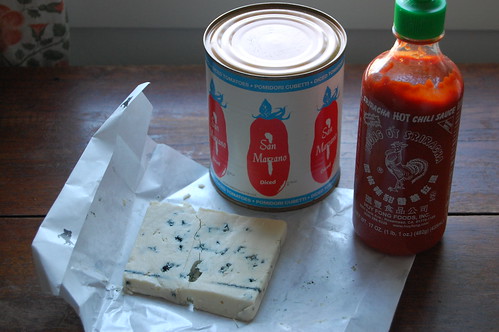
I spied this recipe over at Leite's Culinaria, and luck be had it, I had the three primary ingredients- canned tomatoes, blue cheese, and sriracha. I was snowed in at the time, and since we have already discovered that snowstorms are good for your cooking mojo- not only did I discover my new favorite salad, but perhaps also my new favorite soup.

Now, I do have a bone to pick with this recipe, which bills itself as "quick and easy," yet has 10 ingredients, some of which I deemed unnecessary. I nixed the chicken stock for water, since it's subtlety was completely hidden by the blue cheese and hot sauce elements, and left out the heavy cream since the cheese adds creaminess on its own.

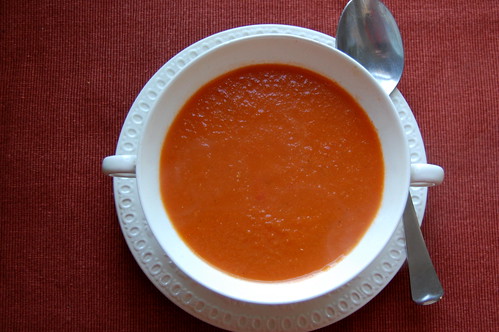
Bust basically what you do is stew a can of tomatoes with some garlic and oregano, just until everything is nice and combined. Then add in chunks of blue cheese and a splash of spicy hot red pepper paste (sriracha). You puree the whole mix and that's it, you've got soup.

Now would be a good time to point out that I actually don't love blue cheese- sure it's great when you're in the mood for it, perhaps over a good wedge salad or matched with pears on a cheese plate, but it can also be overwhelming if used in excess. But paired with hot sauce and tamed with the sweetness of tomatoes, it's pretty darn great.

Spicy Tomato and Blue Cheese Soup
Adapted from Michael Symon.

a splash of olive oil
2 cloves garlic, thinly sliced
1 28-ounce can tomatoes, such as San Marzano brand
1/4 teaspoon dried oregano, or fresh of available
pinch salt
1 1/2 cups water or chicken stock
1/2 cup blue cheese
2 tablespoons sriracha sauce
a splash of heavy cream, if desired

1. Heat the olive oil in a saucepan and saute the garlic cloves until soft. Add the tomatoes, water, oregano, and salt and bring to a boil. Simmer for 15-20 minutes.
2. Add the cheese, sriracha, and cream if desired, and simmer for 5-10 more minutes, until combined. Puree in a blender, taste for seasoning. Reheat if necessary and serve.

28 February 2010

Beet and Carrot Gratin


I've been planning for the last month or so to host a vegetable-centric dinner party, but it seems I keep getting way-laid. There was a work-trip and then dealing with my mother's estate affairs, and there is nothing like a mountain of paperwork and taxes to make you order a pizza.

But I like the idea of a vegetable-centric party, especially for February when all those resolutions seem to melt away into a box of Valentine chocolates. A vegetable-centric party, not to be confused a vegetarian party, but merely something where all the dishes have vegetables as their primary ingredient. This is as opposed to many vegetarian dishes which are loads of pasta, bread, and cream.

For such a party I might serve delicate vegetable-filled wontons, a Lebanese stew of eggplant, tomato, and chickpeas, a salad of bitter escarole, or a garlicy potato mash. Or I might serve this beet-carrot gratin, which I made on a whim one afternoon. Most gratins are very thin slice of vegetables layered with butter and cream, but this one is a more rustic rough mash of things.

Just like the bright magenta color, this dish is warm and softly comforting. It's good for these last days of winter, when it's still cold and dreary and you're just itching to switch your blacks and browns for a warmer magenta hue.
Beet and Carrot Gratin

1 lb carrots, peeled
2-3 tablespoons olive oil
2 large or 3 medium beets
2 tablespoons butter
1/4 teaspoon ground cumin
1/2 teaspoon salt
1/4 cup grated pecorino romano cheese
1/2 cup fresh breadcrumbs
1 tablespoon butter

1. Preheat oven to 400 F. Place olive oil and carrots in a casserole-type dish and roll the carrots around to coat. Place a lid on the dish or cover tightly with foil. Bake for 30 minutes, shaking the pan occasionally for even cooking.
2. Meanwhile, wrap the beets in foil and place in the oven to roast for 1 hour, or until tender. When done, turn the oven down to 350 F.
3. When the beets are cool enough to handle, peel them and roughly dice them. Place the beets in a food processor and pulse to a rough puree. Add the carrots and the 2 tbl butter and pulse until roughly chopped and combined (don't over do it, you don't want a puree). Stir in the cumin, salt, and cheese, and place in a baking dish.
4. Scatter the breadcrumbs over top and dot with slivers of the remaining tablespoon of butter. Place in the oven for 15 minutes, or until warmed through and the breadcrumbs are browned.

14 February 2010

Linzer Tart


I am not one of those people who always keeps bread in the house. I also don't freak out and a run to the store when the weather forecast says snow. I actually like walking the 4 blocks to my little local grocery in the snow.

But last week with three feet of snow on the ground, not only did I not have bread, I didn't even have any flour. I trudged to the store only to find no bread, and no flour (for the record the store had just about everything else you could want). So, I trudged several more blocks in white-out conditions only to find the same situation at the next store. At this point icicles were forming on my eyelashes, so I resigned myself to going back to my sadly starch-less home. The thought of being stuck at home for days without even a baking project to entertain me was making me pretty desperate, as I contemplated grounding my remaining almonds into flour, or making a flourless cake.

And that was when I realized that I should make a linzer tart.

Back at home, warm and with my boots dripping by the front door, I found a lonely half cup of pastry flour lingering in the back of my pantry. I painstakingly picked all the hazelnuts out of a bag of mixed nuts (hey, there wasn't much else to do), and ground them with some almonds into a rough flour. Adding butter, flour, and spices, and voila, a dough was made. A few slicks of homemade jam, and a stint in the oven, and two sweet little tarts were there to see my sugar-tooth through the storm.

Just in time for Valentine's (or Chinese New Year, or the Olympics, or whatever you want to celebrate this week).

Linzer Torte
This classic Austrian pastry hails from the town of Linz. You may also find it is very reminiscent of the Pepperidge Farm linzer cookies your mom put in your lunch box as a kid.

1 cup flour
1/2 cup ground almonds (about 2/3 cup before grinding)
1/2 cup ground hazelnuts (about 2/3 cup before grinding)
1/3 cup sugar
1/4 teaspoon cinnamon
1/4 teaspoon baking powder
1/4 teaspoon salt
a sprinkling of lemon zest
8 tablespoons softened butter
1 egg, separated
3/4 cup raspberry jam

1. Combine the dry ingredients for the dough, plus the lemon zest, stirring to combine. Using a pastry blender, food processor or two knives, cut in the butter until the mixture is crumbly. Add the egg white and mix until the dough comes together (if the dough is dry add a splash of water). Flatten the dough into a disk, wrap in plastic wrap, and chill for an hour.
2. Preheat oven to 350F. Let the dough come back to room temperature, then roll the dough out and fit into an 8" tart pan. Cut remaining dough into shapes as desired. Spread jam inside of tart, decorate with cut-out shapes. Beat the remaining egg yolk with a bit of water and brush over the pastry.
3. Bake 35 minutes or until deeply golden and firm. Cool completely before serving. Dust with powdered sugar if desired.

10 February 2010

Snow (your adjective here) 2010 + my New Favorite Salad


Well, I won't bore you with adding another adjective to this fierce snowstorm that's building up for the 5th day in a row. Snowpocalypse, snOMG, snowmaggedon, whatever you call it, the apocalyptic nature of walking in near white-out conditions is truly magnifying. I went for a walk this morning and encountered only one other person in half an hour, in the middle of our usually bustling capitol. At one point I heard the ringing of a dog's collar, but I could never make out exactly where the noise was coming from, although I couldn't see the end of the street either. It was magical.

It was also a very good opportunity to stay home, build a fire, catch up on paperwork and movies, drink hot chocolate, and make my new favorite salad. Yes, I am mildly obsessed with this salad, which came from an old recipe in Food and Wine, and claims to be Middle eastern, although it's an amalgamation of sorts. I don't really care though, it's addictive, in the "this serves four but I just ate the whole thing myself" kinda way. At least it's full of healthy stuff, because I've been making it constantly for about 3 weeks now.

The original recipe calls for bulgur, but I have two big boxes of quinoa in my pantry, and I actually like it better with quinoa, though either would be fine. There's a bit of prep work here, seeding the pomegranate, chopping tomatoes and cilantro, but nothing major. I also do the cheater's way of just grabbing the bunch of cilantro and mint, and then snipping the top of the bunch with scissors directly into the bowl.

It has soft chickpeas, pops of pomegranate, crunchy nuts, bright mint, and soft roasted tomatoes. I don't know if that makes it good blizzard food, but it does make it my new favorite.


Bulgur, Pomegranate, Walnut Salad (or the Best Salad EVER)
Although I think the dressing here is delicious, I actually prefer making this salad without the dressing sometimes. Reason being, I think the dressing has the effect of weighing down the salad, so that leftovers have that unfortunate wilted effect. I'd recommend making the dressing but not tossing it with the salad until just before serving, or serving it alongside for people to drizzle over. You can substitute flat-leaf parsley if you hate cilantro.

1 cup quinoa or 1 cup medium bulgur, prepare according to package directions
1 cup cooked chickpeas
1 cup cherry tomatoes, about 1/2 pint, halved
1/2 cup walnut pieces
1/3 cup pomegranate seeds (about 1/4 of a large pomegranate)
1/3 cup chopped cilantro
1/3 cup chopped mint
1/2 teaspoon salt, or more to taste

dressing (optional):
1 tablespoon pomegranate molasses dissolved in 2 tablespoons water
a squeeze of lemon juice
1 tablespoon olive oil
1/2 teaspoon Aleppo pepper

1. Prepare bulgur or quinoa according to package directions. Meanwhile, turn on your broiler. Place halved cherry tomatoes on a baking sheet. Place tomatoes under the broiler for 8-10 minutes, until softened. Transfer tomatoes to a bowl but leave the broiler on.
2. Scatter walnuts on the same baking sheet and slip under the broiler just for a minute or two, until toasted but not burned (watch them carefully!).
3. Combine cooked quinoa/bulgur, chickpeas, cherry tomatoes, walnuts, cilantro, mint and salt in a large bowl. Toss to combine. Add the dressing if desired, or reserve it to pass alongside the salad. Sprinkle pomegranates over top. Enjoy!