Showing posts with label Salad. Show all posts

04 June 2011

An Easy Moroccan Salad

DSC_0085
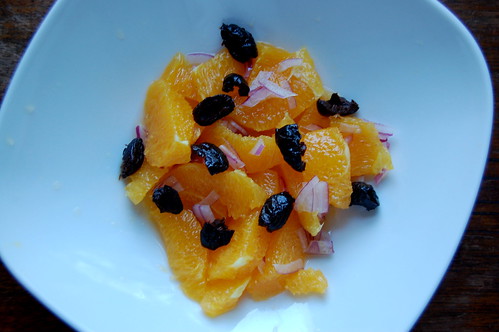
Moroccans like to make salads with oranges (think orange and artichoke salad, blood orange salad) and olive and orange salad is the most classic of them all. We may think of oranges as almost to delicate and juicy for salad, but when properly supremed or simply cut along the bias, they can be quite substantial. At its simplest this is just a salad of oranges and olives, but I like to add some slivers of red onion and perhaps a bit of diced cilantro for uumph. A nice pinch of salt is important to keep the salad on the savory side.

I used Moroccan baladi olives, which I found at a local shop. They are wrinkly and mildly flavored and taste as if they have been marinated in spices, perhaps cumin or allspice (I don't know if that's true, please chime in if you do). But any mild olive will do. The salad is light and refreshing and perfect alongside a heavier dish, like bistaeeya. It can also be used as a topping for grilled fish.

Orange and Olive Salad

3 large oranges (something with thick substantial segements)
olive oil
salt
6-8 black olives, preferably Moroccan baladi style
2 tablespoons diced cilantro
about 1/4 of a small red onion, sliced as thinly as possible and then diced

1. Working over a bowl to collect juice, supreme the oranges, placing the segments in another bowl. Add a pinch of salt to the orange juice, then whisk in the olive oil and the red onion to make a dressing. You should use twice as much oil as you have orange juice, you can eyeball it if you don't want to measure.
2. Gently mix the diced cilantro in with the orange segments. Tear the olives into pieces with your fingers, it can be rustic looking. Arrange salad on a platter. Spoon the dressing over the salad, you will not need all the dressing. Serve salad immediately, reserve remaining dressing for another day.

06 June 2010

Spiced Cherry, Chickpea and Asparagus Salad


There are great things about the boom in the food blogging world, where you can find just about anything from recipes for whole camel to this fantastic guy on barbeque. But the flaws are poorly tested recipes with unclear directions. I recently was reading a recipe for a traditional Lebanese cake (sfoof), which claimed the cake could be made with only molasses as a sweetener. Carob molasses, or molasses made from carob pods, is traditional sweetener in the region, and it sounded plausible that this could be an old school version of the cake. Now, I should have known better, since I've had some of the carob drinks served across the Middle East and carob is very, very bitter. But I went ahead anyway, and let me tell you my friends, when a cake batter tastes bad, you know you have a problem on your hands.

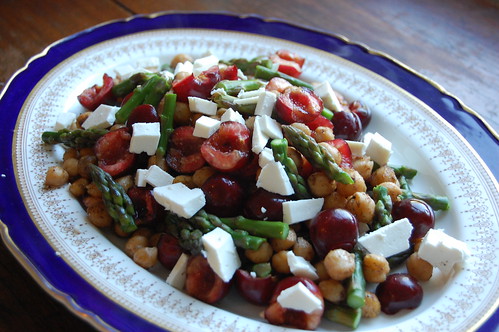
This all brings me to the point that all of the recipes here are tested at least once, and usually twice before they make it on this site. I cook many, many things at home that don't make it onto this site for a variety of reasons. But the reason I often double test things is not just to ensure consistency, but also because I usually have a specific idea in mind, and it may take quite a bit of tinkering to get it right. Take this salad, I had an idea for a salad with cherries and ricotta salata and chickpeas. I knew it needed some more elements though, so I tried several things, frying up the chickpeas in spices, adding chopped arugula and mint, but it still was lackluster. First, the ricotta salata ha to be crumbled into fairly large chunks to stand up to the other ingredients. Second, the cherries needed some more oomph so they got a quick soak in some brandy (bourbon would work nicely too). And finally, the green needed to be more substantial, so I went with asparagus tips, which are in season with the cherries. A balsamic glaze was the final touch, and after about 16 experiments with this salad we were done. Luckily all were tasty enough that we didn't mind eating them.

Spiced Cherry, Chickpea and Asparagus Salad
It seems like a lot of elements, but really this doesn't take that much time. The worst part is pitting the cherries.

tips from 2 bunches of asparagus
2 pints of cherries, stemmed, pitted, and halved
2 tablespoons brandy or bourbon
1 1/2 cups of cooked chickpeas
1 teaspoon seven spice mix
olive oil
1 cup ricotta salata in large chunks
3 tablespoons balsamic vinegar
1 tablespoon honey
some chopped chives or mint for garnish, optional

1. Prep the cherries, place in a bowl and toss with the brandy. Set aside to soak.
2. In a skillet, place a very shallow amount of water. Bring to a boil, add the asparagus and cover and let steam for a few minutes, until green and crisp tender. Sprinkle with sat and set aside.
3. Wipe out the skillet and heat a generous amount of olive oil in it. Add the seven spice mix and a small sprinkling of salt, stirring to combine, and then add the chickpeas. Cook over medium-high heat until the chickpeas are coated in the spices and lightly browned. Set aside.
4. Place balsamic vinegar and honey in a very small saucepan, let simmer until the mixture is thick and syrupy.
5. Layer the asparagus, chickpeas, cherries, and ricotta salata in a serving dish. Drizzle the balsamic over top. You may want to put it through a quick turn in the microwave to make sure everything is a little warm. Scatter mint and chives over top if desired. Serve.

10 February 2010

Snow (your adjective here) 2010 + my New Favorite Salad


Well, I won't bore you with adding another adjective to this fierce snowstorm that's building up for the 5th day in a row. Snowpocalypse, snOMG, snowmaggedon, whatever you call it, the apocalyptic nature of walking in near white-out conditions is truly magnifying. I went for a walk this morning and encountered only one other person in half an hour, in the middle of our usually bustling capitol. At one point I heard the ringing of a dog's collar, but I could never make out exactly where the noise was coming from, although I couldn't see the end of the street either. It was magical.

It was also a very good opportunity to stay home, build a fire, catch up on paperwork and movies, drink hot chocolate, and make my new favorite salad. Yes, I am mildly obsessed with this salad, which came from an old recipe in Food and Wine, and claims to be Middle eastern, although it's an amalgamation of sorts. I don't really care though, it's addictive, in the "this serves four but I just ate the whole thing myself" kinda way. At least it's full of healthy stuff, because I've been making it constantly for about 3 weeks now.

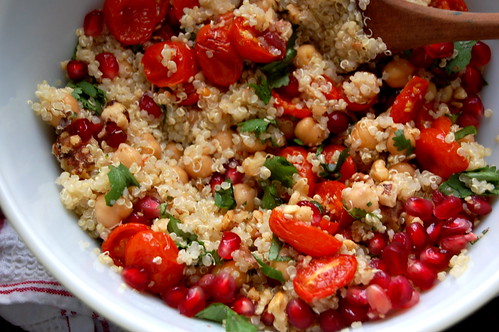
The original recipe calls for bulgur, but I have two big boxes of quinoa in my pantry, and I actually like it better with quinoa, though either would be fine. There's a bit of prep work here, seeding the pomegranate, chopping tomatoes and cilantro, but nothing major. I also do the cheater's way of just grabbing the bunch of cilantro and mint, and then snipping the top of the bunch with scissors directly into the bowl.

It has soft chickpeas, pops of pomegranate, crunchy nuts, bright mint, and soft roasted tomatoes. I don't know if that makes it good blizzard food, but it does make it my new favorite.


Bulgur, Pomegranate, Walnut Salad (or the Best Salad EVER)
Although I think the dressing here is delicious, I actually prefer making this salad without the dressing sometimes. Reason being, I think the dressing has the effect of weighing down the salad, so that leftovers have that unfortunate wilted effect. I'd recommend making the dressing but not tossing it with the salad until just before serving, or serving it alongside for people to drizzle over. You can substitute flat-leaf parsley if you hate cilantro.

1 cup quinoa or 1 cup medium bulgur, prepare according to package directions
1 cup cooked chickpeas
1 cup cherry tomatoes, about 1/2 pint, halved
1/2 cup walnut pieces
1/3 cup pomegranate seeds (about 1/4 of a large pomegranate)
1/3 cup chopped cilantro
1/3 cup chopped mint
1/2 teaspoon salt, or more to taste

dressing (optional):
1 tablespoon pomegranate molasses dissolved in 2 tablespoons water
a squeeze of lemon juice
1 tablespoon olive oil
1/2 teaspoon Aleppo pepper

1. Prepare bulgur or quinoa according to package directions. Meanwhile, turn on your broiler. Place halved cherry tomatoes on a baking sheet. Place tomatoes under the broiler for 8-10 minutes, until softened. Transfer tomatoes to a bowl but leave the broiler on.
2. Scatter walnuts on the same baking sheet and slip under the broiler just for a minute or two, until toasted but not burned (watch them carefully!).
3. Combine cooked quinoa/bulgur, chickpeas, cherry tomatoes, walnuts, cilantro, mint and salt in a large bowl. Toss to combine. Add the dressing if desired, or reserve it to pass alongside the salad. Sprinkle pomegranates over top. Enjoy!

01 June 2008

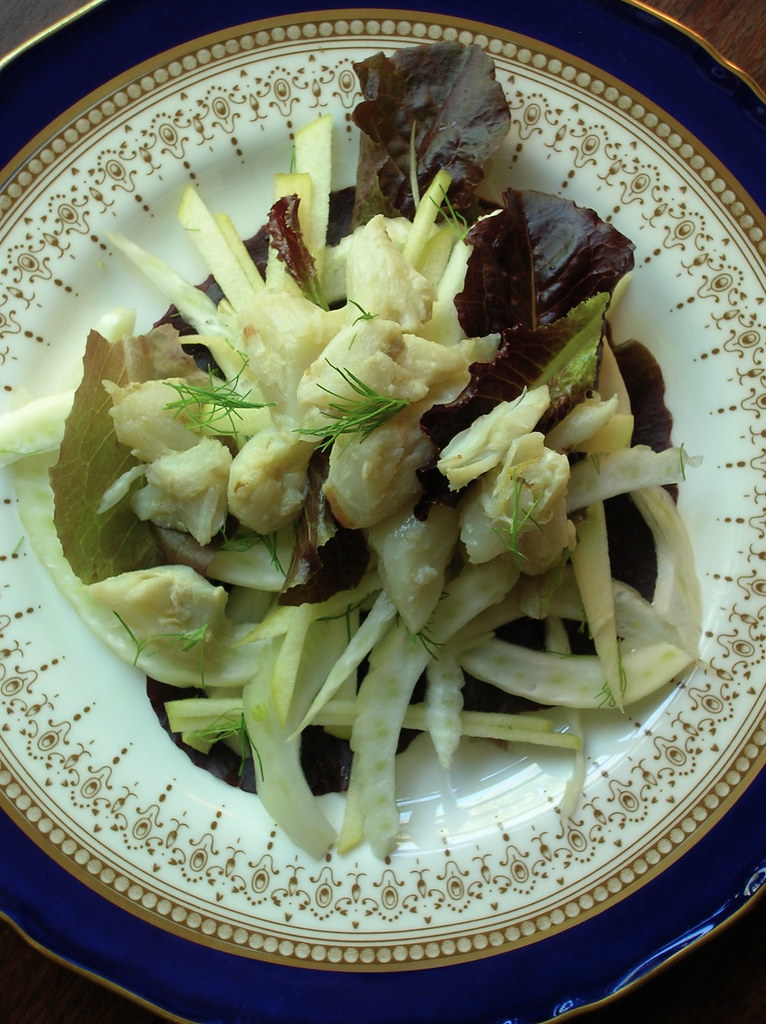
Crab, Fennel, and Apple Salad

When is a recipe for salad really necessary? I mean, you could probably read the title of this post and generally figure out how to go about making this without instructions. Salad is one of my absolute favorite foods, hands down, and as such, I have pretty strong feelings about how salad should be made. Often, I just throw one together with what's on hand, maybe substituting one ingredient for another, lazily chopping or slicing, using some of whichever vinaigrette is in my fridge.

However, good salads, the one's you come back to again and again, work because their components achieve just the right balance. Each ingredient plays off another: the crunchy, soft, salty and sweet. The way ingredients are handled makes a big difference: cutting something in small dice will have a very different effect than in thin slivers. So while amounts for salads maybe done by eye, good salad recipes document those combinations that really work.

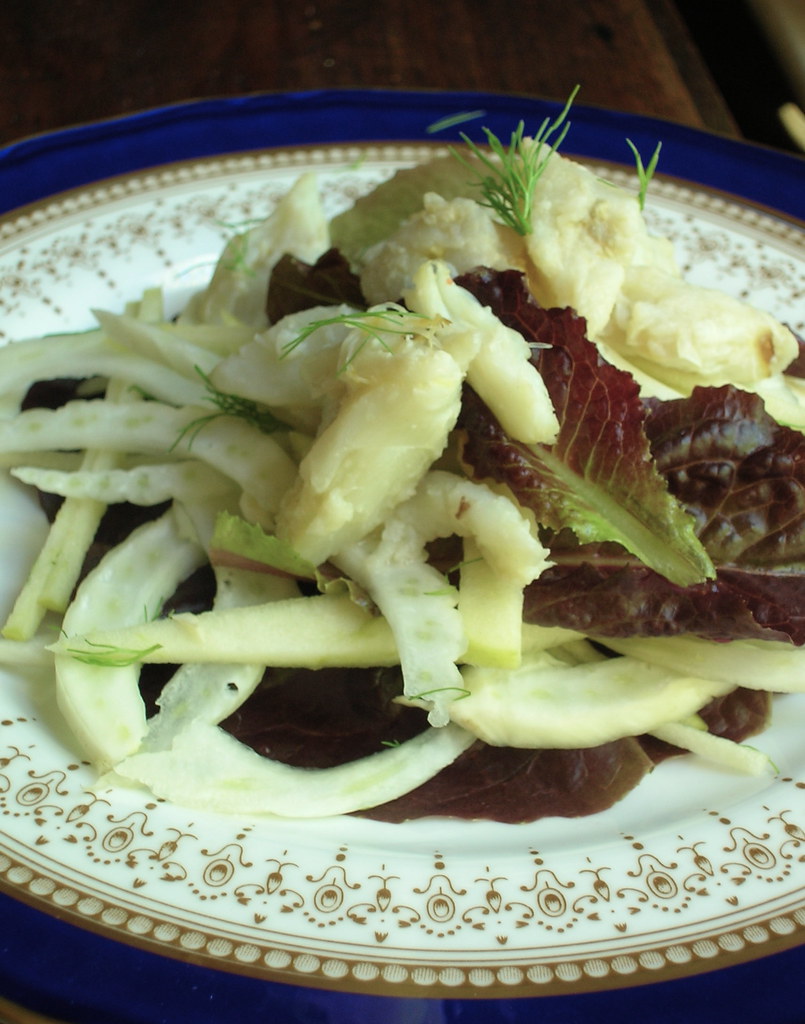
Here's a salad I'm fond of for a special occasion, sliced and served just so. Thin slivers of apple and fennel play tart, bright counterparts against the sweetness of lump crab and baby lettuces. I have these wonderful tiny red lettuces growing in a pot in the backyard, but another mild baby lettuce would work nicely. As long as you promise to follow the recipe.

Crab, Fennel, and Apple Salad
1 cup jumbo lump crab meat
1/2 a fennel bulb, cored and thinly sliced, with a few fronds reserved for garnish
1/2 a Granny Smith apple, cored and cut into matchsticks
baby lettuces, about 4 cups
3 tablespoons olive oil, 2 tablespoons white wine vinegar, pinch sugar, pinch salt

1. Whisk together dressing ingredients in the bottom of a large bowl. Add the lettuces and toss with your hands to coat. Add the apple and fennel and toss to coat. Arrange lettuces and vegetables on serving plates (reserve the bowl). Add crab to bowl and toss around with whatever remaining salad dressing is in the bowl. Mound crab over salad. Garnish with fennel fronds.

30 May 2008

Cilantro-Lime Coleslaw


I realize that cilantro is a controversial herb. Some people truly detest it, some even swear that they are genetically disposed not to like it. But if you can, cilantro is also a great thing to love. Chopping a fresh bunch of cilantro will release a bright, clean, fresh aroma into your kitchen. Unfortunately, when cilantro goes bad it is bad, tasting of soap, and I often worry that people's dislike of cilantro comes from these unfortunate specimens.

This coleslaw was inspired by a bunch of leftovers from a recent cookout. It pairs cilantro with its complimentary partners like lime and sour cream. It works equally well with Mexican and South Asian flavors and was delicious stuffed into an impromptu sandwich with some lemon-pepper shrimp.

Cilantro-Lime Coleslaw

1/2 head green cabbage, thinly sliced
1/2 cup sliced cilantro, loosely packed
1/2 a medium onion, thinly sliced
1/4 cup fresh lime juice
1/4 cup sour cream (low fat is fine)
1 pinch sugar
salt and pepper, to taste

1. Combine sour cream, lime, sugar, salt and pepper in the bottom of your serving bowl. Add cabbage, onion, and cilantro and toss to coat.

30 December 2007

Where I Come From


These are my people. This is where I come from. Sometimes it's good to remember where you come from, even if you never lived there, even if it's only where your mother grew up. Roots, deep, buried. So deep, sometimes we forget them. Even if you know you'll never live there, if you don't fit in there, if it's different than your memories have painted it. It's good to hear the accents, the drawl that can turn "bill" into a three-syllable word. Bi-iieee-uulll. The rocky landscape and the mountain springs, the smell of barbeque, the taste of country ham and biscuits, sorghum syrup, tomato aspic and green beans cooked all day long with a bit of fatback.


With all the wonderful gifts this year, the fancy phone, the camera lenses, backup hard drives, more books than I could dream of (yes, I was truly spoiled), it was a little teacup wrapped in tissue paper that brought tears to my eyes. The gift of my Grandmother's china set, bequethed from my aunt, the antique cream soup bowls with their delicate double handles that speak of responsibility and roots. I promise I'll give them the care they deserve.


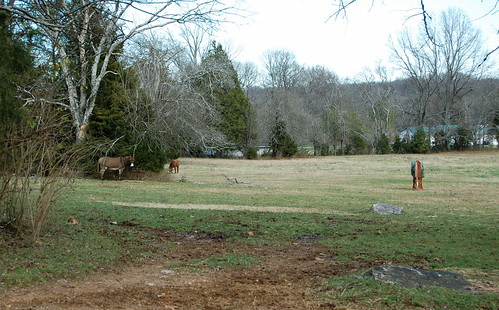
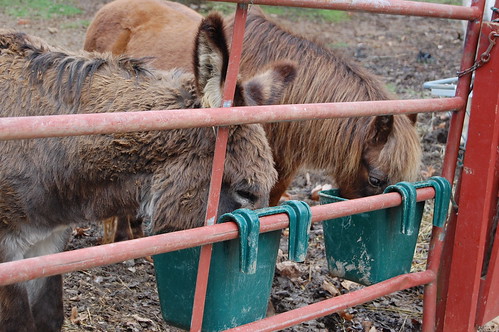
We fed the horses and the burrow, played with the dogs and were entertained by a four-year-old on the trombone. We drove through towns with names like Lebanon, Smyrna, and Carthage, New World versions of Old World titles. I told my cousins about how I went to the original Smyrna, Ismir, in southern Turkey; they looked at me like I was crazy. We ate caramel cake and fought over the Sunday crossword puzzle while sitting by the fireplace. It's good for a city girl to get her boots muddy sometimes. I hope your holidays were as enriching, belly-filling, and relaxing as ours. We're looking forward to the new year!


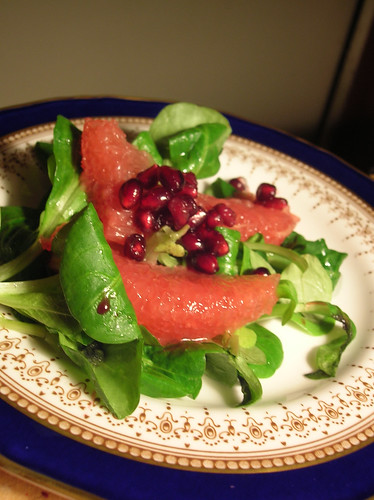
Grapefruit, Avocado, Pomegranate Salad
Every year my uncle sends us a whole crate of Texas pink grapefruit and so begins our annual quest to use all 18 of them before they go bad. The one thing they are destined for is this salad with avocado and pomegranate seeds that my Grandmother always made around the holidays. In our family it's simply thought of as "the Christmas salad."

1 large pink grapefruit
1 large ripe avocado, peeled and sliced
mache or butter lettuce, about 6 cups
1 cup pomegranate seeds
3 tablespoons champagne vinegar
3 tablespoons olive oil
pinch salt

1. Section the grapefruit: Cut off the peel from the top and bottom of the grapefruit. Working from top to bottom, remove the peel and pith in strips, so that the grapefruit flesh in completely exposed. Discard peel and any white pith. Working over a bowl, use your knife to cut between the white membrane so that the grapefruit flesh is released into the bowl in sections. Squeeze juice from remaining flesh and discard.
2. Get another large bowl and whisk together the vinegar, oil, and salt in the bottom. Toss the lettuces in the bowl to coat. Divide lettuces among four serving plates or leave in the bowl. Arrange grapefruit sections and avocado over lettuces. Sprinkle pomegranate seeds over salad. Serve immediately.

01 October 2007

Fattoush Man


As we dug our spoons into a heaping platter of tabboule, my friend Alex remarked through his mouthful, "this is really good, I'm usually more of a fattoush man myself." I loved this idea, a fattoush man, in a country where people are passionate about their salads. The following discussion revealed that many of my male friends had strong preferences in the tabboule verses fattoush arena, though no one would go so far as to refuse either one.

I often overlook fattoush, the classic Levantine salad of chopped vegetables and pita chips, but it is delicious and a perfect use of those late summer tomatoes and cucumbers, and really, who doesn't love a good pita chip, like an Arab crouton? We've talked about tabboule and hummus before, so here are a few important notes on how to make standard fattoush:

1. The dressing uses sumac, a powdered dried berry, that adds a purple hue and a tart acidic note. Sumac is a great thing to have your spice rack, but if you don't have it, substituting a tablespoon of balsamic vinegar can be a good alternative.

2. The vegetables, tomatoes, cucumber, and green pepper are chopped and laid over a bed of greens. Green pepper is traditional because of it's slightly bitter note.


3. The herbs: One of the main concepts in fattoush is that you have a lot of different flavors and textures playing against each other, so you want to look for a range of herbs and lettuces that fulfill this idea. Mint and scallions are traditional, and purslane is used when in season because of it's thick texture. Use a good mix of different herbs and don't shy away from stronger flavors: Umm Hana taught me to add lemon verbena and now I often use it.

4. The pita chips are usually fried for the ultimate crispy flavor, but you can also bake them. This was obviously a way to use up stale pita bread, which is common in Arab households, however, if you don't have pita lying around (as good thin pita bread is terribly hard to find in the U.S.), you can substitute purchased pita chips and use them instead.


5. Presentation: Fattoush is pretty much a toss-it together salad, but for a special occaision here's what we do: Place some lettuces in the bottom of your serving vessel, then toss the vegetables and chopped herbs with half the dressing. Now take some big stalks of pretty herbs (we use lemon verbena and mint) and arrange them over the vegetables. When you make the pita chips, break the pita into large (6 to 8 inch tall) triangles and toast or fry them this way. Arrange the pita triangles, points up, on top of the salad. Pour remaining dressing over. When you serve, hand each person a pita triangle, they can break it up and mix it into the salad themselves.

Phew, I think that covers it. Please, please do not add olives or cheese to your fattoush, this is not Greek salad. Also, I should add that fattoush pairs marvelously with roast chicken, somehow a pile of fattoush and a little roasted chicken breast are a perfect meal. Ok, as if you need it at this point, here's the recipe:

Fattoush

2 cups shredded lettuce, like romaine or mixed lettuces
1 large or 2 small cucumbers, cut into small dice
2 medium tomatoes, chopped
1 small green pepper, diced
3 scallions (green onions) sliced
1/2 bunch parsley, stemmed and finely chopped
1/4 cup mint leaves, finely chopped
1 large or 2 medium pita breads
for dressing:
1/2 cup lemon juice
1/2 cup olive oil
1 tsp sumac
1 garlic clove
salt

1. Smash the garlic clove with a pinch of salt in a mortar and pestle or press through a garlic press. Combine garlic with lemon juice in a bowl, then whisk in the olive oil and sumac to combine.
2. For the pita toasts, brush the bread all over with some olive oil, then toast it in the oven until golden and crisp. (alternately, you can deep-fry the pita if your prefer). Break the toasted bread into bite size pieces.
3. Arrange the lettuces on the base of your serving platter. Toss the diced cucumber, tomatoes, and pepper with the chopped herbs, toss with half the dressing to coat. Place vegetable mixture over the lettuces. Top with the toasted pita pieces, then pour the remaining dressing over top.

13 September 2007

It's That Time of Year Again...


It's fresh date season once again, and I happily plopped a large yellow bunch into my basket the other day. A French lady at the market asked me what they were, and I explained they were fresh dates (balah), that they were dates that are picked early before they've ripened into the wrinkly brown state we're familiar with.

Fresh dates are also a reminder that Ramadan is emminent. Although Islam follows a lunar calendar (meaning seasonal foods don't associate with holidays), dates are an important symbol of breaking the Ramadan fast. During the holiday stores stock up on the most lush juicy dates, as well as dates in various stages of ripeness, date pastes and date molasses. When the fast is broken at sunset, the loudspeakers boom out from the mosques with the call to prayer and a steaming feast is set out on the table before a hungry family gathered together. Traditionally, dates are passed around the table first, as a gentle way of breaking the daily fast. This is usually followed by lentil soup, and then the rest of the meal which will contain a variety of dishes and special juices like a popular tamarind drink. Even though one may be quite hungry after fasting all day, the meal goes at a slow pace, and most people aim to eat modest portions.

Just-picked dates hanging in Palmyra, Syria.

As a foreigner and non-Muslim, I have often found myself anticipating Ramadan with a certain amount of foreboding. Like any holiday, it can also be a hectic time, and the traffic gets absolutely crazy as people rush to get home to break the fast, and hungry people mob the markets to buy last minute groceries. Just try shopping at four o'clock with a market full of people who haven't eaten all day and are eyeing the special pastries in the display windows, let me tell you. There's the added issue that at the office, any time we'd try to schedule meetings or conferences, it was always that Ramadan was coming or happening or ending, and it seemed like we'd lose two months of work to the holidays.

However, having experienced Ramadan in a Muslim country (it's different in places where the population is more mixed, like Beirut or parts of Cairo), I can tell you it's a truly amazing experience. When everyone is fasting together, there is an amazing sense of community, of shared experience, and it is also a time for reflection, family togetherness, and charity (alms-giving is an important part of Ramadan).

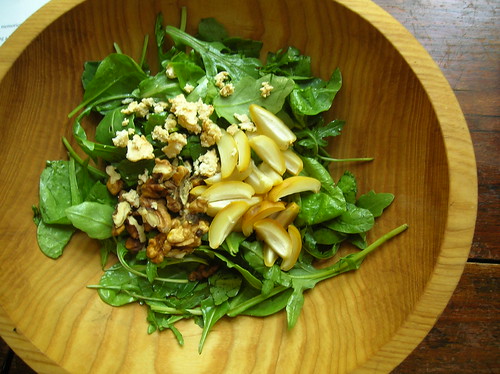
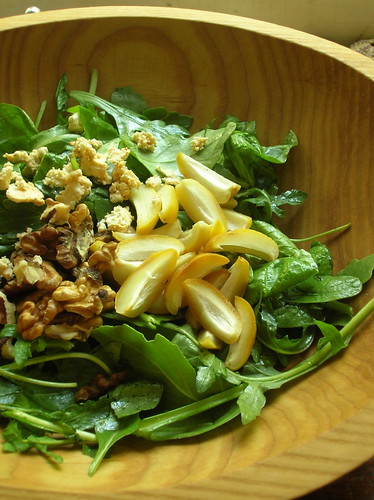
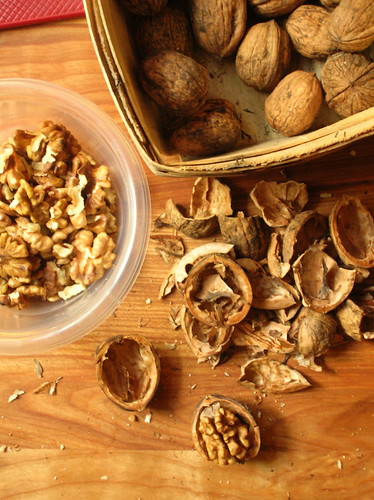
I was thinking about all these things when I bought my fresh dates the other day, even though the holiday had not yet begun. Fresh dates are tart and crunchy and quite similar to apples. In a culinary sense, they don't have much to offer, they make a nice snack on their own. One afternoon, I decided to slice them up and use them in a salad, along with some fresh walnuts I got at a farm recently and some crumbly cheese. This is one of the best salads I've had in a long time, it's one of those salads you have for lunch and then come home and say to your partner/boyfriend/spouse, I had the best lunch today! And then you make it every day for the rest of the week, which is exactly what I did.

If you spy fresh dates at your local market, I urge you to try this salad, or if not you could always substitute some slivers of tart apple. I hope to do some more posts about Ramadan as the holy month gets under way, and if you're observing Ramadan (or any other holiday), I wish you all a happy and joyous year to come.


Fresh Date, Walnut, and Cheese Salad

8-10 fresh dates (the yellow crunchy kind) or substitute a small Granny Smith apple
1/2 cup walnuts
1/2 cup crumbly cheese- shanklish, goat cheese, or feta
6 cups mixed greens
olive oil, salt

1. Place the greens in a serving bowl and drizzle the olive oil over top and sprinkly with salt. Toss to coat.
2. Pit the dates and slice. Lightly toast the walnuts. Place the dates, walnuts, and cheese over the greens. Serve.

31 July 2007

The Best Cashews, and Why I Love the Kurds

summer salad with melon and cashews
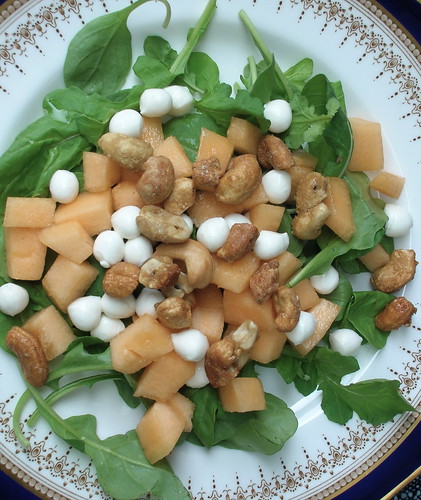
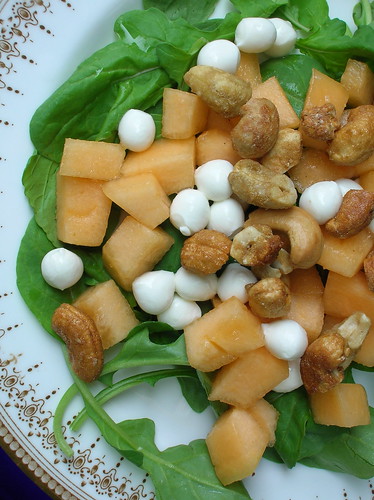
Summer Salad with Melon, Mozzarella, and Cashews

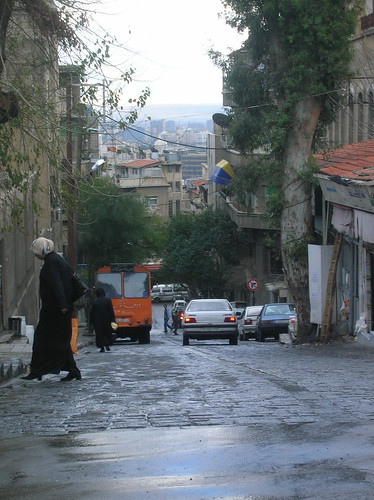
There are a lot of great things I love about my old neighborhood in Damascus, called Muhajereen. Nestled up into the mountain-side, it's got a fabulous market, well-priced rents and apartments that offer beautiful views. Muhajereen means "the immigrants," referring to immigrants from Crete that settled the area long ago, although these days the neighborhood is home to middle class families that have been in Damascus for hundreds of years. It boasts an ancient winding street with Mamluk-era buildings and a Sufi gravesite where local pilgrims come and bring picnic lunches to eat in the cool basement shrine. Bordering on Damascus’ chicest neighborhood, Abu Roumaneh, it's a short-walk to my office and nice shops.

the view

However, it's also a conservative neighborhood, and while that means there aren't many other foreigners around (a plus), there are also some minuses. Many women wear extremely conservative dress: black coats, stockings, black gloves, and a double black face-veil with no eye-holes. Before you ask: yes, it's difficult for them to see through it, and no, I don't have to wear a veil, Damascus women wear a wide range of dress based on personal decisions. But let's move on to that other negative, the complete absence of restaurants in Muhajereen. Conservative households always eat at home, together, and much of the structure of the day revolves around the family meal. So while there are plenty of take-out shops, juice bars, and ice cream parlors, including the best felafel stand in the whole city, there are no sit-down restaurants.


This brings me to why I love the Kurds. At the edge of Muhajereen, off a little side street across from the French embassy, is a bright pink sign reading "The Journalists Club." At one time it was a meeting place for journalists, but these days it’s just a slightly shabby restaurant and cafe. The walls are decorated with florid seventies-era wallpaper and gaudy swirled paintings; weak florescent lights reveal a clientele of older Arab men and a smattering of young ex-pats and Syrians. But what draws us is the single fact that the Journalist’s Club sells alcohol. Don’t get me wrong, I’m not a big drinker, but after a tough day navigating Damascus’ busy streets and bureaucratic struggles, a little glass of wine is a nice way to relax. Though wine and alcohol are available for purchase, the only restaurants and bars with alcohol are in the Christian neighborhoods, far across town from where we live.

The Jounalists Club serves alcohol because it is run by Kurds. I have several Kurdish friends, and though everyone is extremely welcoming in Syria, the Kurds have a unique sense of joy and fun. The other thing that draws us to the Journalist Club is the laid back atmosphere: in a lot of trendy Damascene places it’s all about being seen, women with kohl eyes and men with too much hair gel, at the Journalists Club no one bothers you. And then there’s the cashews. They bring little bowls of roasted cashews to your table that are the most addictive wonderful nuts you’ve ever had. Walking down the hill one evening, Sara mused, “I hope they’ll have the cashews.” Sometimes the bowls are mixed nuts or popcorn, but we adore the cashews. There’s been many an evening I’ve whiled away with a group of expat friends, sipping Lebanese wine and eating one-too-many handfuls of cashews.

nuts please!

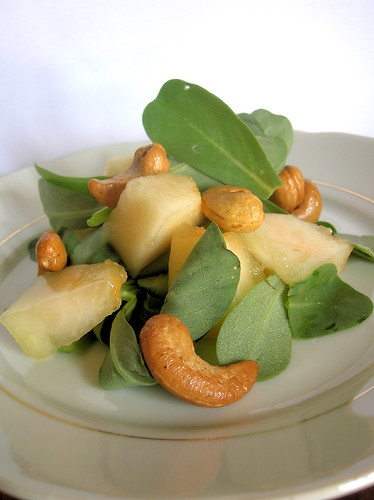
We’ve become friends with the Club’s owners, who told us they get the cashews from a little nut roaster not far from our appartment. Now we can get the nuts whenever we want, golden and hot, straight out of the rotating dark barrel. They rarely last the trip home, but I did manage to incorporate them into a lovely summer salad one day. The meaty cashews made a perfect pairing for the softest, sweetest summer melon, sort of like a play on the classic melon-ham pairing, except in a country without pork products. I used a soft herbal green that I have finally figured out is a type of purslane (anyone know a good source for Arabic/English herb translations?!). It’s worth looking for succulent purslane in your local farmers market, but you could substitute baby lettuces. Finally, tiny little balls of mild cheese round out the salad with a creamy note. It’s a wonderful salad I’ve made many times, but I always think of the jovial Kurds at the Journalist’s Club whenever I reach for the cashews.


Summer Salad with Melon and Cashews

3 handfuls purslane, or substitute baby lettuces or arugula
1 cup sweet melon, such as cantalope or charentais, diced
1/2 cup bocconcini (tiny mozzarella balls), or cubes of soft mild cheese
1/2 cup roasted salted cashews
lemon juice, olive oil, salt to taste

Combine the lemon juice and olive oil in a bowl. Add the purslane and toss to coat, then sprinkle with salt. Place the purslane on your serving plate, then arrange the melon, cashews, and cheese on top. Serve.

Variations: If you, like my mother, are deathly allergic to melon, you can substitute ripe peaches. Or if you, like my friend A., are allergic to nuts, you can substitute some slivers of Parma ham. If you’re allergic to melon, nuts, and dairy, well, maybe this isn’t the recipe for you.

14 July 2007

Making Tabbouleh


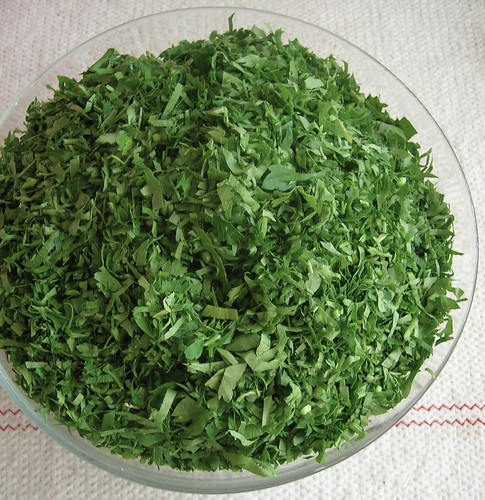
All over Syria and Lebanon, women are chopping parsley. The quiet rhythm of their knives, swish, swish against the cutting board, slicing bunches of verdant green leaves, part of the rhythm of the region. Tabboule is considered the national dish of Lebanon and the pride of Syrian cooks, a salad of bright green parsley flecked with tomatoes, bulgur, mint and lemon. Part of the pride of tabboule is the labor it takes to make it, the parsley must be chopped by hand (a food processor bruises the parsley too much), and it takes a lot of chopped parsley to make even one serving of tabboule. So having someone over for tabboule is a special occasion and an honor- I love this idea, when was the last time someone invited you over where the celebrated dish was salad, when have you seen pot-bellied men clap in delight at a bowl of greens?

When I would make tabboule with Umm Hana, we'd spread a cloth and sit down on the floor and set to work chopping, often working several days ahead of time. Children would run in and out as we chopped and chatted, drinking tea, neighbors or friends might stop by to visit and even join in the labor. A good bowl of tabboule is a delight, whether gulped lustily with a spoon, scooped with elegant lettuce leaves, or eaten with thin pita bread, squeezing the bread to absorb the lemony dressing.
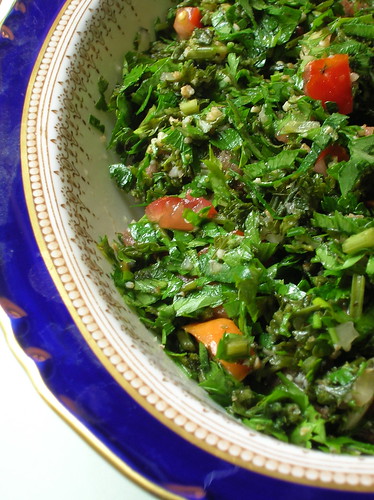
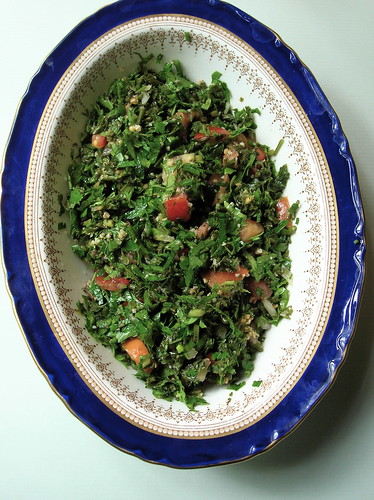

This is a continuation of my discussion about misappropriated Arab foods, last time we talked about hummus, and I want to thank everyone for their passionate responses, I loved hearing your experiences. Now, we're talking about the even-more-maligned tabboule, which so often marauds as a bulgur salad in the West. No, no, no, I want to shriek, tabboule is parsley salad with just a little bit of bulgur. Now granted, there are regional variations, and there is a 'Turkish tabboule' which is primarily bulgur, but tabboule is not synonymous with bulgur salad. Here are some tips for making traditional tabboule:

- Parsley should remain the primary ingredient, not bulgur.
- The parsley should be chopped by hand (I give tips on how to do this below).
- Use a generous amount of olive oil- you need a lot of oil to coat all those little parsley pieces, and don't balk, it's good for you (besides, parsley's a diuretic). You'll also need a complimentary amount of fresh lemon juice, there should be a bit of dressing floating in the bottom of the dish (great for smushing your bread into).
- Traditionally, there is no garlic in tabboule. Also, no cucumber or red peppers please.
- Tabboule is best when served about an hour after it's made- it needs time to rest for the parsley to soften, but if you wait too long it well get soggy.

When I first came to visit my mother after living in Damascus for a year, she joked that I was always chopping herbs in my spare time. She was right, I'd snatch a bit of down time to chop the parsley for that salad I so craved. Sometimes, I'd buy a box of prepared 'tabboule,' then buy a big bunch of parsley, chop it up, and stir them together with some extra lemon juice. I still like chopping herbs, the soothing rhythm of it, the smell of freshness. So if you want tabboule, I'd suggest you sharpen that knife and get to work, there's chopping to be done.

I'd like to point out that the parsley, mint, and tomatoes in the above photo were taken from our garden, talk about a home-made dish! And as always, your own comments and experiences making and eating tabboule are welcome!


Tabbouleh
With a little experience you can estimate the quantities of ingredients by eye when making tabbouleh. However, because bunches of parsley and the size of tomatoes can vary greatly, I give measurements in cups here to ensure the proper ratio of ingredients.
Bulgur is available in the grocery next to the couscous and rice, it is often in a box labeled 'tabboule mix.' You can also find bulgur at your local ethnic market, where it will probably come in grades of coarseness, you want grade 3 or 4.


1/2 cup coarse bulgur
5 cups finely chopped flat-leaf parsley (see instructions)
1 cup finely chopped scallions
1 1/2 cups diced tomatoes
1/2 cup finely chopped mint leaves
3/4 cup lemon juice
3/4 cup olive oil, or more as needed
salt, pepper, and allspice to taste

1. To chop parsley: Sharpen your knife. Gather several stems of parsley in your hand. Pull the stem ends down so that all the leaves are clustered evenly together (see photo). Gather the leaves closely together and press against a cutting board. Holding the leaves in place with your left hand, use your right hand to very thinly slice the parsley leaves. Once you've chopped that bunch, you can go back and chop a few remaining big pieces, but avoid going back over the parsley, as further chopping will result in bruised leaves. Continue with remaining parsley, placing chopped leaves in a bowl. This can be done over 1-2 days, storing parsley in the refrigerator.
2. Bring 1 cup of water to a boil. Pour over bulgur in a bowl and let sit at least one hour, until softened.
3. In a large bowl combine the parsley, scallions, tomatoes, and mint leaves. Fold in the bulgur. Stir in the lemon juice, olive oil, salt, pepper, and allspice to taste. Refrigerate for 1/2 hour to one hour before serving. Serve with small lettuce or endive leaves as scoops.

See also: Clifford Wright's Tabboule
__________________
03 May 2007

Artichokey


The first time I saw an artichoke growing in its natural form was driving through the Bekaa Valley of Lebanon. It had been a confusing day: touring a vineyard and a wine tasting that could have been in France, an annoying Hezbollah checkpoint, passing the odd Roman ruin in the desert. Driving through the semi-arid landscape, there was a whole field of large spiky-leaved plants with tall stalks, “artichokey” said my seat-partner as I looked wide-eyed at the giant thistle-like plants. It is thought the Arabs were the first to cultivate the artichoke while trying to copy Italian cardoons (though Italians, I am sure, would claim primacy). Minutes later, our bus made a crashing turn off the highway and barreled down a dirt road, stirring up dust in a landscape of fields and farms and which was alarmingly devoid of any buildings as far as the eye could see. That is, until we pulled up to a long low restaurant. Situated amongst the artichoke fields, it’s interior revealed bubbling fountains and a packed house of patrons at 3 in the afternoon. Like any good adventurous traveler, I knew I was in for a delicious and lengthy meal.

Previously, my acquaintance with artichokes had been every spring, when my mother would buy artichokes and steam them and we would peel the leaves and dip them in a big bowl of clarified butter, the tooth-torn leaves piling up on our plates as we ate our way towards the meaty heart. Now, half-way around the world, along with the plates of hummus and tabboule, came big steaming platters of artichokes with nutty butter for dipping: the same preparation, only with the odor of nargileh swirling and the strains of Amr Diab overhead. That afternoon there were also artichoke-bottoms, deftly scooped out and filled with a meat and pine nut stuffing, then covered in tomatoes and béchamel sauce and baked, but it was those leaves I savored the most.

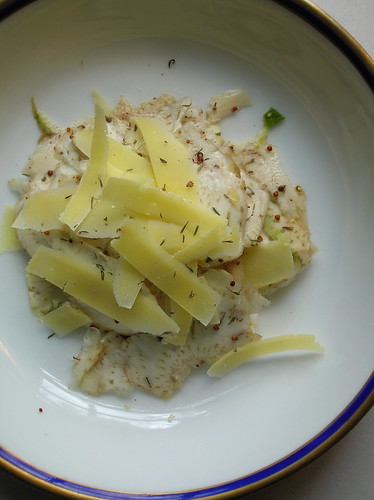
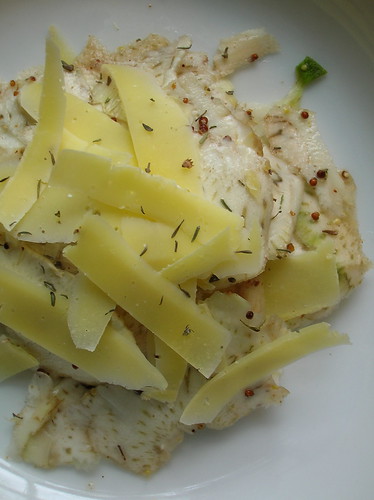
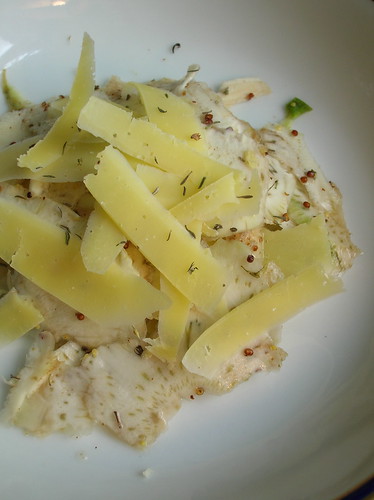
A friend of mine has long-praised a shaved artichoke salad, and this season I decided to give it a go. Just like seeing those artichokes in the field, this salad was a whole new perspective on the vegetable. Like a high school reunion where the dorky kid with the braces and thick glasses returns tall, blonde and enviously successful, so my artichoke transformed into elegant crunchy slivers layered with sharp cheese.

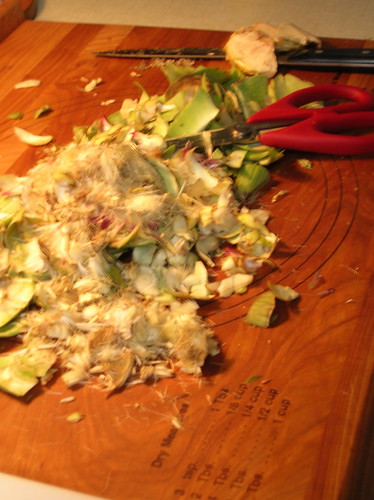
There’s no getting around the fact that trimming the artichokes is a major pain, something to be done only when the season inspires or when enough time has passed that you’ve forgotten the curses you uttered the last time you did it. My own messy process looked much like a a child in a chicken coop, knives and feathers flying. However, you really shouldn’t let that dissuade you, because this salad is truly delicious. It has me wishing (once again) that American markets sold pre-prepped artichokes. I happened to have an asian pear laying around, and a few sweet slices of it paired wonderfully well with the salad, but I imagine some slivers of peppery fennel would also work well. Either way, I hope you are enjoying springs bounty in artichokes and otherwise.


Shaved Artichoke Salad
This flavorful crunchy salad is worth the annoyance of prepping the artichokes. Serves 2-3.

3 artichokes
4 oz parmiggiano-reggiano cheese
1 asian pear (optional)
3 tbl lemon juice
3 tbl olive oil
1 tsp mustard
pinch salt
2 tbl finely chopped parsley

1. Fill a shallow bowl with water and add 1 tablespoon of lemon juice.
2. Pull off the external leaves of the artichoke and cut off most off the top. Pull away the leaves and use the knife to pare away everything but the meaty bottom of the artichoke, scooping out and discarding the fuzzy choke. Place the artichoke bottom in the acidulated water to prevent browning and repeat with remaining artichokes.
3. Using a mandoline or a sturdy vegetable peeler, shave the artichoke bottoms over the bowl, letting the shavings drop into the acidulated water.
2. In a small bowl, whisk together the remaining 2 tablespoons lemon juice, olive oil, mustard, and salt. Drain the artichoke slivers and toss with the dressing to coat. Thinly slice some of the asian pear (I usually only use about half), and add to the bowl with the chopped parsley, toss everything to combine.
3. Place half the artichoke mixture on a serving platter. Shave some of the cheese over the artichokes to cover in a thin layer. Cover with the remaining artichoke mixture, then shave more cheese over top. Serve immediately.

__
18 February 2007

To Market, To Market


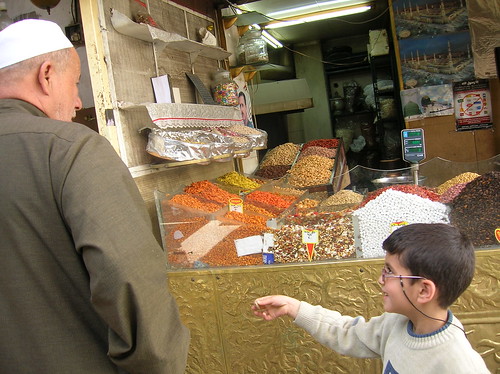
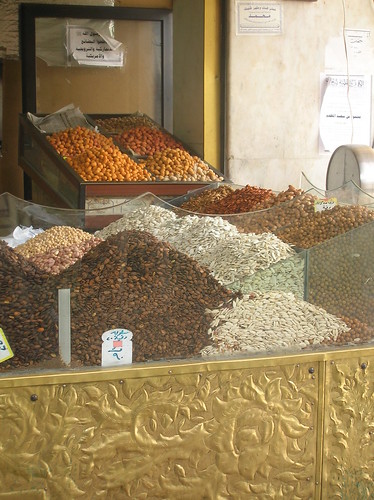
The best thing about my old neighborhood in Damascus, Muhajereen, is the sprawling market tucked up into the slope of the mountain-side. Muhajereen is a middle class conservative neighborhood whose northern location offers sprawling city views; for me, I was drawn by the affordable rent on good-quality appartments and proximity to my office. But I was soon to discover that the best thing about Muhajereen is the souq al-jumoaa, or the market. At the end of al-Afif Street, where the road climbs up the mountain past an eighteenth century mosque and a little lane trundles past some occupied Ottoman-era buildings, is the market’s entrance.


Summer figs, peaches, and unusual fruits.

In Arabic, when someone says they’re going to the market (souq), it could mean anything from going around the corner for some milk to a full afternoon of clothes shopping in the hippest area. Similarly, the market sells just about anything, though it’s primary trade is in fruits, vegetables, meats, cheeses, and breads. Muhajereen’s souq al-jumoaa is particularly expansive, running the equivalent of about 10 blocks packed with vendors in winding streets. A small square halfway through the market fronts onto a mosque which holds the tomb of a famous Sufi leader. In the mornings, clusters of women walk through in their long black robes. The women wear a full black cloth over their faces so that no features are distinguishable, most wear black gloves. Occaisionally, they lean over to inspect the quality of some tender lettuces or a new blender, deftly flipping up and then lowering their veil in a single motion for a clearer view. All the vendors are men.


Making pancakes for qatayaf, romaine lettuce.

On Friday mornings my favorite thing to do is to stroll the market, when it bustles in the morning light. I am the only foreigner but no-one pays to much attention. I visit the cheese man with the saltiest, creamiest feta and the little balls of shankleesh. At the baker, I get the little crunchy yellow cookies with anise seeds in them. I side-step the blood that runs near the area of the meat-market where full carcasses are strung up in the open air. There is always a surprise in the form of an unusual vegetable I’ve never seen, or some tiny berries that will only be available that week.

A Middle Eastern market is not a place to be squeemish about meat.

Whenever I had visitors, I always took them to my local market. In part, the excitement of the market is representative of how little else there is to do here, movies, sports, and theater exist but are primarily fodder for the upper classes. However, the market is also symbolic of a society that revolves around sharing a daily meal with your family, the joys of preparing and eating food together, of living by the season and discovering the daily bounty of nature.


Tomato and Shankleesh Salad
Shankleesh (شنكليش) is a Middle Eastern cheese (also known as sorke) which is shaped into round balls and rolled in either red pepper or zaatar. As the cheese ages it acquires a crumbly texture and pungent flavor. A salad of chopped tomatoes, onion, and shankleesh is a standard addition to any mezze table and often accompanied by arak (an anise-scented liquor).

2-3 balls shankleesh, depending on their size
3 ripe tomatoes, chopped
2 tbl diced onion
pinch of salt

Mix all ingredients, crumbling the cheese with your fingers. Serve immediately with pita bread and arak.

Unfotunately, shankleesh is generally unavailable outside the Middle East, for a discussion on how to make it, see here. There's no real substitute for shankleesh, but I find a mixture of half goat cheese and half blue cheese along with a generous pinch of Aleppo pepper is a good alternative. I use about 3 oz of each cheese, usually chevre or fresh crottin for the goat cheese, and a tangy blue cheese like Bleu d'Auvergne, Roquefort, or Maytag blue.