10 October 2008

Coconut, Cashew, and Pineapple Tart


Until I get to those Middle Eastern recipes I keep promising you, how about I distract you with a little tart? Ah yes, sugar is a great strategy for all sorts of bribery, as parents, young single women, and chastised husbands are all likely to know. This particular tart was culled wholly from ingredients in my pantry- I have a terrible weakness for dried pineapple and papaya, a handful of them makes an excellent weeknight after-dinner nibble. However, super sweet pineapple and papaya need similarly assertive flavors to stand up to them, like coconut (lurking in my freezer), and cashews (leftover from a cocktail party) and rum (in the liquour cabinet from a party long, long ago). And there you have the inspiration (or more like uninspired economy) of a tropically-flavored tart.

The result is somewhere between a marvelous candy bar and a crunchy Caribbean version of pecan tart, which is to say, fabulous. The alcohol in the rum pretty much evaporates in the baking process, taking away the bite but leaving a smooth warm underlying flavor, and the cashews get a great toasty crunch. Didn't you always pick the cashews out of those nut mixes anyway? It's particularly good topped with a scoop of lime sherbert as well, and quite distracting enough to make you forget about whatever I promises you made just a few paragraphs ago.

Coconut, Cashew, and Pineapple Tart
The graham flour (you could also use whole wheat) in the tart dough is not an attempt at health but rather gives the tart a nubbly crust, a graham cracker crust would work nicely as well. Please make sure your cashews are unsalted, those pre-seasoned cashews are unbearably salty and would overwhelm the tart. I imagine this could be blueprint for other tarts, maybe using macadamias, or one with pistachios and dried cranberries at Christmas time.

1 recipe tart dough, made with half graham flour and half all-purpose flour

2 eggs
1/2 cup honey
1/4 cup brown sugar
2 tablespoons melted butter
1/4 cup rum
1 cup dessicated coconut
3/4 cup unsalted toasted cashews
1/8 teaspoon salt
1 cup diced dried papaya and/or pineapple

1. Preheat oven to 375 F. Prepare tart dough according to directions, fit into tart shell and chill until ready to bake. Weight tart dough with pie weights or dried beans, par-bake crust for 15 minutes, until firm but not browned.
2. Meanwhille, place dried fruit and rum in a small bowl or saucepan and heat briefly (on the stove or in the microwave), until just until warm- do not boil. Set aside to allow some of the rum seep into the fruit.
3. In a bowl, beat eggs with honey and sugar until the mixture is thick. Add the butter. Fold in the coconut and nuts, then add the fruit with the rum.
4. Pour into the prepared tart shell, place tart on a baking sheet in the center of the oven. Bake 25-35 minutes, until the filling is firm and the top is deeply golden, watch to make sure the nuts don't burn. Let cool completely before serving.

02 October 2008

Fresh Corn Spoonbread

I owe an apology to anyone who comes here regularly for Middle Eastern recipes- it's not that I haven't been cooking Middle Eastern food, I made taboule just the other day, but mainly it's just those usual staples that I've shared with you here before. Besides, I hope you don't just come here for Middle Eastern recipes, because if that's the case I probably lost you months ago.

But also I was at a conference a week ago where we were discussing the failures of recent American diplomacy in the Middle East. A well-known commentator was criticizing Karen Hughes tenure at the State Department (I should know, I worked under her then), and he described growing up in the Middle East and hearing jazz for the first time on the radio, and falling in love with American blues. He continued that French President Nicholas Sarkozy, when asked about his pro-U.S. views, also talked about hearing American jazz as a kid. The point was that the U.S. does not need to try to sell itself to a specifically Middle Eastern audience (with propaganda like Al Hurra), that we have a culture full of merits that should be selling points on their own. Yes, we need to hire people who speak Arabic and understand Middle Eastern culture, but we also need to hire people who are passionate about American music and art and history.

This got me thinking about a lot of things (like what kind of culture is the U.S. exporting today?), but also about how living in the Middle East taught me just as much about what I love about the U.S. and what I appreciate about where I came from. When I make a new Middle Eastern recipe, I approach it with an academic vigor: I research, I test, I read, I write. But when I go walk around the market on the weekends and think about what I want to cook for dinner, it's those simple-local-fresh things that I want. Not necessarily the foods I grew up with, but those that are sort of indigenous, in a way. Which is why I've got several Middle Eastern recipes in process, but there's fresh corn spoonbread on my dinner table.


Fresh Corn Spoonbread
Loosely adapted from various sources, including Boone Tavern's spoonbread recipe.

2 tablespoons unsalted butter, plus more for greasing the pan
3 cups milk
1 cup white cornmeal
1 teaspoon kosher or sea salt
1 large ear of sweet white corn, or 2 smaller ears corn
1 teaspoon baking powder
4 eggs, well beaten

1. Preheat oven 350F. Grease a 9" round souffle dish or small casserole.
2. Working over a medium-size saucepan, cut the corn from the cob into the pan, then scrape the cob with the back of the knife to get any of the corn juices. Add the milk, butter, and salt to the saucepan with the corn and bring the mixture to a gentle boil, stirring so that the butter melts. In a slow steady stream, whisk in the cornmeal. Stir vigorously to incorporate the cornmeal, until the mixture is thick and bubbling, about 2-3 minutes. Remove from heat and allow to cool to room temperature.
3. Add the baking powder and eggs to the cornmeal mixture and stir well. Pour batter into prepared pan. Bake 1 to 1 1/4 hours, or until the surface is nicely browned. Serve immediately.

29 September 2008

Blueberry Muffins

When it comes to breakfast, I'm generally of the oatmeal/toast/yogurt/granola variety. That is to say, stable, predictable, and likely to sustain me without a mid-morning sugar-crash or a rumbling stomach. Which is probably why you don't see a whole lot of breakfast recipes here, if it's something special I'm more likely to be going out for brunch. I also happen to think most muffins are really jut an excuse to eat cake for breakfast, and these days they are equally likely to be dense, sweet, and about the size of your head.


But on the other hand, a petite little muffin can be just the right amount of sweetness to your morning, and if you live life on the run, it's supremely portable. Based on the simplest wet-dry baking technique, they're also a snap to stir together, and while not the most virtuous in the nutrition aisle, you can at least make them an appropriate size. And now, with the financial markets making us cringe daily, the least you can do is add a little economical sweetness to brighten your morning.


Blueberry Muffins
I particularly like tiny Maine blueberries, defrosted from frozen. You can also substitute 1 1/4 cups buttermilk for the plain yogurt. Makes about 24 muffins, recipe can be halved.

3 cups all-purpose flour
1 tbl baking powder
1/2 teaspoon baking soda
1/2 teaspoon salt
8 tbl unsalted butter, melted
1 cup sugar
2 large eggs
1 1/2 cups plain yogurt
zest of 1 lemon
1 1/2 cups blueberries

1. Preheat oven to 375 F. Grease or line you muffin tins.
2. Combine flour, baking powder, baking soda, and salt in a bowl. In another bowl, beat the egg with the sugar until lightened in color and very thick, about 3 minutes. Drizzle in the butter. Add half the flour mixture to the egg mixture, then the yogurt, then the remaining flour mixture. Fold everything together in a few swift storkes- don't beat the hell out of the batter, some small lumps are ok. Fold in the lemon zest and blueberries
3. Pour batter into prepared cups, filling the muffin tins 3/4 full. Bake 25-30 minutes, or until a toothpick comes out clean. Cool on a rack.

Variations: Cinnamon Blueberry Muffins- add 1 tsp cinnamon. Gingerbread Blueberry Muffins- use brown sugar, 1/2 teaspoon each cinnamon, ginger, and 1/4 teaspoon each nutmeg and allspice. Blackberry Cardamom Muffins- use blackberries and 1/4 teaspoon cardamom. Raspberry Almond Muffins- substitute 1/2 cup flour with ground almonds and add 1/2 teaspoon almond extract.

25 September 2008

End of Summer Chopped Salad

This past week there has been enough of a pronounced chill in the air to declare that fall is officially on its way. I've been reminded how I love a good chunky scarf, and a pullover sweater on cool evenings, and being able to go for long walk without loosing half my body-weight in sweat. And I've also been reminded how much I miss New York; if D.C. has the market cornered on spring, then New York is all about fall.

I want to go for long walks on concrete nature-less streets and then appreciate the man-made beauty that is Central Park; I want to buy cheap jewelry from a stand near Astor Place and meet a friend for a stroll around the Guggenheim, to tuck into a coffee shop and then sit there for hours with a book before taking the subway home.

When I left New York, a friend made the good observation that it takes a certain amount of maturity to leave New York- it's true, I no longer have the young ambitious desire to go to the big city, and I recognize that I may well end up there again. And I like my life in D.C. now, but this week I missed New York.

The one thing I would do if I were in New York is to go wander the Greenmarket, much as I wander Eastern Market or Dupont Circle's market now. And I would probably be reminded, as I was this past weekend, that though fall may be in the air, summer produce is still on its last gasp. There's nothing like a summer tomato, an ear of sweet white corn, perfectly crunchy cucumbers, and herbs from your garden, and there's nothing like that first rush of fall air to make you gather up the last of that summer produce before it's gone for the year. So here's an end-of-summer salad, chock full of whatever you find in the market, with a little avocado and cheese to spruce it up. It's the kind of thing that should be as local possible, no matter where your local may be.

End of Summer Chopped Salad
The key to this salad, besides the best produce your market has to offer, is to get a good balance between softer items (like tomatoes, avocado) and crunchy ones (like corn, onion, and cucumber). Sauteed summer squash, sliced radishes, scallions, and other herbs would be other options to play around with.

2 cups cherry tomatoes, halved
1 medium-size summer tomato, cut in wedges
1 ear corn, shucked and blanched
about 1/4 cup halved and sliced cucumber
2 tablespoons finely diced red onion
drizzle of olive oil, pinch of kosher salt
half a ripe avocado, diced
juice of one lime or half a lemon
goat cheese or feta
tiny basil leaves

1. Place tomatoes in the bottom of the serving bowl. Cut the corn kernels from the cob into the bowl. Sprinkle cucumber and red onion over the tomatoes. Drizzle olive oil and sprinkle salt over salad, toss together to coat. Place the diced avocado over the salad. Squeeze lime juice directly over salad (this should also keep the avocado from browning). Sprinkle cheese over top and scatter basil leaves over. Serve immediately or refrigerate for up to 4 hours.

21 September 2008

Winemaker's Grape Cake

It is known simply as the incident of the grape pie in my family. Whenever anyone asks my mother about my cooking abilities, she can always say, "well there was that grape pie she made." You see, as a kid, the very first thing I learned how to bake was pie. And I was home alone one afternoon, locked in the house while my mother gone somewhere, and making a pie seemed like a good way to pass the time. The only fruit we had in the house was a big bag of grapes, but I enterprisingly found a recipe for "grape pie" in the Joy of Cooking. So I made a homemade crust and followed the directions and baked up a homemade grape pie. With green grapes. And yes, parents, I was probably too young to be making pies unsupervised.

The pie came out looking beautiful, I remember, but it was as inedibly tart as you would imagine green grape pie to be. My mom's friend Shawn, a swim coach with the requisite eat-anything appetite, managed to struggle down a few slices, but I'm pretty sure the rest ended up in the trash. After that failure, I avowed that grapes did not belong in dessert, pair them with your cheese, add them to salads, but keep them out of the baking arena. And despite my adventurous baking nature, I stuck with this rule for years.


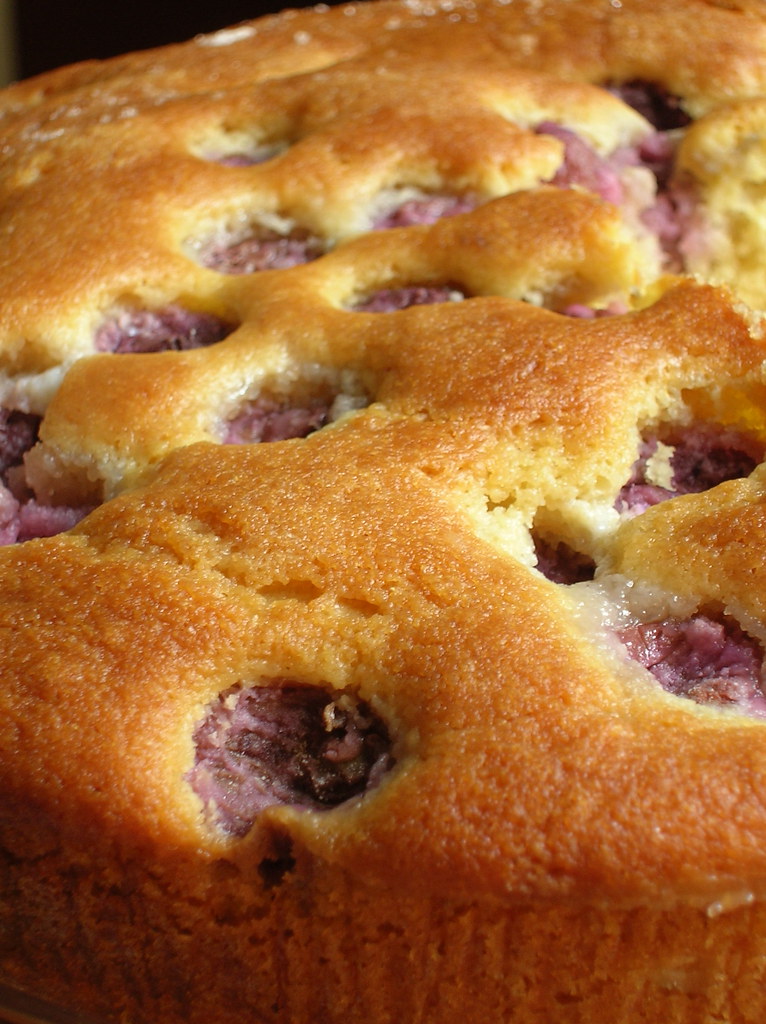
Until I came across a recipe for a grape cake that sounded so intriguing, and had so many positive reviews, that I just had to make it. I had a bottle of muscat wine that I had picked up on a trip to Lebanon's Chatura Vineyards, and it needed to be used up or tossed (being far past its prime for drinking), and I found this recipe. It's just the kind of cake I like, simple, only slightly sweet, and with a burst of ripe fruit. And despite my skepticism about the grapes, well, they were fabulous, just the right accent to the cake.

Don't be skeptical of the olive oil either, it works wonderfully here, just as it does in plenty of other desserts. I've made this cake many times since then, and I've even come across similar versions of the recipe elsewhere (like Patricia Wells' Winemakers' Grape Cake), which means I'm not the only one who's been enamored of the slightly unusual recipe. And so I'll amend my rule for this cake, as long as you make sure to use red grapes, and not green.


Winemaker's Grape Cake

1 1/2 cups all purpose flour
1 teaspoon baking powder
1 teaspoon salt
1/4 teaspoon baking soda
3/4 cup plus 2 tablespoons sugar
4 tablespoons (1/4 cup) unsalted butter, melted
4 tablespoons (1/4 cup) extra-virgin olive oil
2 large eggs
1 teaspoon lemon zest
1 teaspoon orange zest
1 teaspoon vanilla extract
1 cup Beaumes-de-Venise or other Muscat wine
1 1/2 cups red seedless grapes
for topping: 1 tablespoon butter, 2 tablespoons sugar

1. Preheat oven to 400°F. Brush 9-inch-diameter springform pan with olive oil. Line bottom of pan with parchment; brush parchment with olive oil.
2. Sift flour and next 3 ingredients into bowl. Whisk 3/4 cup sugar, butter and olive oil in large bowl until smooth. Whisk in eggs, both peels and vanilla. Add flour mixture alternately with wine in 3 additions each, whisking just until smooth after each addition. Transfer batter to prepared pan; smooth top. Sprinkle grapes over batter.
3. Bake cake until top is set, about 20 minutes. Dot top of cake with 1 tablespoon butter; sprinkle 2 tablespoons sugar over. Bake until golden and tester inserted into center comes out clean, about 20 minutes longer. Cool in pan on rack 20 minutes. Release pan sides. Serve slightly warm or at room temperature.

18 September 2008

Vacation

The place we go for vacation every year, a small island 12 miles off the coast of Maine, is hard to capture in a few words. I realized this as I tried to jot down something on a postcard to a friend, I struggled out a few notes, and finally concluded, "I believe in vacation." And it's true, I do. To get to Monhegan, I have to fly two hours, drive three hours, then take an almost two hour boat ride. It's worth every second, but it's the boat ride that's essential. Each year, even though I've brought a book to read, I end up sitting on the boat and staring out over the ocean, processing all the stresses of daily life, of traffic jams and work conflicts and family foibles and troubles of the heart. And something happens out there in the middle of the ocean, so that when I step off the boat I leave all those things behind, and it's just me and more gorgeous views than you could even count.


The views make eveything on Monhegan noteworthy, having your morning coffee looking at this:


chopping onions with this view from your window:


We eat well on Monhegan, in a way that you can only there: a little bit hard-scrabble, a little bit of work, slightly hodge-podge, a few pristine ingredients, and the appreciation you can have for a meal only after a good long hike.


There's fresh-caught haddock and tiny Maine shrimp, local lobster, home-grown tomatoes, plenty of squash, and a handful of greens pillaged from an out-of-town friend's garden. A salad of stolen lettuces. You have to cook, to work a bit, and to be flexible, substituting for ingredients unavailable in a small island community. But you might end up with something wonderful, like a fish stew tossed together at the last minute. One you didn't photograph, but just sat down and ate, with good wine and family and nothing else on your mind except the sunset and the sound of wind and waves, and what you might cook tomorrow.

(More vacation pictures here)

Improvised Shrimp and Haddock Stew
I originally made this stew using leftover shrimp, and the resulting stew was successful enough that I've left the instructions that way, cooking the shrimp separately. You could also double the shrimp amount, eat it for dinner one night, then make the stew with the leftover the following night. Serves 4.

2 tablespoons canola oil
1 lb tiny Maine shrimp
4 garlic cloves, minced
2 teaspoons sugar
1 lemon, juice and zest
splash of olive oil
1/2 an onion, diced
2 large ripe summer tomatoes, chopped
2 medium sized haddock fllets, about 1 lb, cut into chunks
water, salt, pepper

1. Sprinkle shrimp lightly with salt, set aside. Heat oil in a saute pan, add the garlic and cook, stirring frequently, over medium heat, until softened but not at all browned. Sprinkle the sugar into the pan and allow to melt and caramelize slightly, do not let it burn. Add the shrimp and saute just until firm and 3/4 curled, only about a minute. Add the lemon juice and zest and stir everything together to combine. Remove from heat and set aside.
2. In a stock pot, heat a splash of olive oil. Add the onion and cook until softened. Add the tomato and allow to cook until broken down and bubbling. Add the fish chunks and enough water to make a soup. Bring to a simmer and cook until the fish is opaque and firm. Stir in the shrimp with its juices and simmer until heated through. Taste for seasoning, serve.

06 September 2008

Seed for Thought

"During the United States-led invasion of Iraq, in March, 2003, the looting of Iraq’s national archeological museum received considerable attention, but almost no one noted that the country’s national seed bank was destroyed. The bank, in the town of Abu Ghraib, contained seeds of ancient varieties of wheat, lentils, chickpeas, and other crops that once grew in Mesopotamia. Fortunately, several Iraqi scientists had placed samples of the country’s most important crops in a cardboard box and sent them to an international seed bank in Aleppo, Syria. There they sit, on a shelf in a cold room, waiting for a time when Iraq is stable enough to store them again.

Afghanistan’s bank, which contained rare varieties of almonds and walnuts, and also fruits including grapes, melons, cherries, plums, apricots, peaches, and pears—many of which originated in the region—was destroyed in the 2001 overthrow of the Taliban. Scientists in Kabul had taken the extra precaution of hiding the national seeds in the basements of two houses in the towns of Ghazni and Jalalabad. But when they returned after the fall of the Taliban they discovered that looters had dumped the seeds on the floor. “Apparently, they were after the jars,” Fowler told me. Those randomly scattered seeds represented dozens, perhaps hundreds, of unique varieties—Afghanistan’s agricultural heritage."


~John Seabrook, Sowing for the Apocalypse

More and more I'm interested in process, how things are made and why they come out the way they do. In the kitchen, this leads me more and more to how plants grow, how livestock are raised, what bees feed on when they make honey, and questions about science and agriculture and how our ecosystem works at large. I've never thought of my cooking in such extreme terms before, but in a way that most simple desire to feed oneself leap-frogs out to an existential question of what and how things grow and come into being. Maybe that's why this piece on seed banks struck a chord with me- you can read the full article here.

I'm on vacation until the 16th, see you all soon!