 Fish Baked with Pomegranate and Lime
We were on our usual Friday morning stroll through the market when my friend Sara suddenly let out an excited shriek. “Look,” she cried, “loumi!” Startled, I looked around confused, what, noumi, loumi? It didn’t help that the items at which she was wildly gesticulating were small shriveled black orbs, harder than rocks and somewhat resembling tiny dried brains. Before I could ask any clarifying questions, Sara had already rushed over and was engaged in intense negotiations with the vendor of the little black things, which I had now decided looked more like little grenades. “Loumi,” she asked him, “loumi bosra?” I was beginning to get a little worried about the intense activity around these bizarre objects. You can buy a lot of odd things at a Damascus souq, and I wasn't sure if we wanted these. Finally, Sara turned to me, clutching the newly-purchased package to her chest. “They’re a special kind of dried limes,” she explained, “my dad used them to make this soup whenever we were sick.”
Sara grew up in Britain but her dad hails from Bosra in southern Iraq and he has always been the cook in their family. The soup she described is much like a local version of chicken noodle soup, except it involves lamb and rice and those whole limes simmered in a thin broth. Sara doesn’t much like to cook herself, and when she moved away I inherited those dried limes and I’ve carted them around with me through many kitchens over the years, unable to throw them away because she had cherished them so dearly.

Finding something to make with my loumi proved to be very difficult. Also known as Omani limes or black limes, they have a strong sour-bitter flavor and are often used to flavor rice dishes. However, recipes were few and far between, and most called for grinding loumi into a powder (ironically, General L. Paul Bremmer, who also trained as a French chef in addition to being the former military head in Iraq, discovered loumi while in Baghdad and encorporates them into classic sauces). Anyway, when I found a recipe in Mary Bsisu’s The Arab Table for fish baked with dried limes, I pounced.
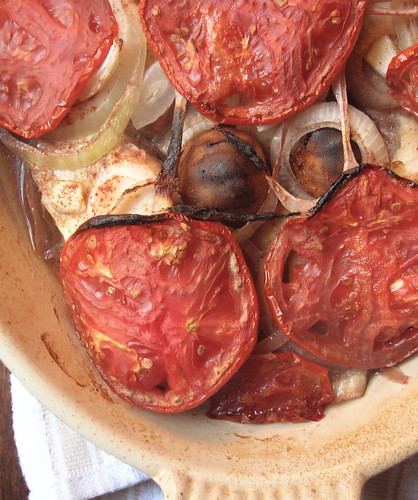
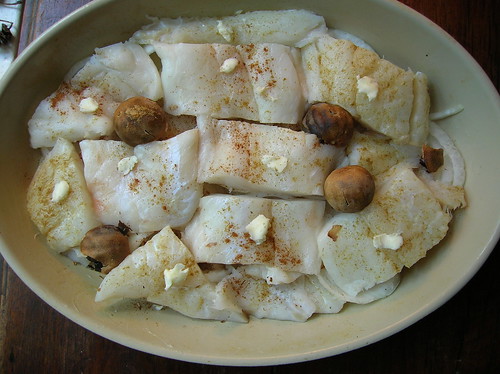
It’s called samak tibsi in Iraq, samak meaning fish and a tibs being the kind of pot it is usually baked in. I ended up deviating greatly from Bsisu’s recipe (which called for 4 lbs of fish for only four servings, and had you scatter raw diced celery over top before serving, ???). Basically, you layer onions, garlic, and fish in a baking dish, nesting the dried limes amongst them, and then you top it with a layer of sliced tomatoes and pour pomegranate juice over top. This is one of those dishes that, as you are putting it together, you know it’s going to be good. As the dish bakes, the vegetables soften and caramelize and the liquid reduces into a wonderfully thick sweet-tart sauce.
I have a tendency to declare something is my “new favorite dish” about once a week, but this really is my new favorite. I’ve made it three times in the past two months, including once for company, and I already know it’s going to be a staple. Let me outline it’s benefits: first it is supremely easy, all you do is slice some things, layer them in a dish, and bake them. It's got your vegetables and protein all in one dish, so you don't need to fix much else, a green salad and some bread perhaps. It is perfect for entertaining, where your guests will love the intricate flavors and tender fish, or for you to eat solo over several days. I’ve also discovered that this is just as good when using whole fresh limes, and since pomegranate juice is readily available in groceries nowadays, you don’t even need any special ingredients.
By now, I'm beginning to sound like my friend Sara, ecstatic over her limes. In the end, it turns out her excitement was worth it. I'll stop my enthusiastic raving, but only if you promise to go out and make this dish as soon as possible.
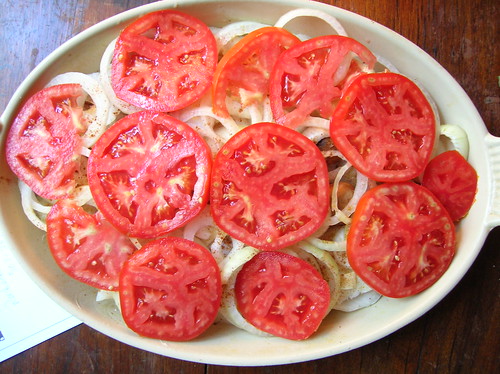 Note: you should use more tomatoes than in this photo.
Fish Casserole with Pomegranate and Lime (Samak Tibsi)
Hands down one of my favorite dishes, easy and sure to impress. Despite the long oven time, the fish remains moist thanks to the syrup and the insulation of the vegetables. When serving, you shouldn't actually eat the whole limes. Serves four.
1 tbl all spice, 1 tsp cumin, 1 tsp cinnamon, 1/4 tsp red pepper flakes, pinch salt
2 tbl butter
2 lb thick white fish fillet, such as orange roughy or red snapper
3 very large white onions (I used vidalia)
4 dried limes or 4 key limes or 2 regular limes
4 cloves of garlic, minced
1 lb tomatoes, sliced
1 cup pomegranate juice (or 3 tbl pomegranate molasses dissolved in 3/4 cup water)
1. Preheat the oven to 400 F. Combine the spices in a small bowl. Rub half the spices over the fish fillets.
2. Grease a casserole dish with 1 tbl of the butter. Thinly slice the onions and seperate into rings. Toss the onions with the remaining spices to coat. Spread half the onions in the bottom of your dish. Cut the fish into medium-sized pieces and arrange over the onions. Cut several slits in the dried limes (if you have larger fresh limes, halve them) and nestle the limes amongst the fish. Scatter the minced garlic over top. Dot the remaining tablespoon of butter over top. Top with the remaining onions, then cover the whole dish with the tomato slices. Overlap the tomato slices slightly as the will shrink when baking. Pour the pomegranate juice over top.
3. Bake the dish for 45-50 minutes, until the onions are softened and the sauce is slightly thickened. Serve warm.
Dried Limes can be found at Middle Eastern stores and ordered from Kalustyans.
Other recipes with dried limes: khorest ghaimeh