Showing posts with label Rice. Show all posts

15 January 2011

Persian Jeweled Rice

DSC_0140

Since we started off the new year with an Iranian stew, I thought it would make sense to continue with a classic Persian rice recipe, shireen polou. Two years ago I posted a photo of Persian rice and several people asked me for the recipe, so it's about time to follow up with another polou recipe.

If you have ever inadvertently burned a pot of rice, then Persian style rice is for you. I'm kidding, but the most delicious part about Persian rice is the delicious golden crust, called tah-dig, that is carefully formed on the bottom of the pan. "Crusty rice," is a technique found all over the world, from Korean bibimbap to northern Indian Biryani to crunchy fried rice. If it were up to me, crunchy rice beats out plain fluffy rice anytime.

DSC_0131DSC_0133

The technique for Persian polou is the same whether you are just making plain rice (rice with butter), or a fancier rice stuffed with everything from sour cherries to chicken to pistachios to vegetables. First, you par-boil basmati rice until it is half way done, about 10 minutes. Then you drain the rice and mix with whatever additions you want to add, whether its spices, herbs, meat, or fruits and nuts. Then you melt a lot of butter (or ghee) in the bottom of a heavy bottomed pot. You add a little bit of rice and stir it in to coat in the butter and pat it down on the bottom of the pot. Then you pile in the rest of the rice in a loose conical shape, and poke a few holes in the rice with the handle of a wooden spoon. Sprinkle a bit of water over the top of the rice, wrap the lid of the pot with a towel, and cook on medium-ow heat until a beautiful crust forms on the bottom of the pan.

DSC_0134

Now today we're making one of the fancier forms of polou, "shireen polou," or jeweled rice. Traditionally made for weddings, this rice is filled with chicken, pistachios, almonds, barberries or cherries, candied orange peel, and saffron. Though sour cherries are usually used for different dish (albalu polou), I love them and happened to add them on hand instead of barberries. The rice is studded with colors and textures, sweets and savories, all mixed with bits of rice both crunchy and sweet. You'll never want to eat boring old steamed rice again.

DSC_0135

Jeweled Rice
You can always play around with different dried fruits and nuts for this dish, and if you don't have candied orange peel a bit of fresh orange zest will do in a pinch. Making polou is a delicate act, if the heat is too low you don't get the crispy crust, and too high and it burns. It may take a bit of practice to get it right, but even the "ugly" versions will be delicious.

6 chicken drumsticks (or 4 chicken breasts)
salt, pepper
2 cups basmati rice
1/2 cup slivered almonds
1/4 cup shelled blanched pistachios
1/2 cup pitted sour cherries (or rehydrated barberries* or dried sour cherries)
1/4 cup golden raisins or diced dried apricots
2 tablespoons finely diced candied orange peel
1/4 teaspoon each allspice, cinnamon, and cumin
1 pinch of saffron mixed with 2 tablespoons hot water
6 tablespoons butter or ghee

1. Sprinkle chicken with salt, pepper. Heat some olive oil in a pot, add the chicken and lightly brown on all sides. Add water to cover chicken, bring to a simmer, and simmer about 45 minutes or until chicken is tender and falling of the bone. Remove chicken to cool and set aside broth.
2. Bring broth to boil, if there isn't much broth add some extra water so that there is at least around 5 cups liquid. The rice should be able to cook freely in the liquid, bouncing around the pot. Add the rice to the boiling broth and let the rice cook 10 minutes, it will be under-done. Drain rice immediately and place in a bowl.
3. Meanwhile pull apart the cooled chicken, discarding skin and bone.
4. Season the rice with salt and add the allspice, cinnamon, cumin, and saffron, stirring well to mix. Fold in the nuts, fruits, and chicken, folding gently to combine.
5. Melt the butter over medium-low heat in the bottom of a deep heavy pot. Scoop out about 1/2 cup of the rice (preferably without any big chunks of chicken or fruit or anything), and add it to the pan, mixing with the butter. Pat this buttery rice layer down to cover the bottom of the pan. Pile in the remaining rice in a loose conical shape. Poke a few holes in the cone with the handle of a wooden spoon. Sprinkle 2-3 tablespoons of water over the rice. Wrap the pot lid in a dish towel, tying it at the top with rubber band. Cover the pan with the lid and let cook undisturbed for 35-45 minutes. Start checking the rice after about 30 minutes, you want the rice at the bottom to be golden brown but not the burn.
6. When the rice is done, remove from the heat and immediately dunk the bottom of the pan in a sink of cold water (this will help the crusty rice release). Wait a moment, then carefully invert the rice onto a platter. If the rice sticks to the pan (as mine always does), just crumble the crusty bits decoratively over the top. Serve immediately, with some plain thick yogurt on the side.

*Barberries and jarred sour cherries are available at your local Middle Eastern or Persian grocery store.

13 August 2009

Mujadara

There are several Middle Eastern recipes that I have not yet posted here for several reasons: a) I don't particularly like the dish (ahem, sheep's feet), b) I lack the special molds, tools or ingredients to make the dish (ma'amoul, kishik), c) it makes a huge amount and I don't have a crowd to feed it to (whole roasted lamb anyone?). And finally, there is a whole slew of dishes that I haven't posted here simply because they are so common and obvious to me that I forget they might be new to someone else. Heck, it took me two years to get a baba ghanoush recipe on this site.

So, while I realize I've been absent from this site due to recent events, I hope to delve more into the both the basics and the more unusual dishes of Middle Eastern cuisine here in the future. I've got a whole bunch of ideas for postings, it's just getting them written down and uploaded. I hope you'll stay tuned.

One example of those most basic of Levantine staples is mujadara- a simple pilaf of rice, lentils and caramelized onions. I hesitated to post it here because it's been blogged about so many times before.

Like so many rice and legume staples- it relies on a simple but key combination of spices and flavors to elevate it from belly-filler to table-decorator. Every cook should know how to caramelize onions, an essential skill that mainly takes patience. Whenever my pantry is bare, leaving me only with some onions lolling in the vegetable drawer and a bit of old bread, I caramelize the onions and eat them over toast, with cheese melted on top. It's delightful.

So mujadara is just rice and brown lentils (cook them separately so they are both done just right), then cooked together with caramelized onions and spices. A simple cheap Mediterranean staple that I finally got around to sharing with you. Sahtain.

Mujadara
I love this dish with dollops of plain yogurt on top, even though it's not traditional it's very, very good.

2 large sweet white onions, thinly sliced
2 tbl butter
2 tbl vegetable oil
1 1/2 cups brown or green lentils (not red lentils or french lentils!)
2 cups long grain white rice
3-4 cardamom pods
1/4 tsp ground cinnamon
1/4 tsp ground cumin
salt and pepper to taste
splash of good olive oil
optional: plain thick yogurt for serving

1. Melt the butter along with the oil and a pinch of salt in your largest skillet, and add the onions. Set heat on medium-low and stir occasionally until very soft, about 30 minutes. Turn heat to medium high and keep cooking and stirring often until deeply browned and sweet, another 20 minutes or more. Deglaze the pan with a splash of water (or more untraditionally white wine), stir and set aside.

2. Meanwhile, cook the rice and lentils separately according to the package directions. Add the cardamom pods to the rice pot while cooking, then discard when done. The lentils should be tender but not smushy or soupy, they should retain their shape.

3. Combine rice, lentils, half the caramelized onions, cinnamon, cumin, salt and pepper in a large pot. Add about half a cup of water and the olive oil and heat everything together until fragrent, warm and combined.

4. Place mujadara in serving dish. Scatter remaining caramelized onions over top. You can also decorate with some toasted pine nuts or chopped parsley. Serve, with plain thick yogurt on the side if desired.

20 February 2008

Anbari Rice Pilaf

muhammar
Anbar, Mosul, Bosra, Samarra. What do you think of when you hear these names? Chances are, you think of violence, of roadside bombs and IEDs, of suicide bombers and gun fights. How sad it is that these cities, once famous for their history and traditions, are now thought of in the context of war and conflict. Samarra, that ancient city, once most famous for the fabulous spiral minaret that every art history student studies.

I’ve been doing research recently about the culinary traditions of different Middle Eastern cities: Aleppo’s unique use of spices, Anataklia and its eggplants, the biscuits of Saida. Mosul is famous for its kibbe mosul, a casserole of ground lamb and rice, and the cuisine of Bosra is characterized by its use of dried limes. It got me thinking about those city names, that those cities can have more than one meaning, that in the past when someone said Iraq one thought of Babylonian gardens, the cradle of civilization, an old and rich culinary tradition, and not of war.

My goal here is not political, in fact, by writing about Iraqi foods my aim is to depoliticize. When you understand what someone eats everyday, how they shop, how they prepare their foods, you begin to understand how they live and what their values are.

That region often in the headlines, el Anbar, was once known for producing some of the best rice in the world. Iraq’s most esteemed anbari rice is slender and highly aromatic. Unfortunately, Anbari rice is no longer available, but you can make a truly witching pilaf using the similar basmati rice. You’ll find this rice dish from Iraq to Oman and it is particularly popular in the Gulf, but it uses those most beloved Iraqi ingredients: dates, cardamom, and rose water. The dish also reflects the Iranian influence on Iraqi cuisine: the technique of cooking the rice to yield a crispy crust and the spice mix similar to the Iranian mix advieh.

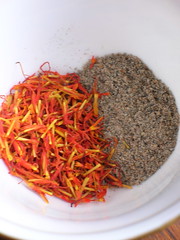
Quite frankly, this is one of my favorite recipes, it always shows up whenever I’m cooking for a crowd and sometimes I make the whole recipe just for the two of us so we can eat it all week long. It has the wonderful scent of rose water, cardamom, and saffron, with a hint of sweetness from the dates. (Or, if you’re feeling cheap, a bit of safflower in place of saffron) The rice is par-boiled, then mixed with the seasonings and cooked over very low heat so that the bottom of the rice forms a delectable crispy crust (tah dig in Persian). Making the crust is part experience and part sheer luck: turn the heat too high and the crust will burn, too low and the crust will be pale and not crisp. The real talent is to be able to turn out the dish in one piece so that the crust makes a beautiful crown on the serving platter. Despite practice, I am never this lucky, and usually half my crust sticks to the pan, in which case you can just crumble the crusty bits over the top, which tastes equally as good. I actually don’t mind if it gets a touch burnt, it adds a nice toasty crunch.

I’ve called this dish Anbari rice pilaf, not because it is specific to el Anbar, but rather in remembrance of that legendary rice. I hope you’ll make it mainly because it’s amazingly good, but also so that next time Anbar comes on the news maybe your senses will be flooded with the scents and tastes of rice pilaf, and not just images of war.

Anbari Rice Pilaf

2 cups basmati rice, rinsed in cold water
1/2 cup date molasses*
1/2 tsp ground saffron
1/2 tablespoon cardamom
2 teaspoons rose water
1 teaspoon salt
3 tablespoons ghee or butter

1. Combine, saffron, cardamom and rose water in a small cup.
2. Bring a large pot of water to boil with the salt. Add the rice and boil uncovered for precisely 8 minutes, then drain.
3. Mix the date molasses with the rice, then mix in the rose water mixture.
4. Choose a medium sized heavy bottomed pot. Melt the butter in it over medium heat. Add 2 spatula-fulls of rice and mix with the butter, patting down to cover the bottom of the dish. Pile the reminder of the rice in a loose cone shape and poke a few holes in the rice with the spoon handle. Sprinkle a few tablespoons of water over the rice, then wrap the pots lid with a towel and cover the dish. Place over very low heat and let cook for 20-25 minutes. Keep a close eye at the end as the rice can burn (use your nose to see if it begins to smell burned).
5. The easiest way to unmold the rice is to prepare a sinkful of cold water, dip the bottom of the pot in cold water for about 30 seconds, then invert the pot onto a serving platter. If the rice crust does not release fully, simply break up the crunchy pieces that stuck to the pot and scatter over top.

*Date molasses is available in Middle Eastern groceries. You can make a quick substitute by placing 1/3 cup minced Medjool dates in a small saucepan with 3 tablespoons water. Bring the mixture to a simmer and mash with a fork so that the dates melt into a paste.

Serving Suggestion: this rice is delectable alongside any saucy dish (I often serve it with Sweet and Sour Fish), but our favorite serving is the following. Mound the rice on a platter, or on individual plates. Take shredded cooked chicken meat (from a roast chicken or poached chicken breasts, whatever you’d like), scatter the chicken meat over the rice. Get some good plain yogurt, add a pinch of salt, and thin it with a bit of water so that the yogurt is thick but pourable. Pour the yogurt all over the chicken to cover. Sprinkle cinnamon over the top. Serve immediately.

Note: In parts of the Gulf this dish is called Muhammara- which just means red. The name muhammara is often used to refer to any reddish colored dish, do not confuse it with the red pepper dip from Syria or the Iraqi dish of rice with tomatoes, both of which bear the same name.

28 October 2007

Forbidden Rice Pilaf


Every time I walk into New York's Kalustyan's, an international grocery, I'm always entranced by the array of rice displayed along the right side wall. A veritable rainbow of Bhutanese red rice, green Bamboo rice, black japonica, Camargue red, purple jasmine, brown rice, wild rice, basmati, sticky rice, sushi rice, short grain, long grain, oh the possibilities! Of course, I'm always attracted to buy some, but the problem is we aren't really rice eaters. Sure, I stir up a risotto now and again and I'm the first to jump at an invitation for my friend's special Iranian pilaf, but overall we aren't big on the rice front. When my Chinese friend describes the number of rice cookers she has to put into use when her family visits I practically blanch in horror. And yet, everytime I walk into Kalustyan's I'm tempted, which is why I've got four unopened bags of rice in my cabinet.


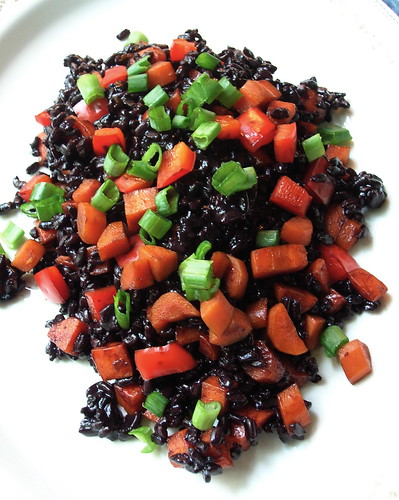
I decided to put some of that rice to good use, "look, this one's called forbidden rice, it says it was prized by Chinese emperors," I said as I pulled it from the cabinet. P. who lived in Hong Kong, just laughs at me, "they call everything in China 'forbidden,' '' he says. Yes, it's probably a marketing ploy, but the fact is this Chinese rice has a lot of other things going for it. The rice is an heirloom Chinese variety whose black color comes from its whole bran exterior. This means it is high in fiber and the deep purple hue it emits hints at a wealth of phytonutrients and iron, another reason you can find it at many health food stores. But most importantly, the rice is delicious, with a deep nutty taste and aroma. I combined it with soy-glazed carrots and red pepper and scallions, not a traditional recipe, but certainly a delicious one. It's one of those dishes that you find yourself shoveling one forkful after another, scooping up soft little grains and salt-edged vegetables in every delectable bite. At dinner there were no jokes about forbidden emperors, only a nice story about traveling in China, told between approving gusty bites. Which was a good beginning, because we still have three and a half bags to go.

With October 31 around the corner, I can't help but think this orange-and-black dish is perfect for the holiday. Happy Halloween!


Forbidden Rice Pilaf
An heirloom variety of Chinese black rice sometimes called forbidden rice, it is available at many health food stores and gourmet markets (do not confuse it with Thai purple sticky rice, which must be handled differently). Serves 4.

1 1/2 cups Chinese black rice
3 cups water
olive oil, salt
1 red bell pepper, diced
2 large carrots, peeled and cut into small dice
3 tbl soy sauce
1/2 cup chopped green onions (scallions)

1. Rinse the rice in three changes of water, until the water begins to run clear (the water will still be a little purple, but should not be cloudy). Bring the three cups of water to a boil with a pinch of salt. Add the rice to the boiling water, cover the pot and simmer over low heat for 35 minutes, until rice is tender and water absorbed.
2. Meanwhile, choose a pan with a tight-fitting lid and heat some olive oil in it. Saute the bell pepper until softened and darkened in a a few spots. Set the pepper aside. Wipe out the pan and heat some more olive oil in it. Add the carrots, stirring to coat them in the oil, then cover the pan with the lid and turn the heat to very low. Sweat the carrots until softened, about 15-20 minutes (you should not need to add any liquid to the pan, but if it looks dry you can add a bit of water). Uncover the pan, raise the heat to medium, add the soy sauce and swirl around so that the sauce reduces a bit and coats the carrots. Remove the pan from the heat and stir in the reserved bell pepper.
3. When the rice is done, combine it with the carrots and pepper and taste for seasoning. You may want to add a bit of red pepper, or a few more drops of soy sauce. Turn rice out onto a platter. Top with the scallions. Serve immediately.