We've been in Malta on holiday, eating good Gozitan cheese and bread and nougat and ice cream, going to the beach, sightseeing, and drinking good wine. We're now off to Seattle for a few days but I will get back to posting as soon as we're home!
09 September 2009
A Pause...
We've been in Malta on holiday, eating good Gozitan cheese and bread and nougat and ice cream, going to the beach, sightseeing, and drinking good wine. We're now off to Seattle for a few days but I will get back to posting as soon as we're home!
26 August 2009
Mango Pie
And though mangos may not be traditional in pie, they certainly stand up perfectly to the short-crust treatment. They were soft and sweet without being runny or mushy. Looking at the price and labor of using fresh mangos, I decided to go for frozen, which turned out the be an excellent economical choice. The only thing I would say about frozen mangos is to thaw them and check them over for under-ripe pieces. Our bags had a few firm pieces that never softened up in baking, so I wished I had gone over the fruit first. Of course, fresh mangos would be even better I imagine. The pie is spiked with a bit of rum ad ginger, and we served it with an excellent homemade coconut ice cream for the a la mode treatment.
Mango Pie
If using frozen mangos you'll need 2 bags of frozen. Thaw them, check over for any too-firm pieces, and slice in half any of the larger segments. Then use as below.
dough for a double-crust pie
4 1/2 cups cubed mango
2/3 cup brown sugar
3 tbl cornstarch
2 tbl dark rum
1 tbl diced crystallized ginger
optional:1 egg for egg wash
1. Preheat oven to 425F. Roll out pie crusts and refrigerate.
2. Combine filling ingredients (mango, sugar, cornstarch, rum, ginger) in a large bowl.
3. Fit pie crust into pan, add filling, top with second pie crust and trim edges. Cut slits for vents on top crust. If desired, beat egg with a tablespoon of water and brush over crust.
4. Bake for 20 minutes at 425F, then lower oven temperature to 375F and bake for 30 minutes.
20 August 2009
Middle Eastern Cooking: The Saj

The saj (صاج ) is a round domed grill found across the eastern Mediterranean, particularly in Lebanon, that is used for cooking a preparing a variety of breads, sandwiches, and meats. The saj is literally a metal dome with a heat source underneath, usually a ring of gas flames. Saj's are often seen at roadside stands and cafes where they are used to prepare sandwiches.
For the sandwiches a piece of flatbread dough is quickly cooked on the saj, then one side of the flatbread is spread with toppings (za'atar with oil, cheese, diced chicken, or thick labne yogurt are popular choices). The toppings are allowed to warm and melt and then the sandwich is folded up and eaten. Crispy in some parts and chewy in others, it's the Middle Eastern marriage of a crepe and a panini. The large round surface of the dome allows multiple sandwiches to be made at once.
Numerous types of flatbreads can be made on a saj, so the term "saj bread," occaisionally seen on Middle Eastern style menus in the West, could refer to any number of breads. Probably the most famous type of bread made on the saj is marquk (markook, marquq) bread. This bread, native to the Chouf Mountains of Lebanon, a yeasted flat bread that is a very large, with the rounds paper thin in some points and thicker and chewier in others. It is also probably one of my all time favorite breads. The easiest way to replicate the saj at home is to find an old wok you don't care about, then clean the bottom well, invert it over a gas burner, and heat it up. It worked quite nicely for me to make breads and sandwiches on a makeshift saj. Last time I was in Paris I think I saw more saj stands than in Lebanon, such was their popularity for tasty cheap street food. A friend and I always thought we could make a profitable business in bringing the saj to New York, but until we do, the U.S. may continue to be a sadly saj-less place.
13 August 2009
Mujadara
So, while I realize I've been absent from this site due to recent events, I hope to delve more into the both the basics and the more unusual dishes of Middle Eastern cuisine here in the future. I've got a whole bunch of ideas for postings, it's just getting them written down and uploaded. I hope you'll stay tuned.
One example of those most basic of Levantine staples is mujadara- a simple pilaf of rice, lentils and caramelized onions. I hesitated to post it here because it's been blogged about so many times before.
So mujadara is just rice and brown lentils (cook them separately so they are both done just right), then cooked together with caramelized onions and spices. A simple cheap Mediterranean staple that I finally got around to sharing with you. Sahtain.
I love this dish with dollops of plain yogurt on top, even though it's not traditional it's very, very good.
2 large sweet white onions, thinly sliced
2 tbl butter
2 tbl vegetable oil
1 1/2 cups brown or green lentils (not red lentils or french lentils!)
2 cups long grain white rice
3-4 cardamom pods
1/4 tsp ground cinnamon
1/4 tsp ground cumin
salt and pepper to taste
splash of good olive oil
optional: plain thick yogurt for serving
1. Melt the butter along with the oil and a pinch of salt in your largest skillet, and add the onions. Set heat on medium-low and stir occasionally until very soft, about 30 minutes. Turn heat to medium high and keep cooking and stirring often until deeply browned and sweet, another 20 minutes or more. Deglaze the pan with a splash of water (or more untraditionally white wine), stir and set aside.
2. Meanwhile, cook the rice and lentils separately according to the package directions. Add the cardamom pods to the rice pot while cooking, then discard when done. The lentils should be tender but not smushy or soupy, they should retain their shape.
3. Combine rice, lentils, half the caramelized onions, cinnamon, cumin, salt and pepper in a large pot. Add about half a cup of water and the olive oil and heat everything together until fragrent, warm and combined.
4. Place mujadara in serving dish. Scatter remaining caramelized onions over top. You can also decorate with some toasted pine nuts or chopped parsley. Serve, with plain thick yogurt on the side if desired.
25 July 2009
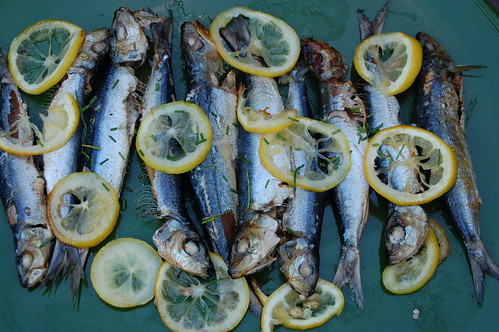
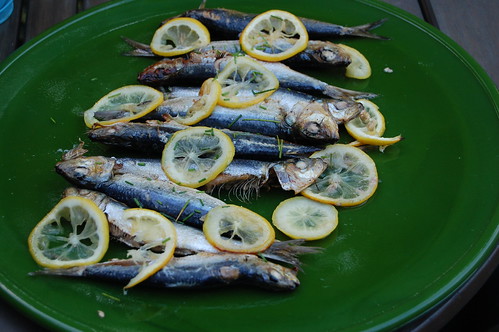
Grilled Lemony Sardines
Fresh sardines are in season now, and I couldn't resist picking some up. Sardines are also one of the few undebatedly sustainable fish left to eat (although I fear someone will dispute me in the comments). I grilled them with whole slices of lemon and a bath of garlicky olive oil.
Having been over-zealous, I faced a week of sardine sandwich eating for lunch. This is not a bad thing: a toasted bun layered with a few leaves of spinach, sardines, grilled whole lemon slices, and goat cheese is a pretty good thing. However, most of my colleagues eat Thai take-out for lunch, and I was sheepishly assembling my sardine sandwich for lunch when a colleague stopped me. He loved sardines he said, and was eager to know where to get fresh ones and how to cook them. Relieved, I explained the following recipe to him.
1 lb fresh sardines, gutted and rinsed
2 large thin-skinned lemons, sliced as thinly as possible
3 tbl olive oil
1 garlic clove, pressed
1 pinch Aleppo pepper
sea salt, to taste
1. Preheat a grill, or preheat your oven to 475 F. If you're using a grill you'll want some sort of grill pan.
2. Combine oil, garlic, pepper, and 1/4 teaspoon salt in a large bowl. Add the sardines and toss to coat.
3. Grease your grill pan or baking sheet. Scatter half the lemon slices on the pan. Spread the sardines over top- try not to crowd them so they cook evenly. Sprinkle with some more salt. Top with remaining lemon.
4. Grill the sardines for about 10 minutes, tossing everything around mid-way through, until sardines are done and lemons are soft. If using the oven it may take 12-15 minutes.
15 July 2009
Halva Mousse
I tried to make halva once, the sesame-paste sweet that is ubiquitous across the Middle East. It was a disaster, a sticky gooey, too soft mess that stuck all over every pan and surface it touched. Sometimes it's better to leave the candy making to the professionals. I often describe halva (halvah/helwa/halaweh) as the Middle Eastern equivalent of peanut butter fudge, only made with sesame seeds and slightly more crumbly. Halvah is made by mixing sesame seed butter (tahini) with a sugar syrup and cooking it to the hard crack stage, but it is a delate operation that involves just-right temperatures and constant even mixing.
Though popular all over the Middle East, halva is often associated with Israel where it has an entire section in every grocery (and where I'm sure Israelis an Arabs argue over the origins of the food, much like the do felafel and hummus). Likewise, halva mousse is found on nearly every menu in Israel, as common as chocolate cake, they range from dense and thick to light and fluffy.
8 oz halva (preferably pistachio variety, or add a 1/4 cup of pistachios)
1/3 cup milk
2 tsp plain powder gelatin
1 pint heavy cream
3-4 tablespoons powdered sugar, to taste
1. Beat the cream to stiff peaks. Add the powdered sugar. Refrigerate until ready to use.
2. Place the milk in a small bowl and sprinkle the gelatin over top and let sit 10 minutes. Heat the milk in the microwave and stir to dissolve gelatin. Combine milk with the halva in a food processor and pulse until fairly smooth.
3. Fold halva mixture into whipped cream. Divide among serving glasses, refrigerate at least an hour before serving.
08 July 2009
Shrimp, Avocado, and Mango Salad
This makes it sound like I haven't been cooking, but I have. Mostly everyday things, I'm trying to whittle down my pantry in the spirit of the new economy, lots of beans and grains and lentils finally being put to use. I've had a few salads of my homegrown (!) spinach and homegrown tomatoes, I made a batch of this white nectarine compote and used it to make turnovers.
There is nothing like hauling boxes and moving furniture all day to work up an appetite, and while slogging through mom's house is a pain (goodness she kept everything), I've found some real treasures too. Like pictures of my mom as a baby, or of the family making homemade ice cream. That's the part I like best, finding things I've never seen before.
Shrimp, Avocado, and Mango Salad
1 mango
1/4 of medium-sized red onion, finely diced
2 tbl finely diced red bell pepper, or hot chili pepper
a few cilantro leaves, finely chopped
3 tbl fresh lime juice
1 avocado, chopped
1/2 lb shrimp, peeled
salt and cayenne pepper to taste
1. Set a large pot of salted water to boil.
2. Peel and slice the mango, working over a bowl. Squeeze the juice from round the pit of mango into the bowl. Add the onion, pepper, cilantro, lime juice and toss to combine.
3. Adjust the heat so the pot of water is just simmering. Add the shrimp and cook until just opaque and curled in 3/4 circles. For goodness sake do not overcook the shrimp into pink rubber bands. Immediately transfer shrimp to a colander and run cool water over them to stop cooking. Dice the shrimp.
4. Add the shrimp and avocado to the mango mixture. Season with salt and pepper to taste. Serve as desired.
Subscribe to:
Posts (Atom)