Showing posts with label Legumes. Show all posts

15 April 2011

Chickpeas with Date Masala

DSC_0257
This blog is named for my love of dates, which often don't make it into a recipe because I'm busy gobbling them all up. However, I've made this chickpea and date recipe several times recently, including for two dinner parties. People rave about it every time.

The recipe is from the New York Times, but being me, I've completely altered it. I moved the spices around a bit for a warmer less sharply spicy feel, and I've increased the masala-to-chickpea ratio. Most of my Levantine Arab friends hate Indian food, a trend I've observed widely, and which I haven't quite figured out. They don't like things that are spicy hot and for some reason the Indian style of cooking doesn't appeal to them (if anyone wants to explain this to me, I'm all ears). But in this recipe I think I've something to appeal to anyone, the dates melt into a luscious thick sauce and the spices are warm and comforting. It's also a snap to make.

DSC_0261


Chickpeas with Date Masala

Serves two very hungry people for lunch, or 4 as a side dish.

3 cups cooked chickpeas (from 2 15-oz cans or cooked from scratch)
1/4 cup olive oil
1 small onion, peeled and finely diced
2½ tablespoons tomato paste
12 medjool dates, pitted and chopped (or another soft sweet variety, like deglet noor)
1/4 teaspoon ground black cardamom
4 teaspoons ground cumin
2 teaspoons kosher salt
1 teaspoon Aleppo pepper
1/2 teaspoon ground ginger
2 whole star anise

1. Drain chickpeas and set aside. Combine all spices (cardamom through star anise) in a small bowl.

2. In a medium pot set over medium-high heat, heat the oil until it begins to shimmer. Add the onions and sauté for a few minutes, until they have softened and started to brown. Reduce heat to medium and stir in the tomato paste. Add the spice mixture and allow to toast for a minute or two.

3. Add the chickpeas, dates, and ½ cup or more of water, enough to make them less than dry. Simmer the mixture for about 30 minutes, stirring occasionally to incorporate the flavors, until the dates have fallen apart and the chickpeas are very tender, you may have to add a splash of water if the pan gets dry. Serve warm.

28 January 2010

Ful - Beans for Breakfast


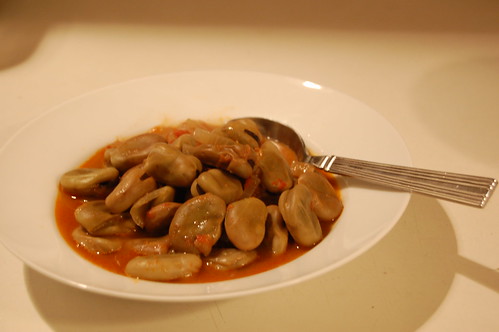
First of all, this is not a recipe for ful medammes. This is a recipe that uses ful, or dried fava beans. Ful medames is the national dish of Egypt, the breakfast beans that people line up around the block for, that workers eat in the morning for breakfast, and revelers eat at 3 am after a night of arglieh and arak. It is popular across the Middle East, but in Egypt it is a simple stew of small pinto-bean shaped aged dried fava beans that is practically a religion.

The most suprising thing about ful, for those cooks raised in the European tradition, is that those are in fact fava beans. No, they are not the delicate soft first-of-spring fava beans that you have to peel twice in a labor of love. No, these fava beans are aged and dried, with a thick tough outer skin and a soft tender interior. Some people actually pull the tough skins off the beans as they're eating, and along side construction sites in Damascus you might see a pile of skins on the ground where the workers ate their lunch.

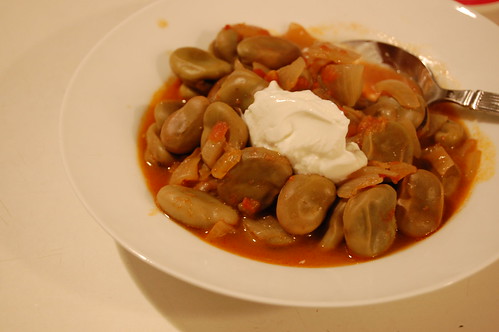
The ful you find in Syria are larger, like the ones pictured here, which I found in the grocery of my very average Safeway, in a foreign looking package. They are usually eaten in a simple stew with bits of tomato and garlic, scooped into pita breads with a squeeze of lemon and washed down with a glass of sugary hot tea. You can also find ful in yogurt, fu on top of hummus, and one of my favorites, ful in a tahini lemon sauce.

If the idea of eating beans for breakfast seems weird to you, think of them more as brunch or lunch, and when served alongside a fried egg they are quite reminiscent of a Mexican pinto bean and tortilla breakfast. Personally, I think beans are under utilized as a satisfying healthy breakfast, so why not start here.

Ful
If you can't find frozen ful (broad beans), you can probably find them dried or canned in your local Middle Eastern grocery. Cook dry beans according to the package directions and then proceed with the recipe.

2 cloves garlic, diced
1 small onion, finely diced
1 small tomato, finely diced
3 tablespoons olive oil
1 teaspoon salt
1/4 teaspoon cumin
1 lb frozen, canned, or cooked from dry broad beans (ful)
a squeeze of lemon
to serve: lemon wedges, pita bread, chopped parsley

1. Place all ingredients in a saucepan and bring to a simmer. Simmer for 15 minutes, until onions and beans are soft. Remove a heaping spoonful of the beans and smash them with a fork, then mix them back into the pot to thicken the dish, Simmer a few more minutes, then serve.

13 August 2009

Mujadara

There are several Middle Eastern recipes that I have not yet posted here for several reasons: a) I don't particularly like the dish (ahem, sheep's feet), b) I lack the special molds, tools or ingredients to make the dish (ma'amoul, kishik), c) it makes a huge amount and I don't have a crowd to feed it to (whole roasted lamb anyone?). And finally, there is a whole slew of dishes that I haven't posted here simply because they are so common and obvious to me that I forget they might be new to someone else. Heck, it took me two years to get a baba ghanoush recipe on this site.

So, while I realize I've been absent from this site due to recent events, I hope to delve more into the both the basics and the more unusual dishes of Middle Eastern cuisine here in the future. I've got a whole bunch of ideas for postings, it's just getting them written down and uploaded. I hope you'll stay tuned.

One example of those most basic of Levantine staples is mujadara- a simple pilaf of rice, lentils and caramelized onions. I hesitated to post it here because it's been blogged about so many times before.

Like so many rice and legume staples- it relies on a simple but key combination of spices and flavors to elevate it from belly-filler to table-decorator. Every cook should know how to caramelize onions, an essential skill that mainly takes patience. Whenever my pantry is bare, leaving me only with some onions lolling in the vegetable drawer and a bit of old bread, I caramelize the onions and eat them over toast, with cheese melted on top. It's delightful.

So mujadara is just rice and brown lentils (cook them separately so they are both done just right), then cooked together with caramelized onions and spices. A simple cheap Mediterranean staple that I finally got around to sharing with you. Sahtain.

Mujadara
I love this dish with dollops of plain yogurt on top, even though it's not traditional it's very, very good.

2 large sweet white onions, thinly sliced
2 tbl butter
2 tbl vegetable oil
1 1/2 cups brown or green lentils (not red lentils or french lentils!)
2 cups long grain white rice
3-4 cardamom pods
1/4 tsp ground cinnamon
1/4 tsp ground cumin
salt and pepper to taste
splash of good olive oil
optional: plain thick yogurt for serving

1. Melt the butter along with the oil and a pinch of salt in your largest skillet, and add the onions. Set heat on medium-low and stir occasionally until very soft, about 30 minutes. Turn heat to medium high and keep cooking and stirring often until deeply browned and sweet, another 20 minutes or more. Deglaze the pan with a splash of water (or more untraditionally white wine), stir and set aside.

2. Meanwhile, cook the rice and lentils separately according to the package directions. Add the cardamom pods to the rice pot while cooking, then discard when done. The lentils should be tender but not smushy or soupy, they should retain their shape.

3. Combine rice, lentils, half the caramelized onions, cinnamon, cumin, salt and pepper in a large pot. Add about half a cup of water and the olive oil and heat everything together until fragrent, warm and combined.

4. Place mujadara in serving dish. Scatter remaining caramelized onions over top. You can also decorate with some toasted pine nuts or chopped parsley. Serve, with plain thick yogurt on the side if desired.

04 January 2008

Never Too Late for Luck


By now, you've probably messed up your first few checks, replaced your calendar, and generally settled into a new year with a big fat round eight at the end of it. I'm not one for New Year's resolutions or much retrospection, but a new month at the start of a new year does encourage a bit of reflection. If you had asked me, I would have probably told you that 2007 involved a lot of waiting, several wrong turns, and a few frustrations. But when (while twiddling my thumbs on the train) I started listing the things that had happened in the past year, it looked like quite a lot:

- I made 20 ice cream recipes
- I left a job and a city I loved
- My significant other of several years became less significant and more other
- I found a new joy instead (albeit one who eats my shoes)
- I learned to do vrschikasana.
- I found a part of my family I had never known before
- I got a new job
- I'm moving to a different city
- I am finally learning to drive (about 9 years after I should have)

There are many more things I could add to that list, but it's quite a bit, really. I'll be starting a new job at the end of the month and will be in Washington, D.C. for the next three years. I'm a bit apprehensive about all of it, but I hope it will be new and exciting and challenging intellectually, plus it will be nice to be able to see my family and friends regularly without the medium of Skype. This blog will continue as usual, and I've already got some things tucked up my sleeve, including one of my absolute favorite Middle Eastern recipes and some other new-to-me discoveries.

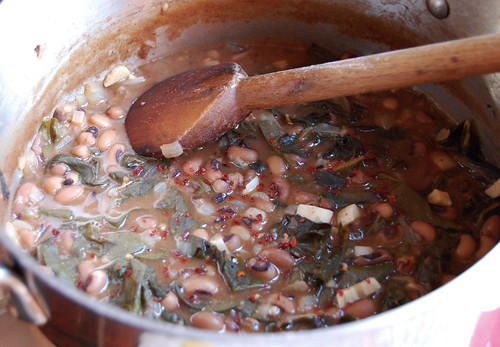
My mom should get a big thanks this year, as she's played host to me in my transition, generously ceding her kitchen to my endeavors and also footing some major grocery bills. In our family, we've always had traditional foods for the new year: black-eyed peas (for seeing into the new year), collard greens (green for greenback$) and cornbread (for gold). I have no idea if any of those symbolisms are verifiable, but I've always liked the idea of them. Imagine my delight when, while traveling in northern Syria, I learned that they also eat black-eyed peas for good luck? In Aleppian Jewish tradition they eat black-eyed peas on Rosh Hashana (the Jewish New Year), usually with veal. The other traditional Syrian preparation of black-eyed peas involves the peas stewed with Swiss chard. This dish is literally a dead ringer for one you might find in the American South: swap the chard for collards and the Aleppo pepper for paprika and you've gone from one half of the world to another. I find these similarities terrifically fascinating, but then again I'm a total nerd.

The new year may have come and gone, but I say it's never too late for a little luck. Plus, this dish is really hearty and delicious: the peas are long-cooked so that they take on a sort of velvety smoothness punctuated by a hint of spice. You can serve it as a thick stew in bowls, dolloped with a little plain yogurt, or as I had it in Syria, ladled over rice.

So here's to 2008 and all the changes it may bring. I hope yours is healthy and happy and I look forward to sharing it here with you. And if you live in D.C. and see a girl in a brand new VW Rabbit, you might be advised to change lanes.


Black-Eyed Peas with Swiss Chard

splash of olive oil
1 thick-cut slice of bacon (optional)
1 medium-sized onion, diced
3 cloves garlic, sliced
1 bunch (~8 stalks) Swiss or Rainbow Chard, ribs removed and leaves roughly chopped
4 cups fresh black eyed peas or 1 1/2 cups dry black eyed peas soaked in water overnight
2 tablespoons tomato paste
pinch of salt
1 teaspoon Aleppo pepper or other mild red pepper

1. In a medium-sized pot, heat the olive oil. Add the onion and garlic (and bacon, if using) and saute until soft and translucent but not browned, 10 minutes. Add the chard, black-eyed peas, tomato paste and enough water to just cover the mixture by an inch and bring to a boil. Season with salt and turn down to a simmer. Simmer, stirring occasionally, for 45 minutes for fresh peas and 1 1/2 hours for dried peas. You may need to add a touch of water- it should be thick and stew-like. Stir in the Aleppo pepper and simmer another 2-3 minutes to combine. Taste for seasoning and serve warm.