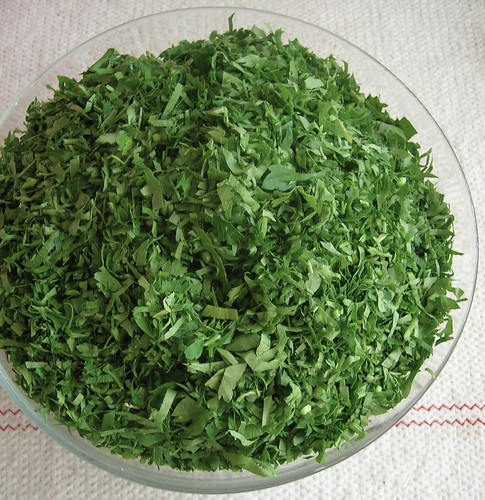
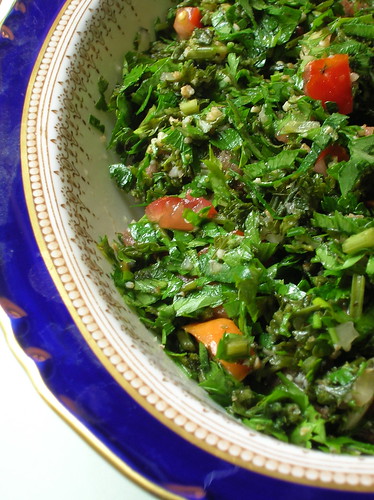
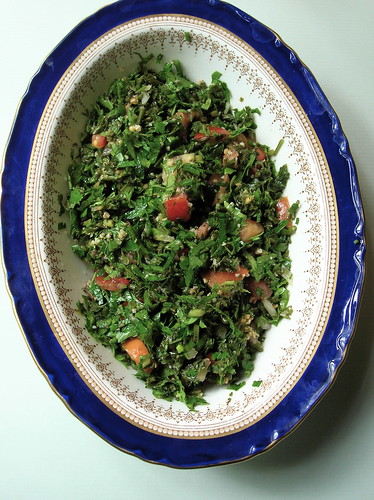
All over Syria and Lebanon, women are chopping parsley. The quiet rhythm of their knives, swish, swish against the cutting board, slicing bunches of verdant green leaves, part of the rhythm of the region. Tabboule is considered the national dish of Lebanon and the pride of Syrian cooks, a salad of bright green parsley flecked with tomatoes, bulgur, mint and lemon. Part of the pride of tabboule is the labor it takes to make it, the parsley must be chopped by hand (a food processor bruises the parsley too much), and it takes
a lot of chopped parsley to make even one serving of tabboule. So having someone over for tabboule is a special occasion and an honor- I love this idea, when was the last time someone invited you over where the celebrated dish was salad, when have you seen pot-bellied men clap in delight at a bowl of greens?
When I would make tabboule with
Umm Hana, we'd spread a cloth and sit down on the floor and set to work chopping, often working several days ahead of time. Children would run in and out as we chopped and chatted, drinking tea, neighbors or friends might stop by to visit and even join in the labor. A good bowl of tabboule is a delight, whether gulped lustily with a spoon, scooped with elegant lettuce leaves, or eaten with thin pita bread, squeezing the bread to absorb the lemony dressing.
This is a continuation of my discussion about misappropriated Arab foods, last time we talked about
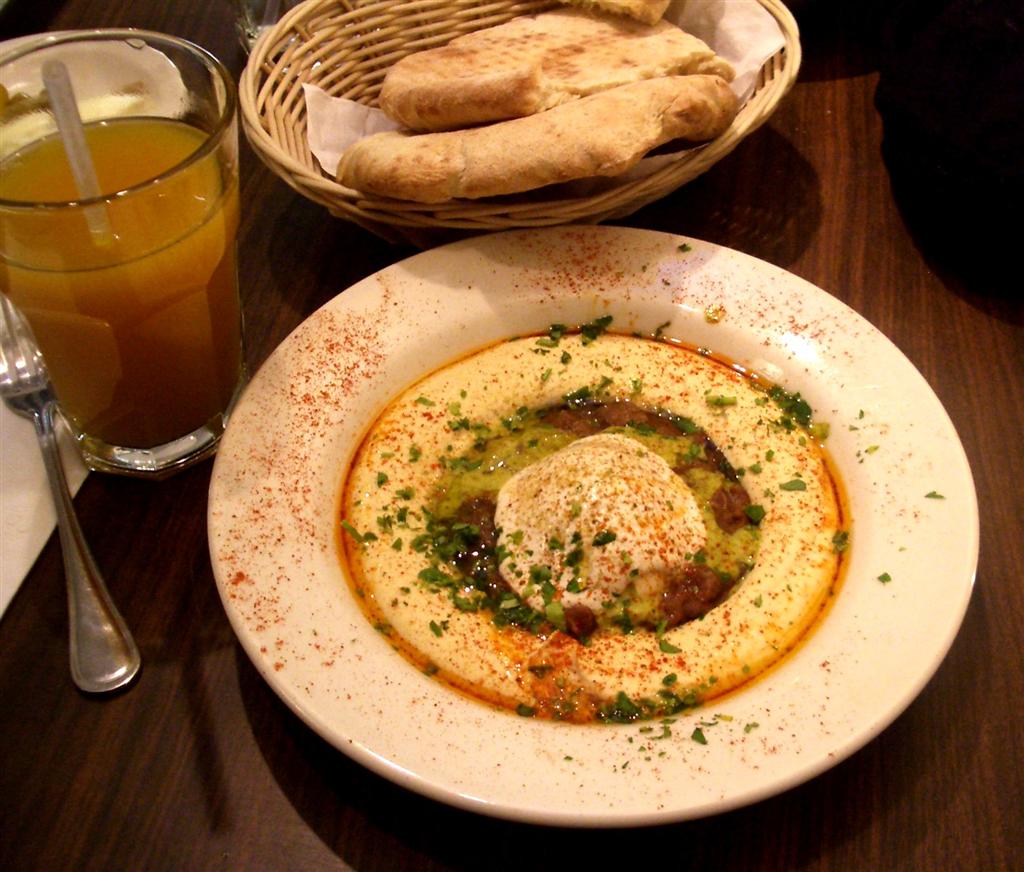
hummus, and I want to thank everyone for their passionate responses, I loved hearing your experiences. Now, we're talking about the even-more-maligned tabboule, which so often marauds as a bulgur salad in the West.
No, no, no, I want to shriek, tabboule is parsley salad with just a little bit of bulgur. Now granted, there are regional variations, and there is a 'Turkish tabboule' which is primarily bulgur, but tabboule is
not synonymous with bulgur salad. Here are some tips for making traditional tabboule:
-
Parsley should remain the primary ingredient, not bulgur.- The parsley should be chopped by hand (I give tips on how to do this below).
- Use a generous amount of olive oil- you need a lot of oil to coat all those little parsley pieces, and don't balk, it's good for you (besides, parsley's a diuretic). You'll also need a complimentary amount of fresh lemon juice, there should be a bit of dressing floating in the bottom of the dish (great for smushing your bread into).
- Traditionally, there is no garlic in tabboule. Also, no cucumber or red peppers please.
- Tabboule is best when served about an hour after it's made- it needs time to rest for the parsley to soften, but if you wait too long it well get soggy.
When I first came to visit my mother after living in Damascus for a year, she joked that I was always chopping herbs in my spare time. She was right, I'd snatch a bit of down time to chop the parsley for that salad I so craved. Sometimes, I'd buy a box of prepared 'tabboule,' then buy a big bunch of parsley, chop it up, and stir them together with some extra lemon juice. I still like chopping herbs, the soothing rhythm of it, the smell of freshness. So if you want tabboule, I'd suggest you sharpen that knife and get to work, there's chopping to be done.
I'd like to point out that the parsley, mint, and tomatoes in the above photo were taken from our garden, talk about a home-made dish! And as always, your own comments and experiences making and eating tabboule are welcome! TabboulehWith a little experience you can estimate the quantities of ingredients by eye when making tabbouleh. However, because bunches of parsley and the size of tomatoes can vary greatly, I give measurements in cups here to ensure the proper ratio of ingredients.
Bulgur is available in the grocery next to the couscous and rice, it is often in a box labeled 'tabboule mix.' You can also find bulgur at your local ethnic market, where it will probably come in grades of coarseness, you want grade 3 or 4.1/2 cup coarse bulgur
5 cups finely chopped flat-leaf parsley (see instructions)
1 cup finely chopped scallions
1 1/2 cups diced tomatoes
1/2 cup finely chopped mint leaves
3/4 cup lemon juice
3/4 cup olive oil, or more as needed
salt, pepper, and allspice to taste
1.
To chop parsley: Sharpen your knife. Gather several stems of parsley in your hand. Pull the stem ends down so that all the leaves are clustered evenly together (see photo). Gather the leaves closely together and press against a cutting board. Holding the leaves in place with your left hand, use your right hand to
very thinly slice the parsley leaves. Once you've chopped that bunch, you can go back and chop a few remaining big pieces, but avoid going back over the parsley, as further chopping will result in bruised leaves. Continue with remaining parsley, placing chopped leaves in a bowl. This can be done over 1-2 days, storing parsley in the refrigerator.
2. Bring 1 cup of water to a boil. Pour over bulgur in a bowl and let sit at least one hour, until softened.
3. In a large bowl combine the parsley, scallions, tomatoes, and mint leaves. Fold in the bulgur. Stir in the lemon juice, olive oil, salt, pepper, and allspice to taste. Refrigerate for 1/2 hour to one hour before serving. Serve with small lettuce or endive leaves as scoops.
See also:
Clifford Wright's Tabboule__________________