Showing posts with label Aleppo. Show all posts

16 September 2010

Kebab Karaz (Cherry Kebabs)

DSC_0268

This dish is a specialty of Aleppo, Syria, where sour cherries are prevalent. I ate this dish for the first time at the famous Beit Sissi in Aleppo, a must-visit for anyone interested in Levantine cuisine. I'd never made kebab karaz because sour cherries are very hard to come by in my neighborhood. But if you're determined, possessing of friends from Michigan, or willing to order frozen or canned cherries, it is possible to get your fix. You can check out Middle Eastern or Persian/Pakistani groceries too.

At its simplest version, kebab karaz involves stringing sour cherries and little meatballs on a stick and grilling them. The idea is always to have the cherries and the meatballs approximately the same size. In a slightly more complicated version, you make a sauce with the cherries and add the grilled meatballs to it afterwards, and in the most complex version, you make kibbeh (follow this recipe) and then add it to the cherry sauce.

DSC_0260DSC_0263

I prefer the middle version, since it's easy and the cherry sauce that coats the meatballs is a beautiful glistening red, and delicious. The photo here really does not do it justice. I'm not a big eater of red meat, and yet I made sure I got the last portion of this to take for my lunch the next day. I think that says a lot.

DSC_0266

Kebab Karaz (Cherry Kebabs)

Be sure to serve this over flattened pieces of pita bread, or over rice, to absorb the juices.

1/2 an onion, finely diced
4 cups sour cherries, pitted
2 generous tablespoons pomegranate molasses
2 tablespoons sugar, or to taste
1 pound ground lamb or beef
2 teaspoons baharat
1/2 teaspoon cinnamon
1/2 teaspoon cumin
2 teaspoons salt
black pepper to taste
cilantro, pine nuts, for garnish

1. Prepare meatballs: knead the meat and remaining ingredients together until the mixture is smooth and sticky (you can also pulse it in the food processor if you want. Shape the mixture into balls the same size as large cherries and string onto kebab skewers. Refrigerate.
2. Preheat grill.
3. Saute the onion in some olive oil in a large skillet until it is translucent and tender. Add in the cherries, pomegranate molasses, and sugar and stir to combine. Simmer for 5-10 minutes, just to combine.
4. Grill the meatballs until nicely browned on the outside and cooked through. Add meatballs to the cherry sauce. Garnish with cilantro and pine nuts as desired. Serve immediately over rice or bread.

01 January 2010

New Year Vegetable Plate


This year was my first time spending the holidays without my mother, and I'll admit I was terrified. I pictured myself, the child with no parents, no siblings, no grandparents, lonely and sad on the holidays. And you know what? It was fine. There was Thanksgiving in Texas with my uncle, and Christmas with wonderful friends, and someone even made me a stocking, and gifts of cookbooks, and kobenstyle pans, and novels and jewelry. And it all went by, and I have to say it was pretty fun.

And at the same time I was stuck with this nagging feeling, the feeling that it just wasn't the same. That without my mom, Christmas will never feel like it used to, there will never be all those presents with her handwriting under the tree, or her silly wearing of the those crowns that come with firecrackers at Christmas dinner. And what I felt wasn't so much sadness, but rather this clear delineation between childhood and adulthood. This stark black line between 2008 and 2009 that said now you have to fend for yourself. Some people never have this line, some people slip between childhood and adulthood in a series of slow transitions, they go from spending Christmas with their parents to spending Christmas with their own children and a slow natural progression. They do not have the black line.

I think of 2009 as the year I spent mirred amidst the headlines. As the news droned on about the housing crisis, I fought with mortgage companies to sell my mother's house, perplexed at how the act of giving them their money could be so confoundingly complex. I filed claims with health insurance companies while 3 blocks away the House and Senate debated much needed health care reform. And in the midst of all this, I packed pounds of body armor into my car, and sent the boy I love off to Afghanistan. I think we need some better headlines.

I'm glad 2009 is over. For the new year, it would be traditional for me to make hoppin' john, and greens, and cornbread. But I went to the store yesterday, and I just bought all sort of vegetables, because I thought this year needs a new start. A healthy, vitamin-enriched way to begin the year. And so I present to you, the new year vegetable plate.

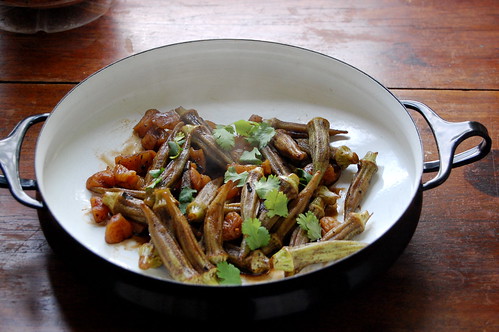
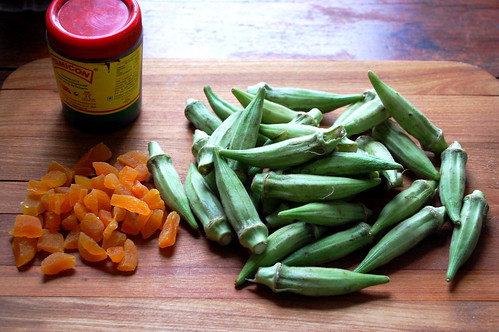
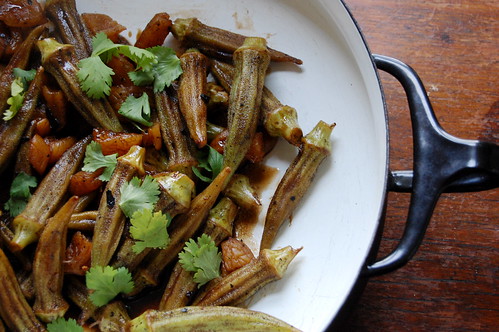
We have pan-roasted brussel sprouts, mashed carrot salad with feta and coriander, braised red cabbage, and okra with apricots and prunes. The okra is a traditional Syrian recipe from Aleppo, a place where ingredients like apricots and tamarind paste are common fare. The most popular Syrian preparation for okra is a simple stew with tomatoes and olive oil (bamia b'il zeit), but I like the sweet-sour profile or this recipe. I chose the tiniest okra possible, which I think reduces sliminess and helps them cook quickly. It's a nice compliment to a plateful of vegetables.

Hello 2010. I'm looking forward to it.


Okra with Apricot and Prunes
The okra you get in Syria are so tiny they can be the size of the tip of your pinky, so we never trimmed the ends. However, if your okra are larger the ends may be tougher, you can trim the tips before cooking, or I prefer to leave them on and just trim them as I'm eating. This is definitely a recipe for okra-lovers, so just keep that in mind.

12 oz whole baby okra, as small as possible
splash of olive oil
1 tablespoon tomato paste
1 teaspoon tamarind paste
juice of half a lemon
1/2 cup water
1/8 teaspoon salt
1 pinch sugar
1/2 cup chopped dried apricots
1/2 cup chopped prunes

1. Combine the tomato paste, tamarind, lemon juice, water, sugar, and salt in a small bowl
2. Heat the olive oil in a saute pan over medium-high heat. Add the okra, tossing to coat, and saute until the okra is browned in spots and beginning to soften.
3. Add the water mixture and add the apricots and prunes. Bring to a boil, and then simmer for 15-20 minutes, until the sauce has formed a thin glaze and the okra are cooked through.
4. Serve immediately, perhaps over rice.

19 September 2009

Muhammara


We returned from a lovely (if hot) vacation in Malta, spent a day in DC, and then left the following evening for Seattle for a wedding, plenty of good food, and some kayaking. And then I came back to DC and went back to work, and I'm still trying to sort through the massive pile of mail, catch up on bills and emails, and mainly just figure out what time zone I'm in.

Oh, and I need to update the blog.

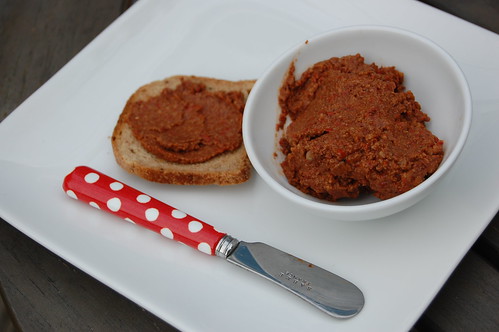
And of course the one recipe I want to tell you about, the recipe just waiting in the queue wondering when, oh when, will she finally get home from vacation so I can get posted? Well, what happened is what often happens, I made the recipe for a party, everyone loved it and devoured it, and I forgot to take a picture of it until the next day, when all was left was this measly little dab. See:


So, pathetic pictures aside, that's muhammara up there, and you should really get to know her. Muhammara, the word coming from the Arabic for red, is a spicy dip made of roasted red peppers, walnuts, and chile flakes. It has this sort of amazing dense nutty texture that comes from the walnuts and the handful of breadcrumbs that are added to the dip. Muhammara is a specialty of Aleppo, Syria, which is unique among Middle Eastern cuisines for it's use of fiery spices, especially the famous Aleppo pepper. If you don't have Aleppo pepper I'd really recommend you seek it out, as it is both spicy and subtly smoky. But if you don't have any, a mix of half paprika, half red chile flakes will do in a pinch.

The nice thing about muhammara is that while it's excellent spread on bread, it has a myriad of other uses too. Add it to a sandwich with some sliced avocado and baby lettuces, slather it on top of pan-roasted chicken, or use it as a sauce for fish.

So, at least I've gotten you this recipe, and I've also figured out today is Saturday. I hope to get around to telling you about the delicious eats of our trips, as soon as I figure out what time zone it is again.

Muhammara
Pomegranate molasses and Aleppo pepper are available at Middle Eastern groceries.

1/2 cup walnuts, toasted
2 tbl tomato paste
1 1/2 tbl pomegranate molasses
1 teaspoon Aleppo pepper
2 medium or 3 large roasted red peppers
1 teaspoon cumin
3/4 cup bread crumbs
pinch each sugar and salt

1. If you are roasting the peppers yourself, roast them, then peel off the skins, core and remove the seeds. You can also use jarred roasted peppers
2. Pulse the walnuts in a food processor until the resemble the texture of coarse meal. Add the tomato paste, pomegranate molasses, Aleppo pepper, roasted peppers, and cumin and process until yo achieve a relatively smooth mixture. Add in the bread crumbs and season to taste with sugar and salt. Pulse everything to combine.
3. Refrigerate at least two hours before using to allow the favors to meld and the red crumbs to soak into the dip. Serve at room temperature with pita bread or as desired.

05 March 2008

The Power of Kebab


Never underestimate the power of a good kebab. Regular readers here may have noticed I don’t eat a lot of meat, I’m not a vegetarian and I eat plenty of seafood, but meat just isn’t to my taste. I’d probably forget about it completely if it weren’t for other people reminding me and a once-a-year hankering for a BLT. But while living in Damascus, there was one meat dish I could always be counted on partaking in, one carnivorous dish I truly loved. Kebab halabi, or Aleppo-style kebabs.

Before we talk about those kebabs, however, it’s important to backtrack and talk about kebabs in general. How unfortunate is it that outside the Middle East people think of kebabs as chunks of things stuck on skewers, how drab, how boring, how limited. No, no, no, I always want to say, you are missing out on the best kebabs! You see, most often the favored kebabs are those made with ground meat. Both kinds of kebabs are available, the kind made with chunks of skewered meat are known as shish kebabs (from the Turkish sis) and the kind made with ground meat are called kefta or kofte kebabs. It is no wonder that kefta kebabs are the favorite kebabs because when you think about it they are really just like hamburgers only made into a different shape. The meat for these kebabs is most likely lean ground beef or lamb, and occasionally camel.

The second key element of eating kebabs is presentation. You do not simply plop the kebab down on a plate all naked and alone. No! Kebabs are always placed over pita breads, which have often been rubbed with a little tomato paste, and then they are usually covered with more bread over top. Just like when you order a hamburger you expect a bun and some ketchup, when you order kebabs you expect it to be sandwiched with those tomato-rubbed flatbreads. And those breads which have absorbed the kebab juices, they’re my favorite part.

At a kebab house, you’ll be presented with a variety of choices of kefta kebab. Most of the choices are named after geographical locations and refer to how the kebab will be seasoned, kebab Istambouli includes pine nuts in the meat mixture, while Izmirli includes cubes of cheese interspersed between the meat. I’ve always been rather fascinated by this, who, for example, decided that Anataklia was synonymous with eggplant or Anatbli with mushrooms?

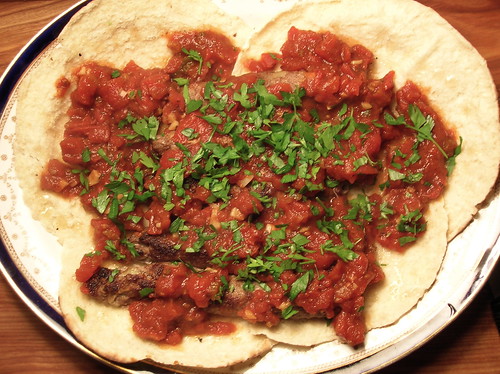
So what’s so special about those kebab halabi, the Aleppo-style ones? Well, the kebabs themselves have chopped parsley in them, but the best part is the spicy thick tomato sauce they come bathed in. Tongue-tinglingly spiced with the famous Aleppo pepper, that chunky tomato sauce transforms the kebabs into one of my favorite meals.

All the time I’ve lived, worked, and studied in the Middle East, my mom has never come to visit me. She’s practically refused to travel to the region, preferring to send my uncle as an envoy. She’s heard a million stories, seen a plethora of my pictures, and knows more about daily life there more than most Americans, but traveling was never on her agenda. I made Aleppo-style kebabs for dinner together one night, and as we sat and I explained about all the kinds of kebabs, she said “you know, I think I might like to visit there one day.” Just as I said, never underestimate the power of a good kebab.


Aleppo-Style Kebab
While traditionally made with lean meat, I think it’s fine to make these kebabs with a fattier meat, like a shoulder cut of lamb, just make sure to keep an eye on the grill as any dripping fat can cause flare-ups. We make these all the time in the winter using the broiler as well.

2 lbs ground lamb or beef, preferably very lean
2 medium-sized onions, grated or pulsed in a food processor
1/2 cup chopped flat-leaf parsley
1 teaspoon each cinnamon, allspice
salt and pepper to taste
for the tomato sauce:
1/4 cup olive oil
6 garlic cloves, sliced
1/4 cup tomato paste
1 28-ounce can diced tomatoes
1 to 2 teaspoons Aleppo pepper, or substitute a mixture or red pepper and paprika
1/2 teaspoon sumac or lemon zest
to serve:
pita bread (the very thin kind)
lots of chopped parsley

1. Place all the kebob ingredients in a large bowl. Knead the mixture with your hands for 5-10 minutes. The mixture will change consistency and become quite sticky (the nature of the proteins in the meat have changed, which is what you want). Cover the mixture and refrigerate for at least half an hour.
2. Make tomato sauce: Heat the olive oil in a large pan. Add the sliced garlic and cook over low heat so that the garlic softens but does not brown. Add the tomato paste, stirring so that it lightly toasts, then add the chopped tomatoes. Season with salt, pepper, and sumac. Simmer the mixture for about 20 minutes until it forms a nice chunky-thick sauce. Taste for seasoning (it should be pleasantly spicy) then set aside.
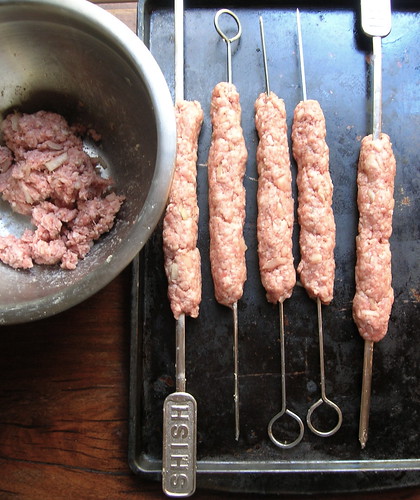
3. Preheat a grill or broiler. Have the tomato sauce warm, but not piping hot. Using damp hands, form the kebabs around metal skewers (they may want to fall off at first, just work the meat mixture around the skewer with your hands until it is cohesive). Grill or broil the kebobs for 8-10 minutes, turning once.
4. Open up half the pita breads. Use the breads open-side up to line your serving platter. Slide the kebobs off their skewers onto the bread (if you used a broiler and there are some meat juices on the pan, pour them over the bread as well). Spread the tomato sauce over the kebabs. Sprinkle chopped parsley over the platter. Serve, making sure everyone gets some of the bread, kebab, and sauce, with extra pita bread alongside.

10 February 2008

An Apple By Any Other Name

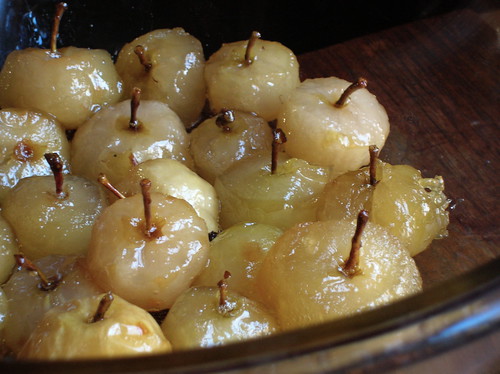
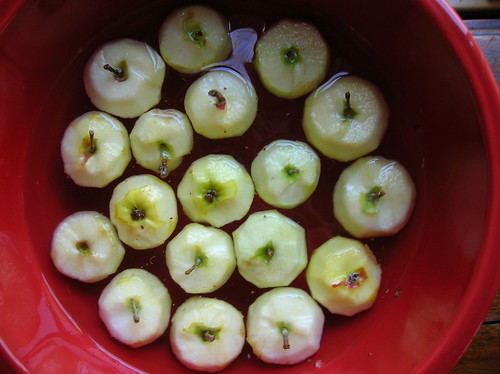
This recipe has been knocking around in my files for about thirty-eight days, waiting for me to tell you about it. It has not been forgotten because it's not delicious (it is) or difficult (it isn't), and it's not that I don't have anything to say about it, I do. Problem is I don't know what to call this recipe. Candied baby apples? Glazed apples? Glaceed apples? None of those quite work. Lady Apples in Syrup, maybe...

Instead, let's talk about these lovely sweets. There is a tradition in the Middle East, and in fact across the Mediterranean, of preserving tiny fruits in syrup. It is quite similar to jam, but the fruits are usually kept whole and cooked in a syrup, in Greece this is called "spoon sweets." Unlike jam, where less-than perfect fruits are cooked down, the tiniest prettiest fruits are chosen for cooking in syrup, thereby preserving their beauty. They are often offered to guests, on a small plate topped with a bit of yogurt or thick cream. Standard are tiny lady apples, little pears no bigger than your thumb, teensy apricots, and figs. Dates, watermelon rinds, nuts and kumquats are other options. I've written before about the beautifully spiraled rolls of Seville orange and grapefruit peels which are cooked in the same process. And most fascinating, this technique isn't just limited to fruits, but used for vegetables too: chunks of pumpkin, tomatoes, and even the elegant baby eggplants are candied in syrup (there's a recipe in Aromas of Aleppo if you're interested).


At fancy sweet shops you might see these preserved whole fruits drained and individually wrapped in plastic, but the more home-style version is to leave the fruits in the syrup and can them or keep them in jars. Here I've used tiny lady apples that are in season now. I read recently that you should peel the apples, something I'd never bothered with before, so I tried peeling half of them, and I can tell you there's barely a difference and it is certainly not worth the effort. It is, however, essential that your core the fruits, or you'll get a mouthful of seeds, a tiny melon baller is the best tool for this.

So there you have it. Now that you know all about these sweets in syrup, you can decide what to call them yourself. I suppose a name isn't that important as long as they're as tasty as these are.


Lady Apples in Syrup
Though you want small apples for these sweets, keep in mind you have to core them, so you don't want teeny-tiny apples or you won't have any flesh left. The apples can be served as dessert on their own and also make great gifts in jars.

2 lbs lady apples
4 cups sugar
4 cups water
2 tablespoons orange blossom water or lemon juice

1. Working from the bottom of the apples, cut a cone out of the bottom, then use a small melon baller to scoop out the seeds from the center. Leave the stem attached on the top.
2. Place sugar, water, and orange blossom water in a wide deep pot. Bring to a boil, stirring so the sugar dissolves. Let boil gently for about five minutes so that the syrup is thick and viscous. Add the apples, stirring to combine. Lower the ehat and let the apples simmer gently in the syrup for 35-45 minutes. The apples should become translucent and soft but should not fall apart. The syrup will reduce somewhat but should not darken in color.
3. Remove apples with a slotted spoon to jars. Pour syrup over top. (If the syrup seems thin, you can continue to boil it until it thickens up a bit, but this shouldn't be necessary). Store in the refrigerator. Serve at room temp, with yogurt or clotted cream.

04 January 2008

Never Too Late for Luck


By now, you've probably messed up your first few checks, replaced your calendar, and generally settled into a new year with a big fat round eight at the end of it. I'm not one for New Year's resolutions or much retrospection, but a new month at the start of a new year does encourage a bit of reflection. If you had asked me, I would have probably told you that 2007 involved a lot of waiting, several wrong turns, and a few frustrations. But when (while twiddling my thumbs on the train) I started listing the things that had happened in the past year, it looked like quite a lot:

- I made 20 ice cream recipes
- I left a job and a city I loved
- My significant other of several years became less significant and more other
- I found a new joy instead (albeit one who eats my shoes)
- I learned to do vrschikasana.
- I found a part of my family I had never known before
- I got a new job
- I'm moving to a different city
- I am finally learning to drive (about 9 years after I should have)

There are many more things I could add to that list, but it's quite a bit, really. I'll be starting a new job at the end of the month and will be in Washington, D.C. for the next three years. I'm a bit apprehensive about all of it, but I hope it will be new and exciting and challenging intellectually, plus it will be nice to be able to see my family and friends regularly without the medium of Skype. This blog will continue as usual, and I've already got some things tucked up my sleeve, including one of my absolute favorite Middle Eastern recipes and some other new-to-me discoveries.

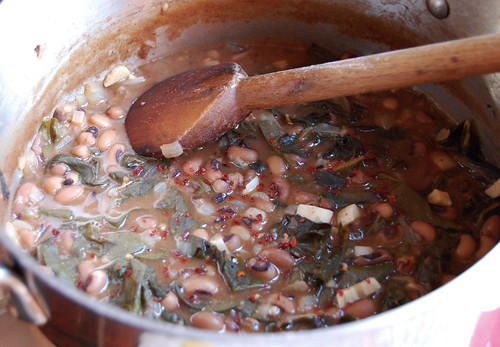
My mom should get a big thanks this year, as she's played host to me in my transition, generously ceding her kitchen to my endeavors and also footing some major grocery bills. In our family, we've always had traditional foods for the new year: black-eyed peas (for seeing into the new year), collard greens (green for greenback$) and cornbread (for gold). I have no idea if any of those symbolisms are verifiable, but I've always liked the idea of them. Imagine my delight when, while traveling in northern Syria, I learned that they also eat black-eyed peas for good luck? In Aleppian Jewish tradition they eat black-eyed peas on Rosh Hashana (the Jewish New Year), usually with veal. The other traditional Syrian preparation of black-eyed peas involves the peas stewed with Swiss chard. This dish is literally a dead ringer for one you might find in the American South: swap the chard for collards and the Aleppo pepper for paprika and you've gone from one half of the world to another. I find these similarities terrifically fascinating, but then again I'm a total nerd.

The new year may have come and gone, but I say it's never too late for a little luck. Plus, this dish is really hearty and delicious: the peas are long-cooked so that they take on a sort of velvety smoothness punctuated by a hint of spice. You can serve it as a thick stew in bowls, dolloped with a little plain yogurt, or as I had it in Syria, ladled over rice.

So here's to 2008 and all the changes it may bring. I hope yours is healthy and happy and I look forward to sharing it here with you. And if you live in D.C. and see a girl in a brand new VW Rabbit, you might be advised to change lanes.


Black-Eyed Peas with Swiss Chard

splash of olive oil
1 thick-cut slice of bacon (optional)
1 medium-sized onion, diced
3 cloves garlic, sliced
1 bunch (~8 stalks) Swiss or Rainbow Chard, ribs removed and leaves roughly chopped
4 cups fresh black eyed peas or 1 1/2 cups dry black eyed peas soaked in water overnight
2 tablespoons tomato paste
pinch of salt
1 teaspoon Aleppo pepper or other mild red pepper

1. In a medium-sized pot, heat the olive oil. Add the onion and garlic (and bacon, if using) and saute until soft and translucent but not browned, 10 minutes. Add the chard, black-eyed peas, tomato paste and enough water to just cover the mixture by an inch and bring to a boil. Season with salt and turn down to a simmer. Simmer, stirring occasionally, for 45 minutes for fresh peas and 1 1/2 hours for dried peas. You may need to add a touch of water- it should be thick and stew-like. Stir in the Aleppo pepper and simmer another 2-3 minutes to combine. Taste for seasoning and serve warm.

13 December 2007

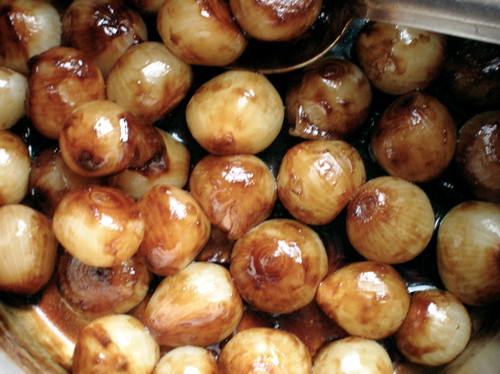
Tamarind-Glazed Pearl Onions

Tamarind is a sweet-tart fruit that comes from the pods of tamarind trees. Though native to Africa, tamarind is used in Middle Eastern cuisine, most commonly in the form of a tamarind drink. Aleppo, in northern Syria, is famous for its highly developped cuisine which is quite distinct from other parts of the region. The Arab name for Aleppo is Halab, derived from the word for milk (haleeb) on account of its excellent dairy products, it seems Aleppo has always been associated with great food. There are several key ingredients that are hallmarks of Aleppian cuisine: smoky-hot spices in the form of Aleppo pepper, plenty of red peppers, tart tangy pomegranate molasses, and the use of tamarind concentrate. These aspects of Aleppian cuisine developped as a result of many factors: Aleppo was a major city on ancient trade routes like the Silk Road, also the presence of Armenian immigrants, nearby Kurds and a strong Jewish community (though no longer extent) have all contributed to a unique repertoire of dishes.


Tamarind came to the Middle East by way of India, where it is popular, hence its name in Arabic tamr hindi, or Indian date. In Aleppo, the tamarind concentrate made by extracting the thick viscuous syrup from the fruit’s pulp is known as ou. Ou is an important ingredient in everything from soup broths to tomato sauces to bulgur salads. In a uniquely Aleppian dish called mehshi basal, onions are formed into rolls stuffed with a meat mixture, and then simmered in a tamarind sauce. A simpler version involves small baby onions simmered in that sweet-sour sauce.

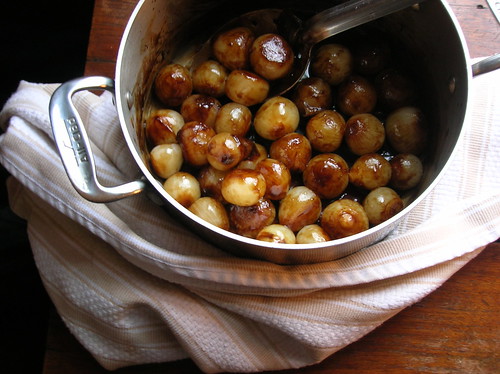
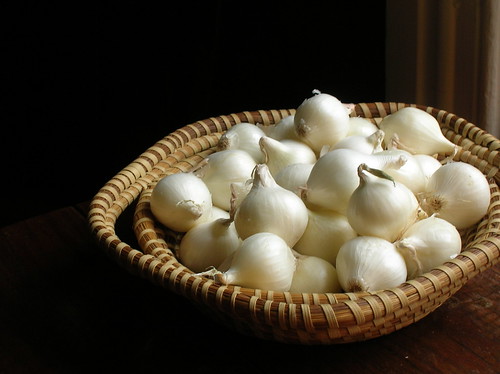
I prefer this second (albeit less traditional) version, not only because it’s easier, but mainly because I love pearl onions. We always have little baby onions at the holidays, and the poor person who volunteers to help me in the kitchen usually gets stuck with the task of peeling them (and I wonder why they stop asking?). These tamarind glazed onions are quite similar to the popular Italian cippoline in agrodolce but I like the way the sauce is even thicker and tangier than those made with balsamic vinegar. The recipe’s provenance may be far away, but spearing them with a fork as they slippery-slither across the plate, crashing into the potatoes, the onion layers bursting from inside each other, and finally using the last bit of sauce to coat your entree, it tastes like the holidays to me.


Tamarind-Glazed Pearl Onions
Tamarind concentrate is available at Whole Foods and international markets, it keeps well and has many uses so it's a great addition to your pantry. This Syrian version of sweet-and-sour onions has a great thick and tangy sauce.

2 pounds white pearl onions (about 30)
3 tablespoons extra-virgin olive oil
3 tablespoons tamarind concentrate
1 tablespoon lemon juice
3-4 tablespoons sugar, to taste
pinch of salt

1. Heat a large pot of water to boiling. Trim off the base and tips of the onions. Submerge the onions in the water and let boil 7 minutes. Drain the onions into a colander and rinse with cold water. Slip the peels off the onions.
2. Heat the olive oil in a saucepan. Add the peeled onions and saute over medium heat for 5 minutes, until just browned. Add the tamarind, lemon, sugar and salt and cook until the mixture caramelizes and turns sticky, 3-5 more minutes. Taste for seasoning. Serve at room temperature.

P.S. If you don't have tamarind concentrate on hand, the recipe works perfectly well using balsamic vinegar instead.
____________________________________