Showing posts with label Yeast Breads. Show all posts

12 April 2012

Paul's Easter Challah

DSC_0027
DSC_0036

Paul's Easter Challah - we used the challah recipe from Peter Reinhart's bread book and we found that it was too dry. So no recipe for today, but I thought it was pretty to share.

In the future, I would have mixed the food coloring into the liquid mixture when making the bread (in this case the liquid mixture was eggs + water + oil). We tried to knead the food coloring into the dough after it was formed and it didn't quite distribute evenly.

10 July 2011

Turkish Pide Bread

DSC_0143

Pide bread is the Turkish version of flatbread. It is puffier and richer than other flatbreads in the region, and totally delicious. Traditionally shaped in a long flat oval, it can also serve as a bed for toppings, such as roast eggplant or tomato and cheese, the Turkish version of pizza. Pide bread can also serve as a vehicle for kebabs, placing the long kebab over the long pide bread and topping the whole thing with grilled tomatoes and peppers and chopped parsley.

DSC_0145

The plain pide bread is either roughly dimpled with your fingers or scored with a knife in a cross hatch design. My pide shaping skills still need some work. Like most flatbreads, these are best the first day they are made, but they keep well and can refresh nicely when reheated in the oven or toaster.

DSC_0147

Pide Bread

Adapted from Annisa Helou.

2 1/4 teaspoon yeast (1 package)
3 cups flour
2 teaspoons sugar
2 teaspoons salt
2 tablespoons olive oil
warm water

optional: egg wash, sesame seeds

1. Dissolve yeast in 1/4 cup warm water in a large bowl. Stir in the flour, sugar, salt, and oil. Gradually add 2/3 cup warm water to form a dough. Knead the dough to form a smooth elastic ball of dough, about 10 minutes.
2. Rinse out the bowl, oil it, and cover with plastic wrap or a damp towel and allow the dough to rise in a warm place for 1 hour. Punch down the dough and let rise another 45 minutes.
3. Preheat oven to 425 F. Grease a baking sheet, divide the dough into long oval loaves (you can make one very long loaf or several smaller ones). Place on the baking sheet, cover with a damp towel until the dough is slightly puffed, 10 minutes. Dimple the dough with your fingers. If desired, brush with egg wash and sprinkle with sesame seeds. Bake 20 minutes for smaller loaves, 30 minutes for one large loaf, or until golden and firm. Eat fresh.

01 March 2011

Currently Eating: Manoushe bi Kishik


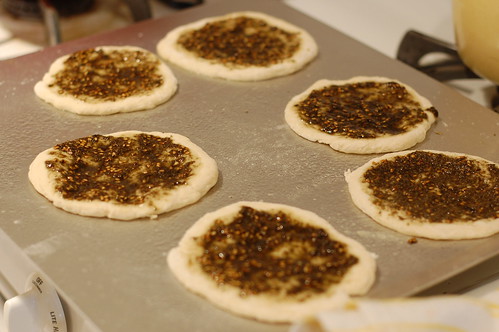
This is manoushe bi kishik, or a flatbread with kishik. Kishik is made by mixing yogurt and bulgur and letting it ferment. Kishik can be served fresh (mixed fresh and only a few days old, which you'll find in Middle Eastern cheese shops). Or kishik can be dried completely in the sun, and then ground to a powder. This powder is then rehydrated as a soup or sauce and has a very distinctive sour taste.

Pictured is a very traditional kishik flatbread, where kishik powder is mixed with tomato paste, olive oil, and sesame seeds and spread on bread. It's very mild and quite delicious.

02 September 2010

Pita Bread

DSC_0159
Believe it or not, despite the fact that I make homemade bread every few weeks, and despite that I've made Middle Eastern breads like mishtah and qurban, I've never actually made pita bread. In my defense, very few people in the Middle East make their own pita bread either.

DSC_0148DSC_0150
DSC_0151DSC_0158
One of my favorite routines in Damascus was to go to my local bakeries, where the fresh baked bread tumbled down on a sort of bread escalator, and was sold to a waiting crowd by the ounce (see pictures here). Young boys could be seen carrying stacks of bread taller than themselves while simultaneously munching on a round of fresh baked khobz.

Old ladies could be found practicing a bizarre form of bread maintenance on view across the Middle East: spreading their fresh bread out to dry on whatever surface available. And yes, that included spare railings, cars parked on the street, and even patches of sidewalk. As unhygenic as it might sound, there is a logic here: fresh baked bread releases steam, and if you immediately stack all your breads together that steam will lead to moisture and to mold.

But on to making pita bread. It won't ever be the super-thin large rounds you find at a Middle Eastern bakery, but homemade bread has its own puffy charm. As for getting your breads to puff, I have no special tricks here. Like making pancakes, the first few never quite turn out right, but luckily even the un-puffed ones are just as tasty.

DSC_0156
Pita Bread (Khobz)
It is important that the dough is very moist, and it helps to have a moist environment in the oven, so spritz a bit of water in there if necessary. However, don't worry about the dough being too wet, it's okay to have a little flour on the dough to keep it from sticking to the baking surface. Keep in mind pita bread goes bad pretty quickly, so keep it in a sealed moisture-free bag, and store it in the fridge after the second day or so.

3 cups all-purpose flour, plus 1/4 cup more for kneading (16 oz. total)
2 teaspoons salt
2 teaspoons instant yeast
2 tablespoons olive oil
1 1/4 cups water, at room temperature (10.4 oz.)

1. Mix all ingredients with wooden spoon. Knead the dough in the bowl until it comes together. Sprinkle the additional flour on a work surface, turn dough out and knead until the dough is smooth and slightly sticky, at least 5 minutes. Pita dough needs to be very moist so try not to add additional flour.
2. Place the dough in a greased bowl, cover and let rise until doubled in size (in a warm room this will take 1 hour, but in the winter it could take as long as 3 hours).
3. Meanwhile, preheat the oven to 500 F at least 30 minutes ahead of time. You want to make sure the oven is nice and hot. Place a pizza stone in the oven if you have one, or a greased sturdy baking sheet.
4. Separate the dough into 8-12 pieces and keep them covered with a cloth. On a very lightly floured surface, roll out 3 of the breads to just under 1/4 inch thick. Let rest a few minutes, then place them in the oven. It is important that the oven is moist, so you may want to spritz some water in it before you put the bread in (if you live a very humid climate like Beirut or Washington DC than you should be fine). Bake the breads for 3-4 minutes each until puffed but not browned.
5. While the breads are baking, roll out the next set of breads. Continue baking until all breads are done. Let cool at room temperature.

22 December 2009

Finnish Coffee Braid


You may have heard that the East Coast got a bit of snow this weekend. I don't think it's snowed more than an inch since I've lived in DC, and then I woke up one morning to find this outside my door:

At which point, I promptly shut my door and decided to stay inside baking and catching up on all the television I've missed in the past three months. Although, even that gets old after awhile, and there's nothing like a good walk in the snow to get your cheeks rosy.

I also wished I had been one of those crazy people buying milk on Friday as I gazed at my sparse refrigerator contents. No bread, no cheese, and very few green things. I flipped through my favorite bread cookbook looking for something to make, and settled on a Finnish Cardamom-Orange Bread. The recipe calls it coffee cake, but it's what we know as a sweet yeast bread.

I was a bit skeptical about the amount of cardamom, which can be unpleasant if overpowering, but the breads came out very subtly spiced. I baked the breads for the 45 minutes the recipe called for, but found that the bread was a bit drier and darker on the bottom than I would've liked, so I've adjusted the time below.

The recipe makes two ample braids, perfect for gifting this holiday season. I also have to give a plug to Menu for Hope, which has great gifts of foods around the world and benefits the UN World Food Program (my previous employer). There are a lot of good causes out there but this is one I can speak for personally. Then again, I'd be perfectly happy with a batch of cookies.


Finnish Coffee Braid

2 1/4 teaspoons (1 package) active dry yeast
3 tablespoons warm water
1 cup milk
6 tablespoons butter, cut into pieces
2 eggs, beaten
1/2 cup sugar
1/2 teaspoon salt
1/2 teaspoon cardamom
grated peel of 1 orange
about 5 cups all-purpose flour
for glaze: 1 egg yolk mixed with 1 tablespoon milk

1. Place yeast and water in the bottom of a large bowl and let sit.
2. Place milk and butter in a saucepan or microwave-safe bowl and heat until the butter is melted and milk is scalded but does not boil. Let cool to lukewarm.
3. Add the eggs and milk mixture to the bowl with the yeast. Add the sugar, salt, cardamom, and zest and stir to combine. Gradually add the flour to make a fairly stiff dough. Turn out onto a floured board and knead until the dough is smooth.
4. Place dough in a greased bowl, cover and let rise in a warm place until doubled in volume, about 2 hours.
5. Punch down and divide into two portions. Divide one portion into thirds and form each third into a rope about 18-24 inches long. Braid the ropes, pinching together the ends. Repeat the braiding with the second half of the dough. Twist braids into rings and pinch together to seal.
6. Place wreaths on a greased baking sheet, cover and let rise until almost doubled 1-1 1/2 hours.
7. Preheat oven to 350 F. Brush each loaf with the beaten egg/milk mixture. Bake 35 minutes, until golden brown. Let cool on wire racks.

24 October 2009

Swedish Limpa Bread


I remember picking up the first care package in the dingy basement of my college dorm. Sure, I'd been to summer camp before, but now I was on my own, taking the subway with my roommates, dashing across the traffic of Seventh Avenue, pretending like was a real New Yorker, and hoping I would really be one someday soon. And a few weeks went by, and there was that box, with my mom's handwriting on the top, and I opened it and all these colorful things just spilled out. Polka dotted tissue paper and cards and a little stuffed animal and brochures from the last art exhibit my mom went to and extra bobby pins. And right in the middle was a big round loaf of bread, all swaddled in plastic wrap and pink plastic cellophane like you wrap cookies in at Christmas.

In the seventies, when it was trendy to make everything from scratch, my mom knitted blankets and pressed homemade paper and cooked yogurt in little cups and she baked bread. She had the Sunset Book of Breads, and over the course of a year she made every single recipe. Even the danishes, she'd always tell me. But her favorite was the Swedish Limpa bread, the thick crumbed bread flavored with dark rye, molasses, cumin seeds, and orange peel. She loved it because it made great toast, crusty and warm and swathed in butter.

I had had mom's Limpa bread before, but sitting on the floor of my dorm room holding that loaf up to my nose it was as if I was smelling for the first time. And tasting each bit of rye and caraway and orange with each bite. And like mom, it's still one of my favorite breads, perfect for those first cool days of autumn, when the leaves are falling and turning on the oven is just what you want to do.


Swedish Limpa Bread

1 cup boiling water
1/2 cup cracked wheat (aka bulgur)
1 teaspoon crushed fennel or anise seed
1 teaspoon crushed cumin seed
1/4 teaspoon crushed caraway seed
1 1/2 teaspoons grated orange zest
2 teaspoons salt
1/3 cup molasses
3 tablespoons butter
1 package (2 1/4 teaspoons) dry active yeast
1/4 warm water
1 cup milk
2 cups unsifted dark rye flour
about 4 1/2 cups all-purpose flour (sift before measuring)

1. Place cracked wheat, fennel, cumin, caraway, orange zest, salt, molasses and butter in a very large bowl and pour boiling water over top. Let sit about 5 minutes, until cooled to lukewarm.
2. Meanwhile, dissolve the yeast in the warm water and let sit until foamy.
3. Add the yeast mixture to the cracked wheat mixture and add the dark rye and the milk. Add enough flour to make a moderately stiff dough. Turn the douh out onto a floured surface and knead for 10 minutes. Yes, I sad 10 minutes.
4. Place in a large greased bowl, turning to coat. Cover the bowl with plastic wrap and place in a warm place to rise for 2 hours, until nearly doubled in bulk.
5. Punch down the dough and form 1 large or 2 medium size loaves. Place on a greased baking sheet and allow to rise until almost doubled, about 1 hour.
6. Meanwhile, preheat the oven to 350. Bake for 1 hour and 15 minutes for the large 12 " loaf, or 35 minutes for the smaller 9" loaves.

28 April 2009

Homemade Burger/Sandwich Buns

I know, homemade burger buns sound awfully pretentious, don't they? But you know what, they're way better than store bought, and if you're not intimidated by yeast, they're very easy to make too. They have the rich yeasty-ness of a good bread and soak up the juices of a grilled burger or a batch of barbeque just right. They're good enough that I've eaten them toasted, with butter, for breakfast.

If you don't have a stand mixer, I've made these by hand without a problem, just a little more of a bicep workout. Adapted from Gourmet.


ingredients:
2 cups whole milk, scalded and cooled (105–115°F)
1/4 cup warm water (105–115°F)
2 (1/4-oz) packages active dry yeast
1/4 cup plus 1/2 teaspoon sugar, divided
1/2 stick unsalted butter, cut into Tbsp pieces and softened
2 large eggs, lightly beaten
1 tablespoon salt
6 cups all-purpose flour, divided
1 large egg mixed with 1 Tbsp water for egg wash
sesame seeds for dusting (about 1/4 cup)
Equipment: a stand mixer with paddle and dough-hook attachments; a 3-inch round cookie cutter (an overturned small bowl or large cup also works)

1. Stir together warm water, yeast, and 1/2 tsp sugar in mixer bowl until yeast has dissolved. Let stand until foamy, about 5 minutes. (If mixture doesn’t foam, start over with new yeast.)
2. Add butter, warm milk, and remaining 1/4 cup sugar to yeast mixture and mix with paddle attachment at low speed until butter has melted, then mix in eggs until combined well. Add salt and 4 cups flour and mix, scraping down side of bowl as necessary, until flour is incorporated. Beat at medium speed 1 minute.
Switch to dough hook and beat in remaining 2 cups flour at medium speed until dough pulls away from side of bowl, about 2 minutes; if necessary, add more flour, 1 Tbsp at a time. Beat 5 minutes more. (Dough will be sticky.)
3. Transfer dough to a lightly oiled large bowl and turn to coat. Cover tightly with plastic wrap and let rise in a warm draft-free place until doubled, about 2 1/2 hours. (If you run out of time here, you can let the dough rise in the refrigerator overnight, or let it rise partially on the counter and then refrigerate it until you are ready to continue. Allow to come fully to room temperature before continuing.)
4. Butter 2 large baking sheets. Punch down dough, then roll out on a lightly floured surface with a floured rolling pin into a 14-inch round (about 1/2 inch thick). Cut out as many rounds as possible with floured cutter and arrange 3 inches apart on baking sheets. Gather and reroll scraps, then cut out more rounds. Loosely cover buns with oiled plastic wrap and let rise in a draft-free place at warm room temperature until they hold a finger mark when gently poked, 1 1/2 to 2 hours.
5. Preheat oven to 375°F with racks in upper and lower thirds.
Brush buns with egg wash and sesame seeds and bake, switching position of sheets halfway through baking, until tops are golden and undersides are golden brown and sound hollow when tapped, 14 to 20 minutes. Transfer to racks to cool completely.

Cooks’ notes: If you don’t have a stand mixer, stir ingredients together in same sequence with a wooden spoon until a dough forms. Knead dough on a floured surface, incorporating just enough flour to keep dough from sticking, until smooth and elastic, 7 to 8 minutes. Buns can be frozen, wrapped well, up to 1 month.

11 November 2008

Za'atar Flatbreads and Spiced Lamb Flatbreads

Well, this is embarrassing, isn't it? A full 6 months ago, I told you all about the Middle Eastern herb mixture za'atar, made from a special kind of thyme combined with sesame seeds. And while I meant full well to follow up with a recipe for using za'atar, well, here we are half a year later, and I'm just getting around to it. I know, I'm a terrible friend.

But here we are nonetheless, and you're going to get not just one but two recipes, to make up for lost time. Flatbreads with savory toppings (mana'eesh مناقيش) are a classic across the Middle East- they were my office's go-to take out item, and they're sold at stands on every corner and present at every buffet. Basically, the simplest pizza dough is topped with a variety of classic toppings: za'atar mixed with oil, a spicy tomato paste, a cheese-parsley mixture, spinach, and varieties made with ground beef or lamb. The types of flatbreads are so codified that they are always made the same shape: round for the zaatar and tomato ones, boat-shaped for cheese, folded turnovers for spinach.

The zenith of these flatbreads is a lamb version known as either sfiha صفيحة or lahm bi ajeen لحم بعجين (or lahmajoun). Ground lamb is seasoned with the quintessential Levantine ingredients of sweet-tart pomegranate molasses, warm cinnamon, smoky Aleppo pepper, and sprinkled with toasty pine nuts. Recipes vary slightly, you might see tamarind paste used in Aleppo, and some use fresh tomatoes while I prefer the more concentrated taste of tomato paste (which also holds true to the Armenian influences in this dish).

Mana'eesh (also manaoshe or fata'ir) are the perfect meal-on-the-go type item, but they're also really great for feeding crowds and a fun addition to a party (I like to make them at the holidays, when their red and green colors are particularly festive). You can even start with purchased pizza dough, which will make them that much easier. So I hope you'll take both these recipes as a belated peace offering, and that we can still be friends.


Manaoushe bi Za'atar and Sfiha
Za'atar Flatbreads and Spiced Lamb Flatbreads. Makes 16-24 flatbreads, depending on their size.

for the dough (can substitute purchased pizza dough):
2 1/4 teaspoons active dry yeast
pinch sugar
1 1/4 cups lukewarm water
4 cups flour
3 tablespoons olive oil

for the za'atar topping:
1 cup za'atar
1 cup olive oil

for the lamb topping (sfiha):
1 small onion, finely chopped
2 tbl tomato paste
2 tbl pomegranate molasses
1 lb ground lamb
1/2 teaspoon aleppo pepper (or sub half cayenne pepper and half paprika)
1/2 teaspoon cinnamon
1/2 teaspoon allspice
pine nuts, for topping

For lamb topping:
Heat a splash of olive oil in a large skillet. Saute the onions until softened and translucent. Add the tomato paste, pomegranate molasses and stir everything round so that it toasts for about a minute, then add a splash of water (about2-3 tbl) to dilute the mixture. Crumble the ground lamb into the skillet and sprinkle with aleppo pepper, cinnamon and allspice. Cook, stirring, until the lamb is browned and cooked through, 10-15 minutes. Taste for seasoning (salt is not added because of the tomato paste, but use your judgement).

For the dough:
1. In a deep bowl, combine the sugar, yeast, and warm water and allow to proof for 5-10 minutes, until foamy. Add the olive oil and gradually add the flour and salt, stirring with a wooden spoon, until a dough forms. Knead the dough in the bowl, adding flour as necessary to keep from being sticky, until smooth and elastic, about 10 minutes. Rinse out the bowl, lightly oil, and return dough to the bowl. Allow to rise in a warm place until doubled in volume, about 1 hour.
2. Punch down the dough and divide into 16 balls (for medium sized flatbreads, you can divide into 24 balls for smaller flatbreads). Roll out each piece into a circle, let rest for 15-30 minutes, loosely covered with a towel.

Bake the breads
Preheat oven to 350F. Top the breads with desired toppings, transfer to a baking sheet. Bake for about 20 minutes (more or less, depending on the size/thickness of your breads), or until lightly golden on the edges. Do not overbake. Serve warm or at room temperature.

17 October 2008

Whole Wheat Flatbread from South Lebanon (Mishtah)

South Lebanon is known as Hizballah territory, a fact that has solidified as Lebanon becomes increasingly more divided- the European bastion of Beriut's Achrafiya neighborhood, the Sunni city of Tripoli, the Christian villages in the mountains. Such a tiny country, the size of New Jersey, and so much diversity. But say "south Lebanon" to many people, especially many people in Washington, and their thoughts immediately go to paramilitary gun-toting Shiites. It's not so simple.


When I lived in Beirut my roommate was a fellow student from New York, her family hailed from Bint Jbeil, a town in South Lebanon, and a Hizballah stronghold. Her uncles would come up and bring us flats of figs, my first introduction to the fruit, her aunts took us shopping for hijabs (headscarves) in Verdun. In late July, we were invited south, for the family's annual feast day. My friend counseled me on clothing choice- longsleeves please, but no headcovering necessary; her aunts fed us non-stop while showing us how to roll tiny grape leaves (wara 'ainab), the cousins pointed out the family's orchards among the rolling hills, some pock-marked by Israeli bombs, the uncles bought the best tiny lambs on offer from a local herdsman.

So when I think about south Lebanon, yes, I think of Hizballah, of the bizarre memorial at Qana, of Nasrallah posters, but I also think about that beautiful afternoon and the rolling hills and those platters of delicious food. It's a bit more nuanced.

I've been baking a lot of bread lately, and so you'll understand why a recipe for "bread from south Lebanon" caught my eye. These are very simple whole wheat flatbreads, gently spiced with anise and sesame and mahlep (the ground pit of a sour cherry, don't worry if you don't have access to it). I've substituted cracked wheat, available in most groceries, for the jareesh, a local kind of wheat normally used. They're not pita bread, just flatbreads, but they make excellent sandwiches, especially ones spread with apple-pecan butter and muenster cheese and toasted until melting. Nuance, on a plate.

Whole Wheat Flatbread from South Lebanon (Mishtah)
Don't be tempted to make the flatbreads too thin- they're better for dunking into soup or splitting for sandwiches if they're a little thicker. Adapted from Annisa Helou. Read more about mishtah here.

1/2 cup cracked wheat, soaked in warm water for 1 hour and then drained
2 teaspoons active dry yeast
1/3 cup warm water
3 cups whole wheat flour
1 teaspoon kosher or sea salt
3 tablespoons whole aniseseed
3 tablespoons sesame seeds
1/2 teaspoon ground mahlep, if available
1/8 teaspoon each cinnamon, allspice, cumin
3/4 cup warm water
2 tablespoons olive oil

1. Place yeast and 1/3 cup warm water in a large bowl and allow to proof, 5-10 minutes. Meanwhile, combine the flour with the salt and spices. Add the cracked wheat to the bowl with the yeast, then add the flour mixture, stir everything together. Slowly stir with a wooden spoon while adding the remaining 3/4 cup water and the olive oil, until it forms a dough. You may need more or less water, depending on your flour.
2. Turn the bread out onto a floured surface and knead for five-ten minutes, until smooth and elastic. Wipe out the bowl and grease with olive oil. Place dough in bowl, turning to coat with oil, cover wth plastic wrap and allow to rise for about 1 hour, until doubled in volume.
3. Turn out dough and divide into 6-8 pieces. Shape into balls, place on a baking sheet, cover with a damp towel and allow to rise for 30-45 minutes.
4. Preheat oven to 500F. Flatten each ball into a circle about 1/2 inch thick, place on a greased or lined baking sheet. Let rest 10 minutes. Bake 10-12 minutes, until lightly golden. Do not overbake or they will loose their suppleness. Serve warm.

05 April 2008

Flaky Sesame Rolls (Tahinli)


Having grown up in Baltimore and lived in both New York and Washington D.C. I’ve spent more time on Amtrak’s northeast corridor than anyone can imagine or should have to endure. Despite the fact that this should merit a medal of valor (I once joked that I was the curse that made every train I got on break down, including the time we had to dismount in the snow and walk on the train tracks to the nearest platform!) I actually still love the train. I also have an uncanny habit of always running into someone I know, often a collegaue or former classmate, which makes the time fly by.


Recently, I ran into a high school classmate of mine, both of us returning home briefly. When I mentioned my travels abroad, Lisa delighted, exclaiming her parents had grown up in Beirut and had wonderful memories of it and soon we were ensconced in a conversation of travels, languages, and cultures. I had always known Lisa was Armenian, but in the vague way you know things when you’re sixteen and think you know much more than you really do. Now, of course, I knew about the genocide her family must have fled, I’d visited the Armenian district in Beirut with its amazing goldmarket. But mainly, I knew about the great influence Armenian cuisine has had on the cuisine of the Middle East. And I couldn’t help thinking what great culinary knowledge her family might hold (is it bad that I see most people as a potential source of heirloom recipes?)


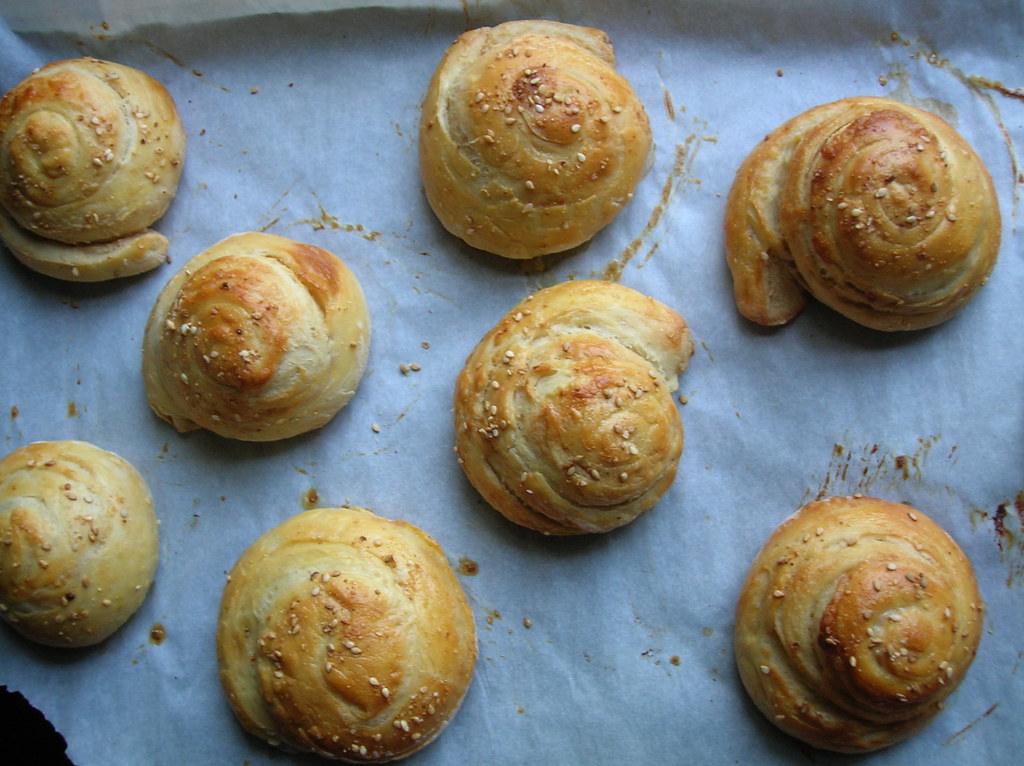
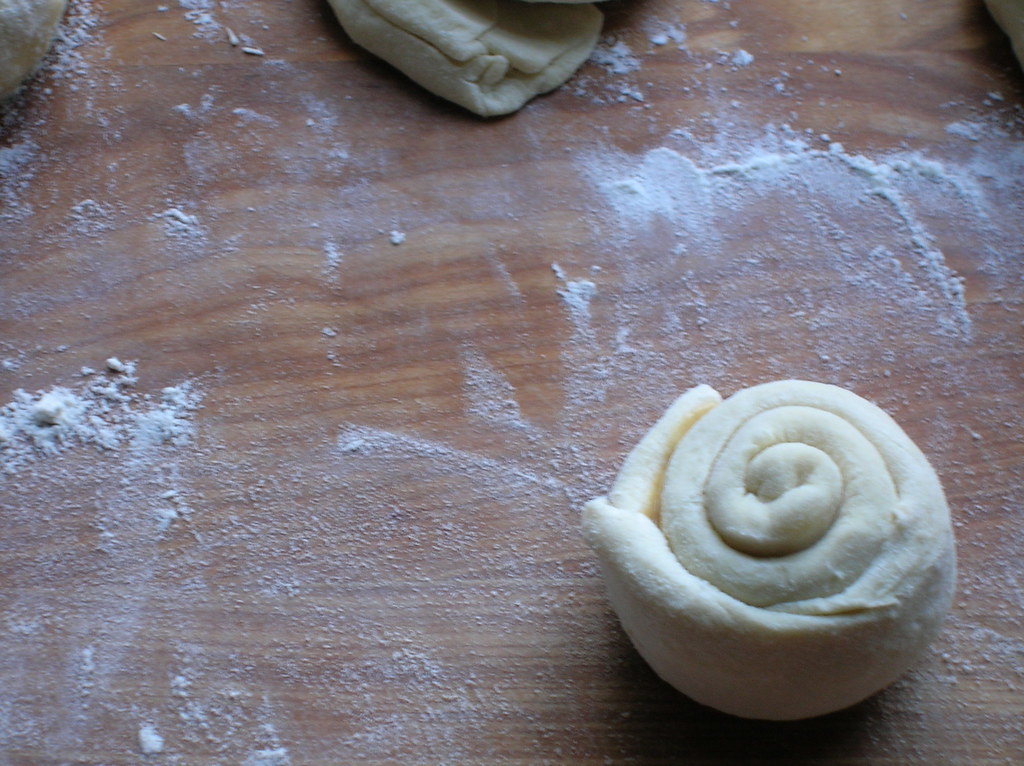
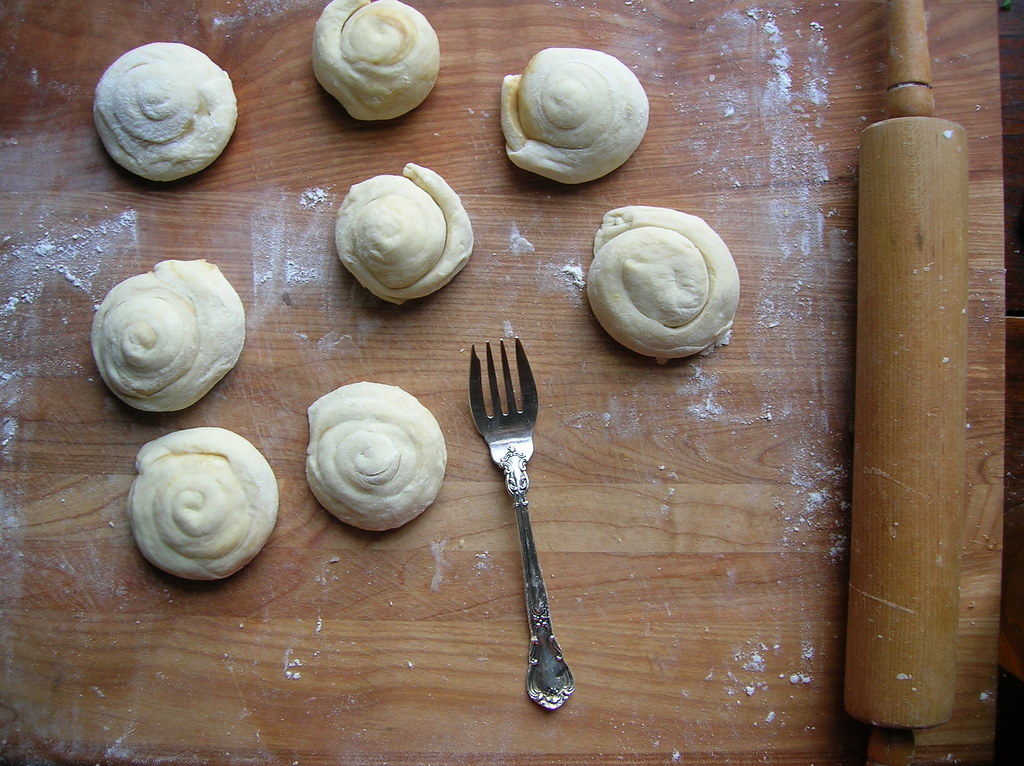
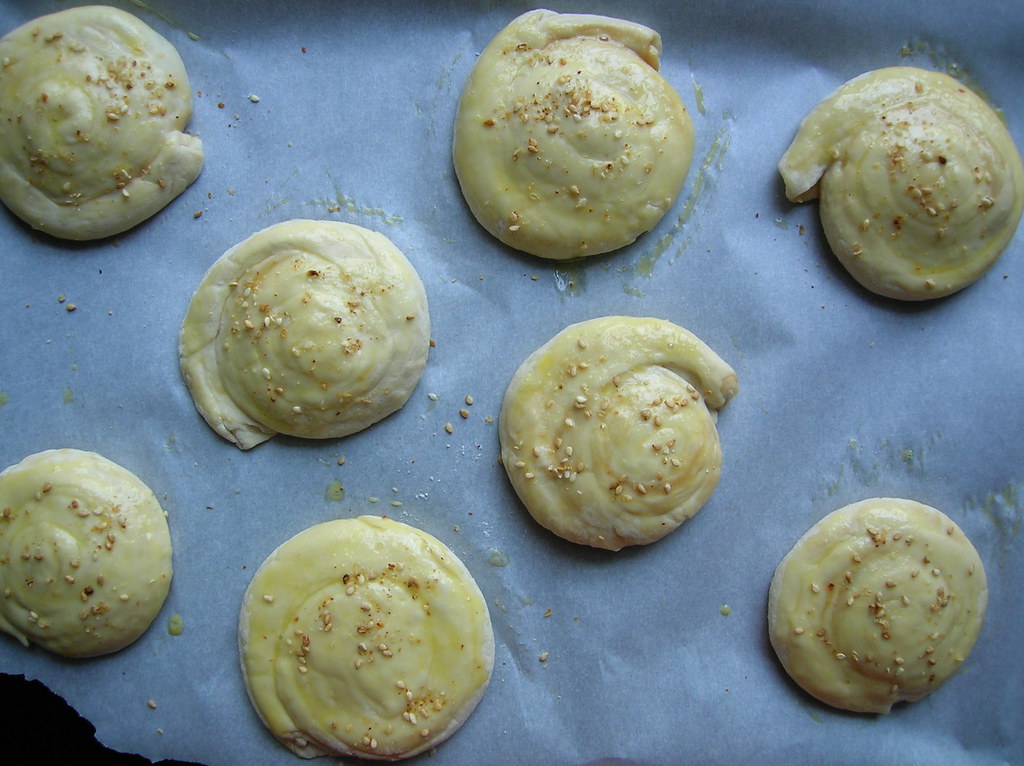
Armenian cuisine is most famous for its use a of red peppers and spices and also for its cured sausages, but one of my favorite Armenian contributions to Middle Eastern cuisine are the flaky sesame rolls known as tahinli. The rolls are made with a yeast dough which is rolled out, spread with sweetened tahini (sesame seed paste), then rolled up and twisted into coils, resulting in a wonderfully flaky texture and a nutty taste. Sesame bread rolls are popular all over the Middle East, sometimes the spirals are as large as a plate but I like them small dinner-roll size. If you imagine a flaky roll with a taste redolent of peanut butter, you’ll understand why I love them so much.

I never got to ask Lisa if her family made tahinli, but when I went home I dug up my own recipe and made them. Dunked in a homemade beet soup, or toasted for breakfast, they were gone before we knew it. And while I won't be thanking Amtrak any time soon, who knows what friend or recipe my next trip will turn up.


Flaky Sesame Rolls (Tahinli)

Dough:
3 1/2 cups flour, sifted
1 cup milk
2 1/4 tsp (1 envelope, 7 gr) yeast
1/3 cup olive oil
1 Tablespoon sugar
1 teaspoon salt
1 egg, beaten
Filling:
1 cup tahini
1/2 cup honey
Glaze:
1 egg beaten
sesame seeds

Directions
1. Combine the flour, sugar, yeast, and salt in a bowl. In a small bowl combine the egg and oil. Heat the milk to warm (120 - 130F). Add the milk to the flour mixture, then work in the egg mixture to make a smooth, elastic and not sticky dough. If needed add more flour.
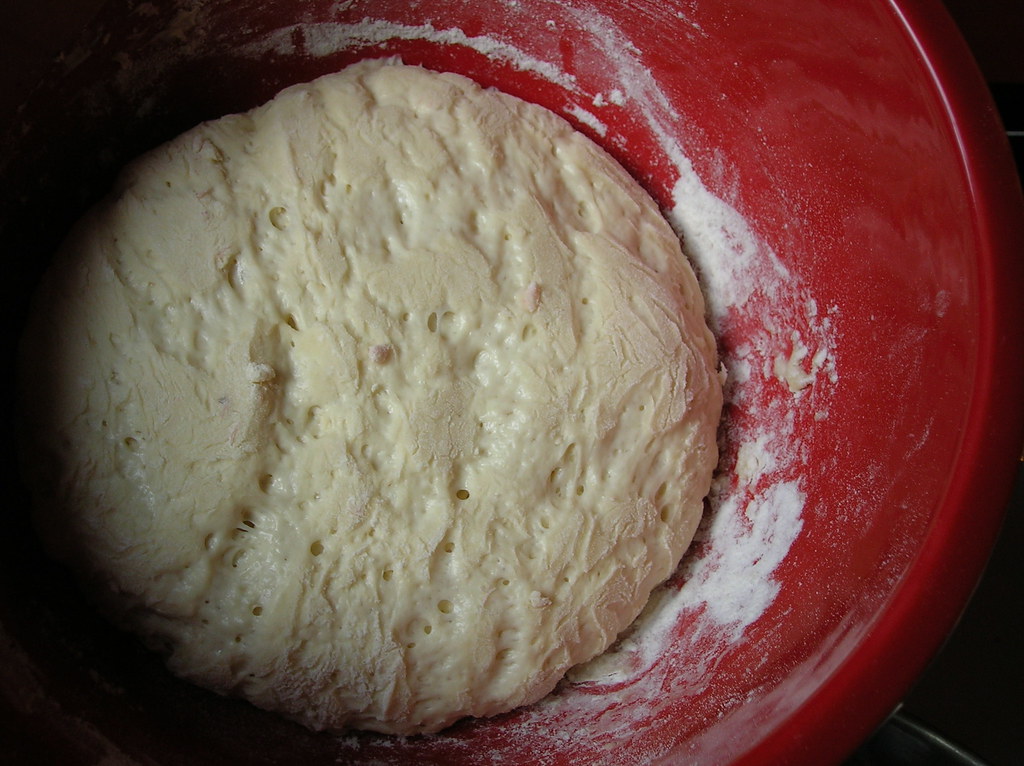
2. Cover with a damp cloth and let it rest for 30 minutes. It will not rise like other breads, do not panic. Mix the filling ingredients while the dough is resting.
4. Divide the dough into 12 pieces, lightly grease them with a bit of oil so they do not dry out and make it east to roll. Let rest, covered, 15-20 minutes.
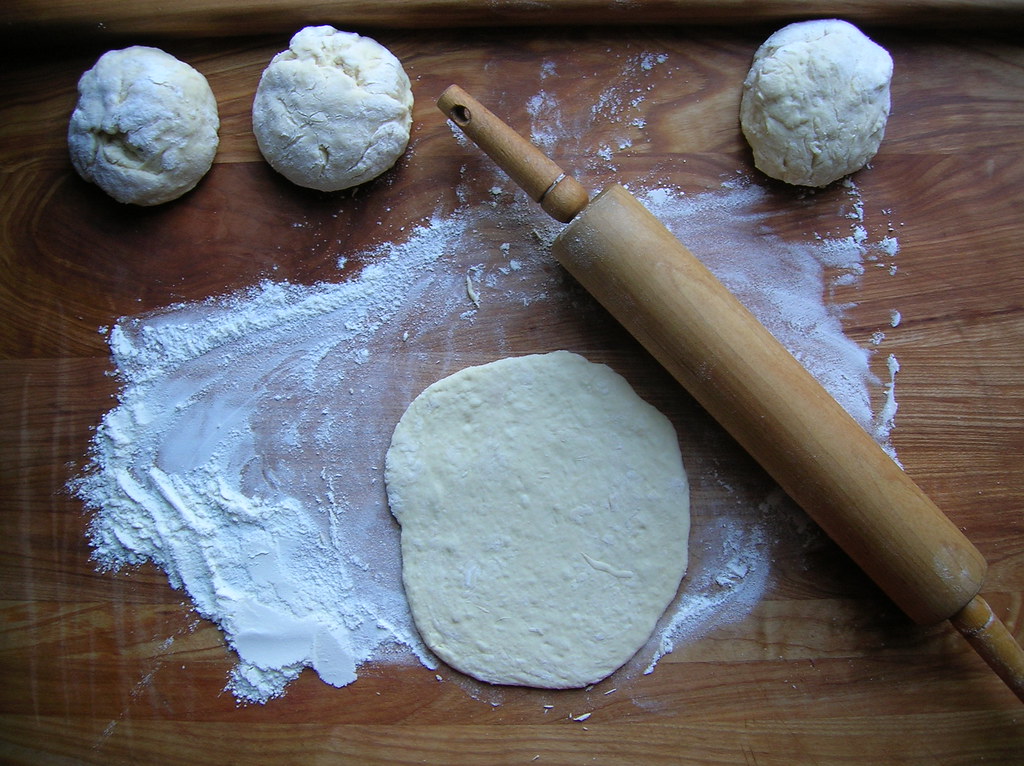
5. Preheat oven to 325 F. Roll one ball of dough out to very wide thin circle. Spread with a thin layer of the tahini mixture (I find it easiest to drizzle the tahini over, then sort of spread it with the back of the spoon). Starting at the longest edge, roll up the dough into a rope. Gently twist the rope so it is spiraled. Roll up the rope to a form a coiled bun. Gently flatten the bun with the rolling pin or a firm press of your hand. Place on a greased or lined baking sheet. Repeat with remaining dough.
6. Brush the rolls with the beaten egg, then sprinkle a few sesame seeds over top. Bake 25-30 minutes, until light brown.

31 January 2008

Pretzel Baguettes

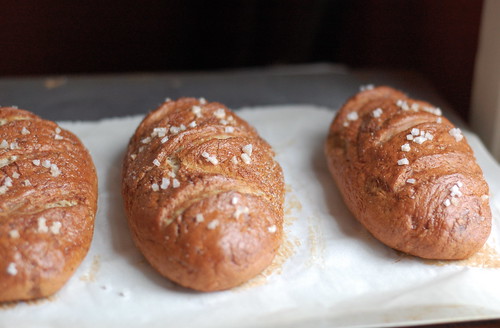
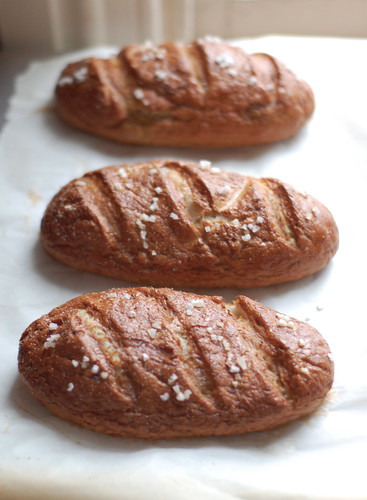
Because the Corner Bakery is conveniently located in the train station where I commute, I occasionally I stop by this local chain to pick up some bread to go with my lunch or dinner. I am particularly fond of their pretzel baguette, basically a soft pretzel in baguette form, in fact I rarely let myself buy them as they are so addictive. They are gorgeous too, smooth, shiny, with characteristic white slash marks across the top. I always thought the pretzel baguette was a quaint quirk made up by a creative baker, but it turns out it really is a real German food, known as laugenstangen.

It also occurred to me that I could make my own pretzel baguettes, thereby creating perfect homemade cradles for sausage and onion sandwiches or merely for slathering with mustard. I found a recipe for pretzel rolls and set to work. Did you know that pretzels get their characteristic shiny exterior from boiling before baking (much like bagels), only that pretzels are boiled in a baking soda bath? I didn’t, but it was fun to boil them in the foamy water and then watch their exteriors turn dark golden and shiny in the oven. Though this is a yeast bread, it has a fairly short rising time, which makes them fast and easy to make.

And the results? While my baguettes weren’t as smooth and shiny as the commercially made ones, the taste was just as delicious, with salt-crusted punctuations and soft interiors. I know they seem destined for meat-filled sandwiches or sauerkraut, but we were perfectly happy dipping them in a bowl of soup. I bet they’d make perfect snacks with a glass of good beer, too.

Pretzel Baguettes
These are really just an excuse to eat a soft pretzel with your lunch or dinner, although they are a good one at that. Keep in mind they can be a bit unwieldy to boil, so it’s best to make them mini-baguette size. A few finely crushed caraway seeds are a nice addition to the dough if you feel like it. Makes 4 mini-baguettes.

2 3/4 cups bread flour
2 1/4 teaspoons rapid-rise yeast or SAF instant yeast
1/4 teaspoon salt
1 teaspoon sugar
1 cup hot water
for boiling and baking:
1/4 cup baking soda
2 tablespoons sugar
2 tablespoons coarse sea salt
1 egg white, beaten to blend

1. Place the yeast and sugar in a large bowl. Add the hot water and let sit a few minutes until bubbly. Gradually add the flour with the salt, stirring to form a dough. Knead the dough a minute just so that it is smooth and combined (I knead it in the bowl, but you could knead it on a board if you prefer). Rinse the bowl out and grease it. Place dough in bowl, turn to coat, and cover with plastic wrap. Place in a warm, draft-free place to rise until doubled in volume, about 35 minutes.
2. Lightly flour a work surface. Knock the dough down and divide it into four pieces. Shape each piece into a mini-baguette and cut deep slashes in the top with a sharp knife or razor blade. Cover loosely with a towel and let rise for 20 minutes.
3. Meanwhile, preheat the oven to 375 F. Line a baking sheet with parchment paper. Bring 8 cups of water to boil in a large deep pot. Add the baking soda and sugar to the boiling water (caution it will bubble up!!). Lower the heat slightly so the water is simmering but not boiling violently. Add the mini-baguettes one or two at a time and boil about 30 seconds on each side. Carefully use a slotted spoon to remove them.
4. Arrange boiled mini-baguettes on the baking sheet. Brush with the egg white glaze and sprinkle with salt. Bake until golden brown, about 30 minutes.
5. Best stored at room temperature loosely covered with a towel. Do not place in a plastic bag or they will become soggy.

08 December 2007

Qurban (Lebanese Holy Bread)


Several afternoons a week I rush out of work, heading across town for my Arabic tutoring session, which is really just an excuse for Wael and me to gab about the ongoing saga of his engagement and other such gossip. I tap my fingers on the window of the service, the van stuck in the smog-filled traffic of Damascus' rush hour. Finally reaching Bab Touma, I leap out and hustle into the winding alleys of the old city. Bab Touma is the Christian quarter of the old city and right at the entrance, between the chicken vendor and the kunafe maker, is a small bakery selling small twisted cookie rings and puffy round breads and sesame breadsticks. When my stomach grumbles I stop quickly, paying a few coins for one of those soft breads, pressing it to my nose to inhale its orange water scent before hurrying on my way.


The bread is called qurban, which means sacrifice, and it is the bread used during communion for the Orthodox Christian churches of Syria and Lebanon. But don't worry, my afternoon snack isn't sacrilegious, qurban are often for sale for public consumption. You can literally smell this bread baking from blocks away, the scent of orange flower water and yeast hooking your nose like a ring though a cow's nostril. They are best when your nose draws you to them, fresh out of the oven, the sweet rounds marked in the center with a stamp in Aramaic, soft and lightly sweet.

I had forgotten about qurban until I picked up a copy of Annisa Helou's Savory Baking from the Mediterranean (I am a Ms. Helou groupy and all her books are fabulous, including this latest one). Ms. Helou, who is Lebanese Christian, describes rediscovering qurban years later as her "madeleine moment," and I can understand why. Since the first time I made them at home they've been in high demand, and I have no objection because I love the way it makes the house smell. Plus, I've had plenty of practice to tweak and streamline the recipe to be more in line with my memory. These are perfect breakfast breads, toasted and spread with sweet butter, or they make a great sweet-savory sandwich with some salty halloumi cheese. And you need not be religious nor observant to enjoy them, though if you have a cup of wine alongside you could pretend you were.


Qurban (Lebanese Holy Bread)
These wonderfully scented breads are best served warm from the oven or lightly toasted with sweet butter.

1 package (2 1/2 tsp) active dry yeast
3 cups all-purpose flour
1 tsp salt
1/4 cup sugar
1/4 tsp mahlep, if available
2 tbl unsalted butter, at room temperature
1 tbl orange blossom water
for brushing: 2 tbl butter melted with 1 tsp orange blossom water

1. Place the yeast in a small with 1 teaspoon of the sugar. Add 1/3 of a cup of warm water and set aside for 5-10 minutes, until bubbly.
2. Meanwhile, in a large bowl combine the flour, remaining sugar, salt, and mahlep. Add the butter and rub it into the flour mixture with your finger tips until well distributed. Make a well in the center of the flour mixture, add the yeast mixture and add 1/2 cup warm water. Knead until you have a rough ball of dough.
3. Knead the dough in the bowl for 3-5 minutes, until smooth and elastic. Rub the inside of the bow with oil to coat, place the dough bal inside. Cover with a kitchen towel and leave to rise until doubled in volume, about 1 1/2 hours.
4. Divide the dough into 8 equal pieces and shape each piece into a ball. Let rest 10 minutes. On a lightly floured surafce, roll each dough ball out into a circe about 6 inches in diameter. Place on a greased or lined baking sheet, cover with a kitchen towel and let rise one hour. Preheat oven to 400 F.
5. Press each dough round with the tines of a fork to make a square in the center. Make sure to press deeply as this will prevent the dough from puffing too much in the oven. Place in the oven and bake 15-17 minutes, until golden. Meanwhile, prepare the glaze. When the bread comes out of the oven brush generously with the butter-flower water mixture. Let cool slightly before serving.