04 January 2008

Never Too Late for Luck


By now, you've probably messed up your first few checks, replaced your calendar, and generally settled into a new year with a big fat round eight at the end of it. I'm not one for New Year's resolutions or much retrospection, but a new month at the start of a new year does encourage a bit of reflection. If you had asked me, I would have probably told you that 2007 involved a lot of waiting, several wrong turns, and a few frustrations. But when (while twiddling my thumbs on the train) I started listing the things that had happened in the past year, it looked like quite a lot:

- I made 20 ice cream recipes
- I left a job and a city I loved
- My significant other of several years became less significant and more other
- I found a new joy instead (albeit one who eats my shoes)
- I learned to do vrschikasana.
- I found a part of my family I had never known before
- I got a new job
- I'm moving to a different city
- I am finally learning to drive (about 9 years after I should have)

There are many more things I could add to that list, but it's quite a bit, really. I'll be starting a new job at the end of the month and will be in Washington, D.C. for the next three years. I'm a bit apprehensive about all of it, but I hope it will be new and exciting and challenging intellectually, plus it will be nice to be able to see my family and friends regularly without the medium of Skype. This blog will continue as usual, and I've already got some things tucked up my sleeve, including one of my absolute favorite Middle Eastern recipes and some other new-to-me discoveries.

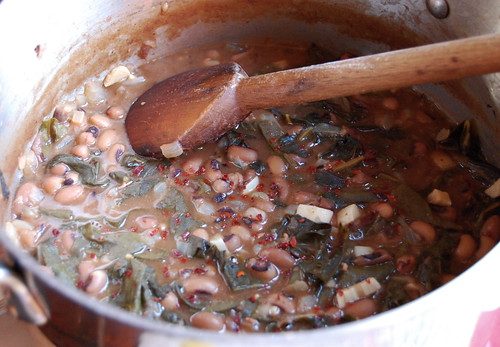
My mom should get a big thanks this year, as she's played host to me in my transition, generously ceding her kitchen to my endeavors and also footing some major grocery bills. In our family, we've always had traditional foods for the new year: black-eyed peas (for seeing into the new year), collard greens (green for greenback$) and cornbread (for gold). I have no idea if any of those symbolisms are verifiable, but I've always liked the idea of them. Imagine my delight when, while traveling in northern Syria, I learned that they also eat black-eyed peas for good luck? In Aleppian Jewish tradition they eat black-eyed peas on Rosh Hashana (the Jewish New Year), usually with veal. The other traditional Syrian preparation of black-eyed peas involves the peas stewed with Swiss chard. This dish is literally a dead ringer for one you might find in the American South: swap the chard for collards and the Aleppo pepper for paprika and you've gone from one half of the world to another. I find these similarities terrifically fascinating, but then again I'm a total nerd.

The new year may have come and gone, but I say it's never too late for a little luck. Plus, this dish is really hearty and delicious: the peas are long-cooked so that they take on a sort of velvety smoothness punctuated by a hint of spice. You can serve it as a thick stew in bowls, dolloped with a little plain yogurt, or as I had it in Syria, ladled over rice.

So here's to 2008 and all the changes it may bring. I hope yours is healthy and happy and I look forward to sharing it here with you. And if you live in D.C. and see a girl in a brand new VW Rabbit, you might be advised to change lanes.


Black-Eyed Peas with Swiss Chard

splash of olive oil
1 thick-cut slice of bacon (optional)
1 medium-sized onion, diced
3 cloves garlic, sliced
1 bunch (~8 stalks) Swiss or Rainbow Chard, ribs removed and leaves roughly chopped
4 cups fresh black eyed peas or 1 1/2 cups dry black eyed peas soaked in water overnight
2 tablespoons tomato paste
pinch of salt
1 teaspoon Aleppo pepper or other mild red pepper

1. In a medium-sized pot, heat the olive oil. Add the onion and garlic (and bacon, if using) and saute until soft and translucent but not browned, 10 minutes. Add the chard, black-eyed peas, tomato paste and enough water to just cover the mixture by an inch and bring to a boil. Season with salt and turn down to a simmer. Simmer, stirring occasionally, for 45 minutes for fresh peas and 1 1/2 hours for dried peas. You may need to add a touch of water- it should be thick and stew-like. Stir in the Aleppo pepper and simmer another 2-3 minutes to combine. Taste for seasoning and serve warm.

31 December 2007

The Maple Syrup Conundrum

Where I grew up and where my mom still lives, our neighbor is a grandmotherly lady who spends her summers in the cool air of Canada. Each year as she prepares to flee Baltimore’s hot weather, we assure her we will keep an eye on the mail and the elaborate system of timers that water her hundreds of prize orchids. And each year, in return, she brings us a bottle of the most wonderful maple syrup you ever did taste. Not pancake syrup, not imitation flavor stuff, but sweet scented liquid gold.

Now, my family loves maple syrup, but it seems we don’t make enough pancakes, because each year when she brought us a new bottle we still had half of last year’s left. Over the years my mom devised several recipes to whittle down our supply, a maple-glazed salmon is still a favorite. However, it seems we’ve been lax once again because between my mom and myself, we’ve got three bottles of maple syrup. Oh, the difficult problems we face. I briefly considered giving one of them as an emergency Christmas gift, but this stuff is so good that even with our surplus I couldn’t bear to let it go. After all, if I had only one bottle in the pantry I might start to get a little nervous, it’s a long way to next August.

Instead, I started searching for a recipe that called for maple syrup, not just a few measly tablespoons, but something by the cupful. I came across a recipe for maple-walnut cake that sounded just right, except for one thing. Problem is, I don’t love nuts in my cakes. Ground nuts, sure, but what I love about cake is the soft texture, something nuts just interrupt. I know, I know, trivial once again. However, I had an idea: I could use chestnuts, which have a nutty taste but a softer texture, and I could chop them very finely so that they sort of melted into the cake.

I suppose if you pour a few cups of fabulous maple syrup into something, you should expect it to be good, but this cake exceeded even my expectations. It smells as good as it tastes, supremely maple-y, with just the right soft nubby texture from the chestnuts. Keeping the chestnut theme, I made a frosting with sweetened cream cheese and chestnut paste, which is now one of my favorite new variations on cream cheese frosting. I have only two qualms with this cake: one, my cake lost some of its maple flavor after a few days, but this could be because I didn’t store it properly. Second, with the good maple syrup, chestnuts and chestnut paste, it can be a bit pricey, but I think it would be worth it for a special occasion. If you’re lucky enough to be able to afford candied chestnuts (marrons glacee) they would make a wonderful decoration on the top of the cake.

I love doing a fancy dessert on New Years, when you can serve some cute appetizers, skip the entree, and head straight for the sweet stuff with your glass of Champagne in hand. After all, it’s only tomorrow that you swore off sweets and committed to salads. Until then, why don’t you have another piece of cake?


Maple-Chestnut Layer Cake
This layer cake is best the first day it's made, that is, if you can resist the smell of the cake coming out of the oven. The frosting is delicious, but you could also use a maple buttercream frosting if you prefer.

1/2 cup (4 oz) unsalted butter, at room temperature
2 1/2 cups flour
1 tablespoon baking powder
1/2 teaspoon salt
1 teaspoon ginger
1 1/2 cups pure maple syrup
3 eggs
1 teaspoon vanilla extract
1 cup chopped cooked chestnuts
Chestnut Cream Cheese Frosting, recipe follows

1. Preheat oven to 350 F. Grease two 9" cake pans. Place chestnuts in a food processor and pulse to make a coarse meal (alternately, if you don't have a processor, you can chop them as finely as possible). You should have 3/4 cup chestnuts.
2. Sift together flour, baking powder, salt, and ginger.
3. Beat butter and maple syrup together until combined. The mixture may look slightly curdled, that's ok. Beat in the eggs and vanilla. Add the flour mixture in two additions, stirring to combine. Fold in the chestnuts.
4. Divide batter between prepared pans. Bake 40 minutes. Let cool on a rack.
5. Place bottom cake layer on a platter. Spread the top with some of the chestnut frosting. Top with second cake layer, frost top and sides of cake with remaining frosting.

Chestnut Cream Cheese Frosting
12 oz cream cheese
4 oz (1/3 cup) chestnut puree
2 tablespoons butter, softened
1 teaspoon vanilla extract
3 cups sifted powdered sugar

1. Cream together the cream cheese and butter until smooth. Add the chestnut puree and vanilla to combine. Slowly sift in the powdered sugar until the desired consistency is reached.

30 December 2007

Where I Come From


These are my people. This is where I come from. Sometimes it's good to remember where you come from, even if you never lived there, even if it's only where your mother grew up. Roots, deep, buried. So deep, sometimes we forget them. Even if you know you'll never live there, if you don't fit in there, if it's different than your memories have painted it. It's good to hear the accents, the drawl that can turn "bill" into a three-syllable word. Bi-iieee-uulll. The rocky landscape and the mountain springs, the smell of barbeque, the taste of country ham and biscuits, sorghum syrup, tomato aspic and green beans cooked all day long with a bit of fatback.


With all the wonderful gifts this year, the fancy phone, the camera lenses, backup hard drives, more books than I could dream of (yes, I was truly spoiled), it was a little teacup wrapped in tissue paper that brought tears to my eyes. The gift of my Grandmother's china set, bequethed from my aunt, the antique cream soup bowls with their delicate double handles that speak of responsibility and roots. I promise I'll give them the care they deserve.


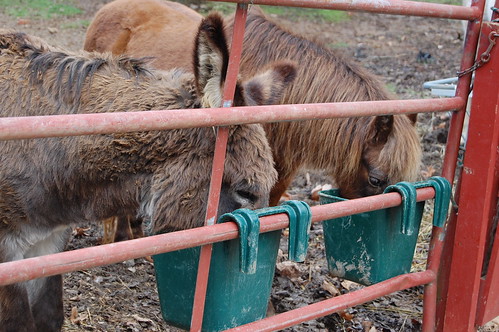
We fed the horses and the burrow, played with the dogs and were entertained by a four-year-old on the trombone. We drove through towns with names like Lebanon, Smyrna, and Carthage, New World versions of Old World titles. I told my cousins about how I went to the original Smyrna, Ismir, in southern Turkey; they looked at me like I was crazy. We ate caramel cake and fought over the Sunday crossword puzzle while sitting by the fireplace. It's good for a city girl to get her boots muddy sometimes. I hope your holidays were as enriching, belly-filling, and relaxing as ours. We're looking forward to the new year!


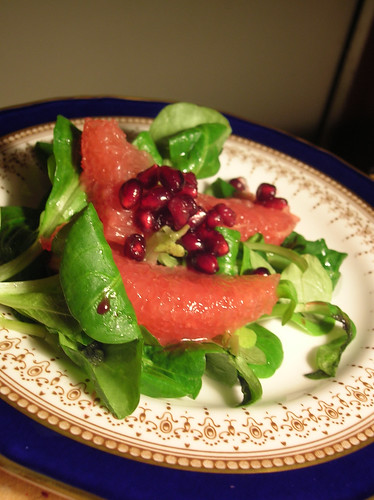
Grapefruit, Avocado, Pomegranate Salad
Every year my uncle sends us a whole crate of Texas pink grapefruit and so begins our annual quest to use all 18 of them before they go bad. The one thing they are destined for is this salad with avocado and pomegranate seeds that my Grandmother always made around the holidays. In our family it's simply thought of as "the Christmas salad."

1 large pink grapefruit
1 large ripe avocado, peeled and sliced
mache or butter lettuce, about 6 cups
1 cup pomegranate seeds
3 tablespoons champagne vinegar
3 tablespoons olive oil
pinch salt

1. Section the grapefruit: Cut off the peel from the top and bottom of the grapefruit. Working from top to bottom, remove the peel and pith in strips, so that the grapefruit flesh in completely exposed. Discard peel and any white pith. Working over a bowl, use your knife to cut between the white membrane so that the grapefruit flesh is released into the bowl in sections. Squeeze juice from remaining flesh and discard.
2. Get another large bowl and whisk together the vinegar, oil, and salt in the bottom. Toss the lettuces in the bowl to coat. Divide lettuces among four serving plates or leave in the bowl. Arrange grapefruit sections and avocado over lettuces. Sprinkle pomegranate seeds over salad. Serve immediately.

28 December 2007

Reminder

Note to self: Cheese should be served at room temperature.

I'm not much of a cheese eater, despite the fact that pretty much everyone else around me can be found digging wedges of stinky Epoisses or cutting hunks of Cotswold before and after the dinner hour. Me, I occasionally have a sprinkling of cheese as an accent in salad, but for some reason last week I found myself craving big hunks of fermented dairy products. Wheels of brie and camembert, carrying the odors of sweet lettuces from spring's milk, are just ripening to perfection around now. Which brings me to the reminder: cheese should be served at room temperature so it oozes perfectly across the plate. Not I-took-it-out-of-the-fridge-five-minutes-ago and not baked in one of those pastry cases. I usually set mine out an hour to half an hour before serving. We had this Camembert with thin slices of baguette and some leftover cranberry-orange chutney. Delicious.

22 December 2007

Run, Gingerbread Man, Run

My holiday rolling pin has been put to good use, its barber-pole red-and-white stripes pressing out cookie doughs which have been cut, baked, packaged and shipped. Tomorrow, we will be following the same path as our cookies, scattering to family across the country. We're packing, packing, packing and soon we'll be going, going, going in the season of giving, giving, giving. No matter what holiday you celebrate I hope you have a good one, full of family and fun and cheer. In the meantime, if you need any last minute treats or sweets for sharing, I've listed a few selections from the archives below. Happy holidays!

Bourbon Balls
Cardamom Wheat Cookies
Chocolate Cookies (with Peppermint Sandwich variation)
Chocolate-Coconut Tartlets
Custard-Filled Baklava
Date Bars
Lebkuchen
(Mom's) Chocolate Chip Cookies
Honey-Nut Caramels
Pecan Pralines
Pistachio-Cranberry Cookie Sticks
Peppermint Ice Cream
Guinness Gingerbread

19 December 2007

Why I Love Tomato Aspic

I love tomato aspic. It only took me twenty years to figure it out.

You see, as much as I've lauded the cooking of the American South, the culinary traditions of my mother's family and many others stretching across Tennessee, the Carolinas, and Texas, I'm afraid it's easy to romanticize things. Somewhere in the past half century the ease of open-a-can-of-this-and-combine-with-a-can-of-that has crept into the vernacular. Like kudzu vine, culinary traditions have been entangled in processed cheese and smothered in creamed soup. Sometimes it's scary.

Don't get me wrong, the barbeque's still great, there's real cornbread and fresh shucked oysters and plenty of pie. But one year we were in Tennessee for the holidays, doing the usual rounds of Christmas parties and visiting. Everywhere people were pressing little cheese biscuits and pecan tassies in your hand, all of them delicious, but after awhile I was starting to crave a vegetable. Or just something, anything, that resembled its fresh natural state. At the dreaded bank Christmas party, amid the ladies in their Christmas sweaters, I looked in desperation for something not slathered in mayonnaise or cream cheese. Finding nothing, I resigned myself to another ham biscuit.

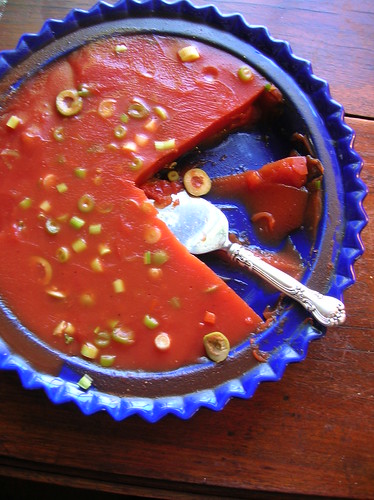
This is how I came to discover tomato aspic. Aspic is just a fancy word for a savory gelatin; aspics were popular in the fifties (think of those molded salads), but in my family and many others' across the South aspic never went out of style. Specifically, tomato aspic. There is no family gathering to be had without tomato aspic, my family is so passionate about it. It was always on every dinner and buffet table growing up but I had never actually eaten it. Few things could be less appealing to a child than a wobbly block of solidified tomato juice.


Then came the holiday of vegetable depletion, and as I surveyed the buffet I saw the tomato aspics my aunt had made, perfectly shaped in Christmas tree molds and decorated with green olives for the season. I took one, along with a heaping salad, and promptly fell in love. It's hard to describe what's so wonderful about tomato aspic, even now I can't really put words to something which sounds, on paper, so unappealing. Maybe you have to be born into the tomato aspic tradition, but I didn't discover it for the first twenty years of my life, so I think there's hope for you too.

Today, tomato aspic is one of my favorite foods. As often as fresh sliced tomatoes make up my lunch in the summer, a wedge of tomato aspic is sure to be on my plate in the winter. I've even packed a whole tray of it in ice to take to the refrigerator at work so I can have it all week long. But more than that, those funny red blocks remind me of home and the holidays, my mom always has a plate of aspic in the fridge when I'm coming to visit. Sometimes it's decorated with green olives or scallions, other times it's plain, simply tomato juice spiced with a bit of Worcestershire and spice. We're headed to Tennessee next week where I'll be eating ham biscuits and bourbon balls and where my aunt is already getting out the molds, so that when the need for a vegetable strikes, the aspic will be ready. In my family, it wouldn't be the holidays without it.


Tomato Aspic
I've made this with both 2 and 3 packages of gelatin and I prefer the firm yet melting aspic that comes from using 2 packages. However, if your aspic will be part of a buffet or sitting out at room temperature for a while, I'd recommend using 3 packages for a very firm gel.

4 cups tomato juice, preferably low-sodium
1 tablespoon lemon juice
1 bay leaf
1 cup chopped onion and celery
1 tablespoon Worcestershire sauce
dash of Tabasco or other hot sauce, optional
1/2 teaspoon salt (omit if not using low-sodium tomato juice and use your judgement)
2 packages (1/2 oz.) gelatin
2 tablespoons mild vinegar, like apple cider vinegar
optional: chopped scallions or sliced pitted green olives
for serving: butter lettuce leaves, homemade mayonnaise

1. In a large bowl, combine 1/2 cup of the tomato juice with the gelatin and the vinegar, stir to combine and set aside.
2. Place the remaining tomato juice, lemon juice, bay leaf, onion, celery, worcestershire sauce, and salt (to taste) in a sauce pan. Bring the mixture to a boil, then let simmer for 20 minutes.
3. Pour the tomato juice through a sieve into the bowl with the gelatin, discard the vegetables. Stir the tomato-gelatin mixture well so that the gelatin is completely dissolved. Transfer the mixture to a 9 inch pie plate or decorative molds and place in the refrigerator to set. If using olives or scallions, press them into the aspic after about 30-45 minutes (when the gelatin is half-way set), so that they are suspended in the aspic. Refrigerate the aspic at least 4 hours before serving.
4. Serve the aspic chilled, on a bed of lettuce leaves, with mayonnaise on the side. Aspic keeps well in the refrigerator.

16 December 2007

Pistachio-Cranberry Cookie Sticks


A lot of people say that bakers, because they follow recipes that rely on precise weights and measures, are the more precise (dare we say rigid) of the kitchen staff, while cooks have the liberty to be more free spirits and daredevils in the kitchen. While I do think cooking and baking are different arts, I don't think this classification is at all true. When I read a baking recipe, I read it for the bones of its structure: the proportions of ingredients, the technique, the temperatures. But when it comes to flavor, I say it's open season on experimentation and creativity. You can take a good base cookie or cake or cheesecake recipe and extrapolate it into a million different flavor variations.

I am saying this because experimentation is how I discovered one of my favorite cookie recipes. I came across a recipe one day for Almond-Cocoa Nib Cookies from the lovely Alice Medrich, whose recipes always come out brilliantly. But I had neither almonds nor nibs, and somehow an almond cookie wasn't really tickling my fancy anyway. I do, however, always keep a good supply of pistachios around, and when brainstorming what to combine them with, dried cranberries seemed like an obvious good choice.

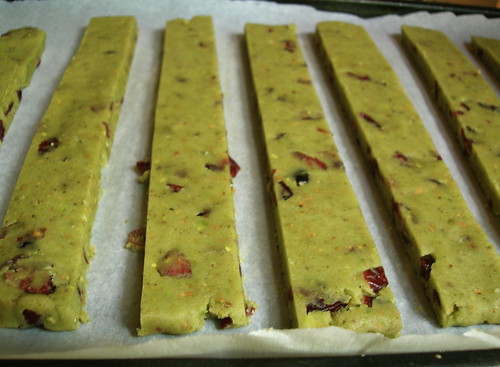
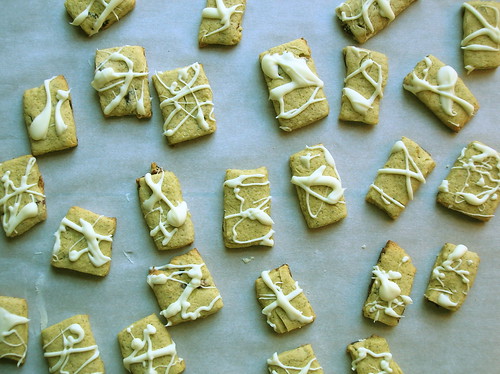
When I first made them, back in the summer, I immediately knew they were destined for my holiday cookie box. First of all, they are red and green colored, and I love the long cookie sticks, I can just see them sticking up out of a cup, waiting for Santa. Second, they are supremely easy to make, just blitz in a food processor and cut with a pizza cutter. I've rarely had a cookie so full of flavor and perfectly crisp, there are plenty of pistachio cookies out there, but few made with pistachio meal (ground pistachios). When I was making these for holiday packages, I ended up cutting them into bite size pieces, and then drizzling the cookies with some white chocolate to make them even more festive. My friend joked they were no longer cookie sticks but cookie stubs, but I think anyone who tastes them will simply call them yum.


Pistachio-Cranberry Cookie Sticks
These colorful cookie sticks are perfect for dipping in a glass of milk. For an extra festive touch drizzle with melted white chocolate.

3/4 cup whole pistachios
1 cup+ 2 tablespoons all purpose flour
2/3 cup sugar
1/4 teaspoon salt
6 tablespoons unsalted butter, cut into chunks
2 tablespoons water
1 teaspoon vanilla extract
1/8 teaspoon almond extract (optional)
1/3 cup chopped dried cranberries or dried cherries

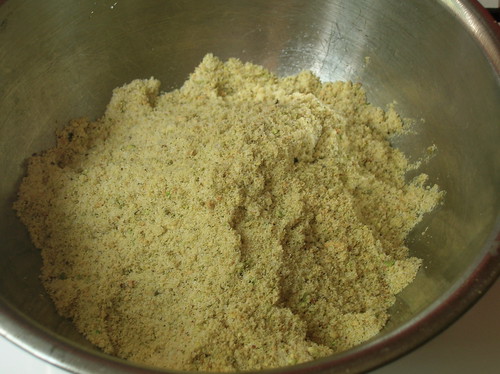
1. Combine the pistachios, flour, sugar, and salt in a food processor and pulse until it is a fine meal. Add the butter and pulse until the dough looks crumbly. Combine the water, vanilla, and almond extract and add it to the bowl, pulsing until it just looks damp. Add the dried cranberries and pulse until evenly distributed.
2. On a piece of parchment paper, roll out the dough into a 6x9 in rectangle that's 1/2 inch thick. Refrigerate for 2 hours or overnight. Preheat the oven to 350 F. Using a pizza cutter or a long knife, cut 3/8 in thick slices and place them on parchment lined cookie sheets, about 1 inch apart. Bake 12-14 minutes, until golden at the edges. Do not over bake, they will continue to firm as they cool.