Showing posts with label Poultry. Show all posts

25 March 2011

Chicken Tagine with Preserved Lemon and Olives

DSC_0187
No one welcomes day light savings time more than me. The dark poorly lit pictures you see here, walking to and from work in the dark, it's time for them to be over. The lighting in our little kitchen is terrible, and in the winter the photos I can manage are less than inspiring. A breath of light and some Moroccan cooking are just what we need.

DSC_0185DSC_0184

This is the most classic Moroccan dish I can think of- chicken with preserved lemons and green olives. It's cooked in a tagine with a bath of Moroccan spices, herbs, and onions. The chicken is slow cooked until it's tender and moist and a velvety lemon sauce is pureed until smooth. The preserved lemons are available in many stores, or you can make your own the classic way or the fast way.

Lemons and olives are a classic combination that you often find in Morocco and in Spain. Here, the lemon and olive aren't added until the end of cooking to preserve their bright flavor. The technique used here of grating an onion on a box grater is a very common one in the Middle East, and I rarely implement it in my recipes here. The truth is, it makes your eyes water like crazy and it's a big pain in the butt. But in recipes like this the slightly pureed slightly chunky texture of the onion makes for a perfect sauce. Don't skip the step of pureeing the sauce, it seems a bit fussy but it makes a big difference.

DSC_0192
Chicken Tagine with Preserved Lemon and Olives
To make a quick version of preserved lemons do the following: trim offf the rind of two lemons (use flesh for juice or simply discard). Dice the thick lemon rind. Bring 2 cups water to a boil with 1/3 cup salt. Boil diced lemon until they are just soft when pierced with a knife. Drain and set aside.

Go easy on the salt while cooking because the lemons and olives added at the end are quite salty. Serve this recipe with couscous or rice.


1 chicken, cut into pieces
4 garlic cloves
Salt
1 teaspoon ground ginger
1 teaspoon sweet paprika
1/4 teaspoon turmeric
1/4 teaspoon ground cumin
1/4 teaspoon ground black pepper

olive oil
1 large onion, grated
1/4 teaspoon pulverized saffron
1/2 cup mixed cilantro and parsley, chopped
1/2 cup ripe green olives, pitted
2 preserved lemon, diced
2 fresh lemons

1. Bash 4 cloves of garlic with 2 teaspoons salt in a mortar and pestle. Add in the spices to form a paste. Rub over the chicken pieces and marinate, covered, overnight.
2. Heat some of the oil in the tagine. Add the chicken pieces (marinade and all) to the pot so that they start to turn golden on the outside, about 5 minutes. Add in 2 cups water, the grated onion, and saffron. Cover and simmer 45 minutes, turning chicken occaisionally. You may need to add water to the pan if it gets dry.
3. Add the diced herbs, preserved lemon, and olives. Simmer 10 minutes for the flavors to combine.
4. Using a slotted spoon, transfer the chicken, olives, and preserved lemons to a platter.
5. Squeeze the juice of the two lemons into the sauce. Let the sauce boil for about 5 minutes until nice and thick. Using an immersion blender, puree the sauce until smooth. Pour the sauce over the platter of chicken and serve immediately.

20 November 2010

A Middle Eastern Thankgiving

DSC_0056
A few years ago at Thanksgiving dinner, a friend who knows about this blog, asked me if I thought it would be possible to do a Middle Eastern Thanksgiving. Despite some people's scepticism, I said I actually thought it was a great idea. Middle Eastern cooking makes great use of spices like cinnamon and allspice, and they have numerous recipes for things like pumpkin and kale and nuts.

My goal here was to do things that hemmed closely to the traditional Thanksgiving, as opposed to just throwing some tabbouleh and hummus next to the turkey. The only real challenge was the stuffing (aka dressing), especially given my great love of cornbread dressing. But a rice pilaf was a good substitute.

DSC_0058

On other things it was much easier to find a good substitute, like pearl onions with a touch of tamarind and swiss chard with a tahini sauce. For the potato kibbeh, imagine mashed potatoes mixed with caramelized onions and then baked until the top is crackly and crispy. I've been told that people actually prefer the mashed carrots to overly-sweet mashed sweet potatoes.

As for the turkey, it's a completely traditional roasting recipe that we tested out last week. A good rubbing of butter, salt, and pepper, and that's pretty much it. But it came out perfectly, moist breast meat and falling-off the bone thighs. But the gravy, infused with some reduced pomegranate gravy, is what makes it special.

As for dessert, what could be more similar to pecan pie than baklava, or a sweet date tart. I know everyone has their die-hard Thanksgiving traditions, but hopefully this can serve as some food for thought for future meals. After all, roast turkey should be served more than once a year. Happy Thankgiving to you and yours!

Pumpkin Hummus
Olive-Potato Bites

Turkey with Pomegranate Gravy (recipe follows)

Pearl Onions in Tamarind
Swiss Chard with Tahini
Potato Kibbeh in a Tray
Anbari Rice Pilaf
Mashed Carrot Salad

Flaky Sesame Rolls

Custard Baklava or Regular Baklava
Marya's Date Tart

(another good addition: Bulgur Salad with Walnuts and Pomegranate)

tahinli baked

Turkey with Pomegranate Gravy
Adapted from Gourmet.

For turkey

* 1 (12 to 14 lb) turkey, any quills removed
* turkey neck and giblets reserved for making stock
* 6 tablespoons butter, softened, plus 4 tbl melted butter for basting
* 1 tablespoon salt
* 1 1/2 teaspoons black pepper
* 1 onion, quartered
* 4 fresh thyme sprigs

For gravy

* 16 oz bottled pomegranate juice
* pan juices (and roasting pan) from turkey
* about 3 cups hot turkey giblet stock
* 1 cup water
* 4 tablespoons all-purpose flour

1. For stock: place neck and giblets (not liver) in a saucepan with one small chopped onion, one clove onion, one chopped carrot, and some salt, pepper and any herbs you have on hand. Cover with water and set to very low simmer for 2-3 hours, or until you're ready to make the gravy.

2. For pomegranate: Place pomegranate juice in a saucepan and simmer until reduced to 2/3 to 1/2 a cup. Set aside.

3. Preheat oven to 350 F. Rinse and pat dry turkey. From the neck, gently run fingers under skin of turkey to loosen the skin all over breast and thighs. Grabbing bits of softened butter with your fingers, work the butter under the skin all over breast and thighs to cover them with butter. Rub turkey outside all over with salt and pepper. Stuff cavity with onion and thyme and place on roasting rack in roasting pan.

4. Place in oven and bake, basting with melted butter every 20-30 minutes, until turkey is golden brown and thermometer inserted into fleshy part of a thigh (do not touch bone) registers 170°F, 2 1/2 to 3 hours. (If turkey is browning too quickly, tent with foil. If bottom of pan looks like it's burning, add some water to pan juices.)

5. Remove turkey from oven, tilting turkey so any juice in cavity run into pan. Move turkey to carving board and tent with foil. Let rest 30 minutes (this temp will rise to 180 F).

6. Meanwhile, pour off any pan juices into a container and place in the fridge. Straddle roasting pan over two burners, add water and cook to deglaze pan, scraping up any brown bits, about 1 minute. Pour liquid through a fine-mesh sieve into a bowl. Add enough turkey stock to pan juices to total 3 cups liquid.

7. Skim 4 tbl of fat off the top of the container you placed in the fridge. Whisk together fat and flour in a heavy saucepan and cook roux over moderately low heat, whisking, until pale golden, 7 to 10 minutes. Add hot stock mixture in a stream, whisking constantly to prevent lumps. Bring to a boil, whisking, and add pomegranate syrup, then reduce heat and simmer, whisking occasionally, until thickened, about 5 minutes.

8. Carve turkey and serve with gravy.

27 August 2010

Bisteeya

DSC_0196
Most of the food I post on here is Levantine cuisine- food from Lebanon, Syria, Jordan or Egypt. I cook a fair amount of other Middle Eastern food, odd dishes from Tunisia or Iraq, Iran or Morocco, and I've long wondered if I should move into a new phase for this blog, exploring those cuisines more. I went through a phase exploring Yemeni breads, but let's just say that not all my experiments were successful.

One of the reasons I like exploring Levantine cuisine is that it is very codified. Maybe it's the French influence in Lebanon, or maybe it's the history of Lebanese cuisine, of traditional preserving (moune) and seasonal cooking. I've often thought about delving into Moroccan cooking for much the same reason, like Levantine cuisine, there are unique pairings, techniques, and ingredients.

DSC_0177

Bisteeya is the queen of Moroccan dishes, a towering pie wrapped in phyllo dough and crammed with squab, eggs and almonds. I've always been curious to make bisteeya (also spelled pastilla, bastilla, etc) because it's unlike anything I've ever made before. I was also confused on how you could make a pie with 10 eggs in it without making a runny mess.

DSC_0185DSC_0186
DSC_0187DSC_0190

On the surface, when you look at bisteeya, you don't think it's going to taste very good- it has shredded chicken or squab, soft scrambled eggs, and sweetened ground almonds. But in reality, it's delicious. You cook the eggs in some of the poultry stock, so that they infuse with the chicken-y flavor and spices, and then drain them so they don't make the pie soggy. The almonds add just a right note of sweetness, something Moroccans love. And really, the whole thing is wrapped in buttery flaky phyllo dough, and who doesn't like that?

Paul said this was one of the best thing I've ever made, but this was coming from a man obsessed with pies of all forms. But I'd be inclined to agree, despite the work involved, I'd make this again in a heartbeat.

DSC_0197

Bisteeya
Traditionally, a Moroccan pastry called waraka, which is shiny on one side and porous on the other, is used in place of the phyllo. I find phyllo is an easy substitute. Though squab is the traditional filling for the pie, I used chicken legs, whose meaty flavor echoes the gaminess of the squab, but which are a bit easier to find and work with. Adapted from Paula Wolfert.

1 box phyllo dough, defrosted
1/2 cup of butter, clarified, or use ghee or samneh
10 eggs
1 large bunch of flat leaf parsley, stems removed and leaves chopped
4 or 5 large chicken legs and thighs (or 4 squabs or 1 whole chicken, cut into pieces)
2 garlic cloves
2 cinnamon sticks
1/4 teaspoon turmeric
3/4 teaspoon ground ginger
1/4 teaspoon allspice
1 scant teaspoon fresh ground black pepper or grains of paradise
2 cups whole blanched almonds
a scant 1/2 cup powdered sugar

1. Rinse the chicken and pat dry. Heat some oil in a dutch oven. Saute the chicken until lightly browned, then sprinkle salt, turmeric, ginger allspice, and pepper over the chicken. Add water to cover and add the cinnamon sticks and garlic cloves. Bring to a boil, then cover and simmer for 1 hour, or until meat is tender.
2. Reserve the broth and let the chicken cool. Shred the chicken meat, discarding skin and bone, and set aside.
3. Meanwhile, bring 2 cups of the broth to a simmer in a saucepan. Beat together the eggs, then add to the broth. Cook the eggs, stirring constantly, until the eggs congeal and look like well-scrambled eggs. Stir in the parsley and some salt and pepper in the last few minutes of cooking. Place egg mixture in a fine mesh strainer or colander lined with cheesecloth and let drain for 20-30 minutes.
4. Meanwhile, roughly grind the almonds in a spice grinder or food processor. Toss with the sugar.
5. Preheat oven to 425 F. Using a springform pan, rub the inside lightly with clarified butter. Lay out your phyllo and cover with a towel. Layer 7-8 sheets of phyllo in the bottom of the pan, brushing each with butter, and letting the edges overhang.
6. Sprinkle half the almond mixture over the bottom. Top with all of the shredded chicken. Top with the strained egg mixture, then top with the remaining almonds. Fold the phyllo over, and top with more sheets of phyllo, brushing each with butter and tucking the ends down into the pan. Brush top with butter and pour some of the remaining butter over the bisteeya.
7. Bake for 20 minutes at 425, until top is golden. Reduce temperature to 350 and bake another 10-15 minutes, until pie is golden brown. If desired, sprinkle top with powdered sugar and cinnamon.

18 October 2009

Musakhan - Bread-Wrapped Roast Chicken

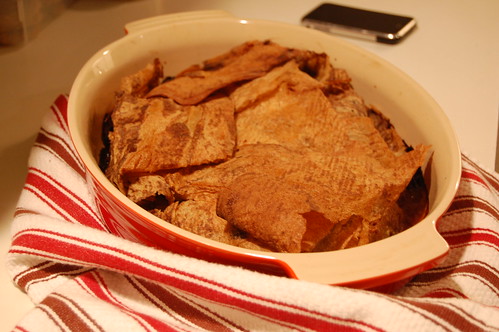
There is a chicken carcass simmering in a pot of water on my stove and my house smells wonderfully of burgeoning chicken stock. But the cause of this smell is something even more excellent and tasty - bread-wrapped roast chicken. This is a Palestinian dish found across the Levant called musakhan. Musakhan, which literally means "warmed," consists of chicken pieces and caramelized onions wrapped up in swaths of of flatbread and baked until the chicken falls off the bone and the bread absorbs all those good chicken juices.

You'll see many different versions of this across the Middle East, including fast food versions that include flatbread dough with onions and chicken baked on top. But the traditional version wraps the chicken in a kind of bread called marquq, a very thin flatbread made on a saj grill. A good Middle Eastern grocery will have marquq, but other thin flatbreads, like shraq or lavash will also work.

When I once described this dish to a friend, she exclaimed, "bread-wrapped roast chicken, that sounds like a dream!" And indeed, it is excellent. The bread, which is soft and full of chickeny juices on the bottom and crisp and crackly no top, the deep flavor of caramelized onions, the fleck of sumac, the tender meat. It's the sort of weeknight comfort food you can eat all week long.

Musakhan
While you can include the chicken wings in the pan, I find the wings are boney and take up too much space in the pan, so I usually set them aside from another use. I like to double or triple the bread on the bottom, so that it absorbs chicken and onion juices, but I like only one layer of crispy bread on the top.

1 chicken (about 3 1/2 lbs), butchered into 2 legs, 2 thighs, 2 breasts
good quality olive oil
2 large sweet onions, or 3 medium size ones
1/4 cup sumac
3-4 sheets marquq bread
salt, pepper

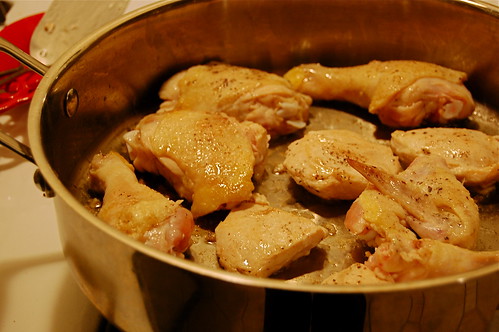
1. In a large, wide skillet, heat a small glug of the olive oil, then lightly brown the chicken on all sides over medium heat, removing to a plate as they brown. Remove and set aside. Add some more olive oil to the skillet and cook the onions until translucent, about 35 minutes, stirring occasionally. Add the sumac and cook for 2 minutes to mix.

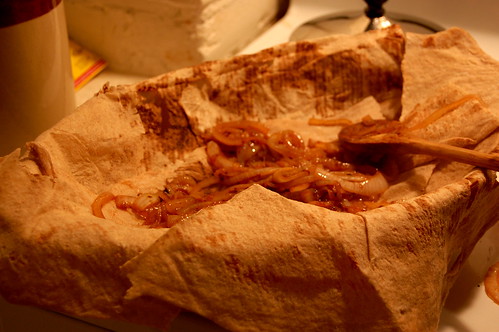
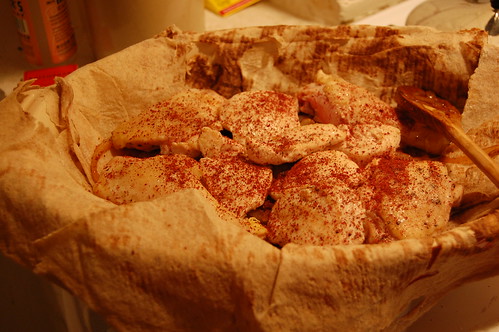
2. Preheat the oven to 325F. Grease an 8x8 inch baking dish or large casserole, then line with two or three stacked sheets of marquq bread, or two halves of Arabic-style bread. Spoon half the onions over each, then arrange the chicken on top of the onions and cover with the remaining onions and the juices from the casserole. (You want the chicken and onion to be crowded in the pan, this prevents the bread from burning.) Cover with a single sheet of marquq bread or halves of Arabic bread, tucking in the sides crusty side up and sprinkling some water over top. Place into the oven.

3. After the first 20 minutes, cover the dish with aluminum foil. Bake until the chicken is very tender and almost falling off the bone, a total of about 1 1/ 2 hours. Keep an eye on the bottom of the pan, if you see juices bubbling in the bottom of the pan add some water to the bottom of the pan so they don't burn.

3. Let rest a few minutes, then serve. Makes good leftovers.

Note: The size of marquq bread varies, so use common sense.

10 November 2007

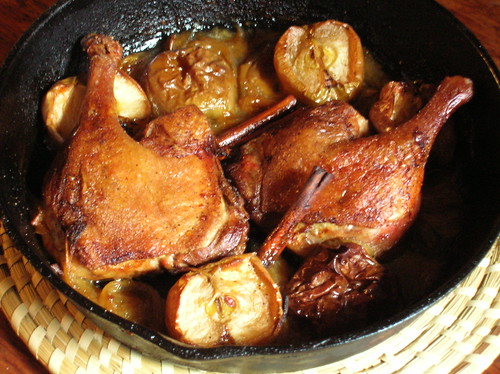
Crispy Duck Legs with Apples

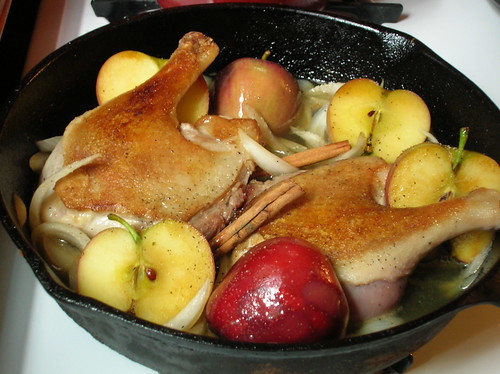
duck w/ apples (batta tufahiyya)
In medieval Baghdad, pomegranates were considered food for the poor. I know this because for a college Islamic art class I had to design an Abbasid palace with certain stylistic specifications. In addition to what seemed like thousands of assigned readings, there were extra optional readings which were intended to give us a feel for the lifestyle of the period: after all architecture is functional, and it would help us to envision the furniture and textiles which would fill the space and the daily lives of the people who would inhabit it. Being the complete nerd that I am, I stopped in the library reserves to get one of those extra readings, the first and I am sure only person to check out the musty cloth-bound papers crumbling with age. Flipping through the book I found a section devoted to the great cuisine of the caliphs and, fascinated, I spent the next hour under the awful florescent lighting of the library basement absorbing every detail.

This is how I know that pomegranates were so plentiful they were distributed to the poor, while the most prized fruits were apples and quince, which were used in stews with lamb or poultry. Later, I found that Charles Perry wrote a lovely little book translating those medieval Baghdadi recipes into modern English. But what I find even more fascinating is that those apple dishes, called tufahiyya, are still made across the Middle East today, from Syrian lamb stew to Moroccan chicken tagines. This recipe of duck and apples hews closely to the classic tufahiyya, which always use apple juice in addition to the fresh fruit. I've used small apples simply halved, but for an even more aesthetic presentation you can use whole tiny baby apples which are so prized by Arabs (if you can find them). You just eat around the seeds, and it's fun to pick up the apples by their little stems. The only change I've made is to do the braise in the oven (ovens are used very sparingly in the Middle East because they use up a lot of expensive fuel). This is where the real beauty of this dish lies: the duck legs are nestled in the liquid so they become meltingly moist, but the top peaks out so you also get perfectly crispy duck skin. There's nothing like crispy duck skin.


It may seem odd now that apples were considered the food of kings, but their deliciousness here is certainly convincing. No matter where you live or what century you're in, I think this is an autumn recipe everyone should have in their repertoire. And if you ever have to design an Abbasid palace, remember to put in a good apple orchard, and a pond for ducks. And maybe a few pomegranate trees, to distribute to your less-fortunate subjects.

On Cooking Duck: If you are at all intimidated by the idea of cooking duck, I urge you not to be. Duck legs have all the wonderful things that chicken does not: it's dark, moist, and full of meaty flavor. Duck has a bad reputation for being fatty, but most recipes call for the fat to be trimmed away. It is unfortunate that many places only sell duck whole, since the breasts and legs are really suited to different preparations. If you have a good relationship with your butcher, he may cut up a duck (or two) and sell you just the legs. If not, I urge you to go ahead and buy a whole duck: it's like a culinary treasure trove. Set aside the breasts for another use, render the fat and store it in the fridge for roasting potatoes or frites, use the skin to make duck cracklings for salad, and use the bones and giblets for amazing duck stock.


Crispy Duck Legs with Apples
A modern interpretation of a centuries-old Middle Eastern recipe. You can double or triple the recipe as needed, the only difference will be you have to transfer to a larger roasting pan. It can also be made using chicken (reduce cooking time to 45 minutes) and also with quince (poach the quince first to tenderize). Serves 2.

2 duck legs
3 very small red apples
1 cup apple juice
1 small onion, sliced into half moons
1/2 cup water
2 cinnamon sticks or 1 tsp cinnamon
1/2 tsp coriander
salt pepper, to taste

1. Preheat the oven to 375 F. Put the apple juice in a bowl, cut the apples in half (leaving the stems intact) and place them in the bowl with the apple juice.
2. The duck legs will probably have a good amount of fat and skin on the underside of the leg- trim away this fat, leaving only the skin on the outer surface of the duck legs (though you don't need the fat in this recipe, I urge you to save the fat and render it for another use). Heat a cast iron skillet or dutch oven until hot. Add the duck legs, skin side down, and cook until nicely browned. Turn over and cook for only one minute, then transfer to paper towels to drain.
3. If there is a lot of fat in the skillet drain off all but one tablespoon of it. Add the onion slices and apples, cut-side down, and saute them over medium heat until onions are softened, a few minutes. Pour in the apple juice and water, add the coriander and cinnamon sticks. Nestle the duck legs in the pan so that just the skin surface is exposed, arranging the apples around them. Sprinkle a little salt and pepper over the surface.
4. Transfer to the oven and braise for 1 hour and 10 minutes, or until duck is tender. Check it a couple times during the process to make sure the pan isn't looking dry, you may want to add a touch more water. Serve warm.

If you are as nerdy as I am, I recommend you check out Jean Bottero's "The Oldest Cuisine in the World: Cooking in Mesopotamia" (U of Chicago Press), Lilia Zaouali's "Medieval Cuisine of the Islamic World" (USC Press), or Charles Perry's "A Baghdad Cookery Book" (Prospect Books).

13 April 2007

Mastering Labaniyya, Questions of Origin Aside


A debate broke out in my office break-room one afternoon; it was heated, I remember voices were raised. It was not about politics or religion, it was about food. Get seven Syrians together talking about the origins of different Arab dishes, and you’re sure to have some lively reparte. The cuisine throughout Syria, Lebanon, Jordan, and Egypt is very similar, relying on many shared dishes, but also with regional varieties and local specialties. There was tension over whose za’atar is better, hairs bristled over baba ganoush. However, we generally agreed Palestinians could claim sayadieh, a fish dish, while Jordanians laid claim to mansaf, Lebanon had moghrabbieh, and Aleppo had its own repertory of spicy dishes.

“So what is particular to al-Sham (the Damascus area)?” Afraa asked. The labaniyya dishes, someone ventured, referring to dishes cooked in a warm yogurt sauce. These dishes, which can actually be found throughout the region, include the classic kibbe labaniyya, meatballs in a warm yogurt sauce, but they can also be made with chicken, lamb, even with pumpkin-bulgur dumplings.

I love these dishes, they have an unusual tangy warmth to them, and I always look for them on the menu in an Arab or Turkish restaurant. Unfortunately, I rarely find them and they are unknown to many Western audiences. The key is knowing how to cook the yogurt (aka laban) so that it is stabilized.

Later that week, I asked my friend Mahmoud about making cooked laban. Mahmoud not only loves to cook, but is also good at explaining things clearly. “Aha,” he exclaimed, jumping up from the couch, “there is a secret!” He proceeded to explain the method in precise detail, and then, so excited at the thought of it, dashed out the door to buy some ingredients so he could show me. The door had already closed behind him before I could even process what was going on.

It turns out, stabilizing the yogurt isn’t too difficult, and for once I was happy to have a crazy Syrian taking over my kitchen. A little egg white and cornstarch are beaten into the yogurt and then gradually heated until very warm, stirring all the while. You can actually cook the sauce all the way to boiling this way, if you stir all the while. This is the most traditional way to make yogurt sauce, bringing it to a boil, but I will admit I find it very stressful. Instead, I like to heat the yogurt until just steaming but not boiling - you don't have to worry about stirring constantly and this way it's one of the easiest and fastest soup bases you can make.

This version is a classic Lebanese one with chicken and little pearl onions that gets lots of flavor from a homemade stock. I really urge people to try this, even the shortcut version, especially if they haven’t had this kind of dish before. Once you’ve mastered the yogurt sauce, you can experiment with all kinds of fillings and additions, I often make just the stabilized yogurt sauce and stir in some cooked chickpeas and broth and serve it as a soup. Sahtain!


Chicken in Yogurt Sauce
This comforting dish is warm with tangy yogurt and homemade chicken broth. Please note the two different versions of making the yogurt sauce. To make the traditional stabilized the yogurt, it must be stirred constantly throughout the heating process, however, once the yogurt has boiled without curdling, you can consider it stabilized and relax the stirring.

1 chicken (about 3 lb), cut into 8 pieces
1 tbl sea salt
16 baby onions. peeled
1/2 bunch coriander or parsley, chopped
6 garlic cloves, smashed
for yogurt sauce:
4 cups (1 quart) plain yogurt*
1 fresh egg white
1 tbl cornstarch (or flour)

1. Put the chicken in a large pot and add water to cover. Bring to a boil, skim the surface, then add the salt and lower the heat. Simmer 45 minutes, skimming the surface occasionally. Add the onions and simmer another 15-20 minutes. Remove the chicken and onions, separate the meat, dice it and set aside with the onions. At this point, I like to to return the bones to the pot, toss in a bay leaf, and let the stock continue to simmer while I prepare the rest of the dish, though you don’t have to do this.
2. Saute the garlic cloves in a bit of olive oil until just softened, add the coriander and saute until soft and vibrant green (do not let it brown). Set garlic and coriander aside.
3. Combine the yogurt, egg white, and cornstarch in a pan off the heat and beat with a wooden spoon until very smooth and creamy, it should look glossy, almost like whipped cream. Have all your ingredients nearby (i.e. the chicken and onions, warm broth, and garlic/coriander).
4. Option One: Place the pan over medium heat and stir the yogurt mixture constantly in the same direction so it does not curdle. Let the yogurt mixture come to a boil (stirring), reduce the heat and simmer (still stirring!), about 3 minutes.
Option Two: Place the pan on the heat and heat until just steaming, stirring occiaisionally, do not let the mixture come to a boil.
5. Add the coriander, garlic, the chicken meat and the onions to the thickened yogurt sauce. Stir in about 2 cups of the warm stock and simmer the mixture, stirring occasionally, another three minutes. The sauce should be thick and combined. Serve immediately, with rice.

Shortcut version: Use leftover chicken meat (or meatballs, kibbe, or lamb) and purchased low-sodium stock. Prepare the yogurt sauce and the coriander, then stir in the meat and stock.

*A note on the yogurt: This calls for plain yogurt, not the thickened strained yogurt known as labneh or Greek yogurt. Low-fat yogurt is fine, but whole-milk yogurt will be richer. I do recommend using the freshest yogurt you can find, you want one with lots of flavor.

__