Showing posts with label Soup. Show all posts

08 May 2010

Watercress Soup


My mother always waxed rhapsodic about watercress, she'd tell tales of how she and my grandmother would gather watercress in the creeks around their home, of the peppery flavor added to tea sandwiches and salads. Now, my grandmother was a tenacious woman, not afraid to get her hands dirty, but somehow I have a hard time picturing my grandmother's Chanel lapel pins tromping around in a stream.

Nonetheless, I always pick up some watercress when it's in season as if compelled by my mother's tales, but I have often found the leaves were thick and tough, or far too peppery to eat as part of a salad. But this year I spied in my grocery a delicate plant of tiny green leaves, with its root ball preserved in a small container of water. Watercress is a fascinating organism- it thrives on the edge of streams, where it has to have constantly flowing water to protect it from parasite and snails. Watercress can quickly become wilted and bitter once removed from fresh water, which explains those many unappetizing specimens I'd had in the past.

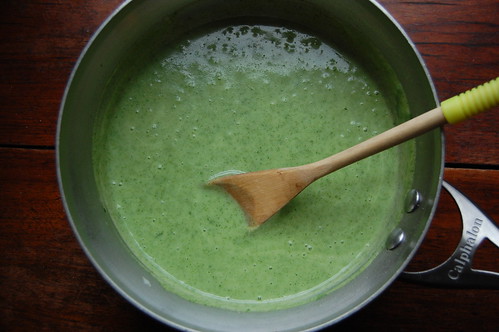
After a few pleasing crunchy salads, I turned the rest of the watercress into a pleasingly simple soup, one thickened with potato and a splash of cream, and bright green like a Shrek cartoon. It's simple in the way many good things are, you could serve it cold like a vichysoisse, or I like it warm with a nice hunk of toast.

Watercress Soup

olive oil, salt
1 large bunch watercress, leaves only, discard the stems
1 medium sweet yellow onion, peeled and diced
1 medium russet potato, peeled and roughly chopped
water or vegetable stock, about 4 cups
splash of heavy cream, optional

1. In a large saucepan, heat the olive oil over medium high-heat. Cook the onions, stirring until browned and caramelized, at least 15 minutes.
2. Pour in the water or stock, add the potatoes, season with salt, and bring to a boil. Let simmer until the potatoes are tender when pierced with a fork. If the water level gets low, add some more. When the potatoes are tender, toss in the watercress leaves and stir until wilted and bright green, a few minutes.
3. Remove the pot from the heat and allow to cool slightly. Place in a blender (or using an immersion blender), blend until very smooth. Add the cream if desired, and taste for seasoning. Reheat before serving.

07 March 2010

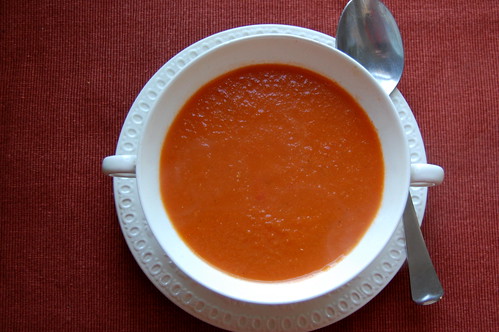
Spicy Tomato and Blue Cheese Soup

This recipe is apparently so well known that it has Google predictive text. And yet I, the person who regularly reads every food section on Wednesdays and has an entire library of cookbooks, I had never heard of it. Which is why you shouldn't feel bad if you haven't heard of it either. Let's remedy that together, shall we?

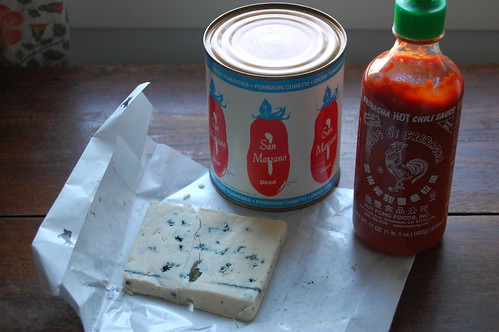
I spied this recipe over at Leite's Culinaria, and luck be had it, I had the three primary ingredients- canned tomatoes, blue cheese, and sriracha. I was snowed in at the time, and since we have already discovered that snowstorms are good for your cooking mojo- not only did I discover my new favorite salad, but perhaps also my new favorite soup.

Now, I do have a bone to pick with this recipe, which bills itself as "quick and easy," yet has 10 ingredients, some of which I deemed unnecessary. I nixed the chicken stock for water, since it's subtlety was completely hidden by the blue cheese and hot sauce elements, and left out the heavy cream since the cheese adds creaminess on its own.

Bust basically what you do is stew a can of tomatoes with some garlic and oregano, just until everything is nice and combined. Then add in chunks of blue cheese and a splash of spicy hot red pepper paste (sriracha). You puree the whole mix and that's it, you've got soup.

Now would be a good time to point out that I actually don't love blue cheese- sure it's great when you're in the mood for it, perhaps over a good wedge salad or matched with pears on a cheese plate, but it can also be overwhelming if used in excess. But paired with hot sauce and tamed with the sweetness of tomatoes, it's pretty darn great.

Spicy Tomato and Blue Cheese Soup
Adapted from Michael Symon.

a splash of olive oil
2 cloves garlic, thinly sliced
1 28-ounce can tomatoes, such as San Marzano brand
1/4 teaspoon dried oregano, or fresh of available
pinch salt
1 1/2 cups water or chicken stock
1/2 cup blue cheese
2 tablespoons sriracha sauce
a splash of heavy cream, if desired

1. Heat the olive oil in a saucepan and saute the garlic cloves until soft. Add the tomatoes, water, oregano, and salt and bring to a boil. Simmer for 15-20 minutes.
2. Add the cheese, sriracha, and cream if desired, and simmer for 5-10 more minutes, until combined. Puree in a blender, taste for seasoning. Reheat if necessary and serve.

20 January 2010

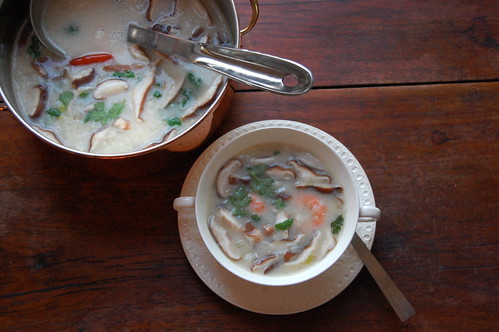
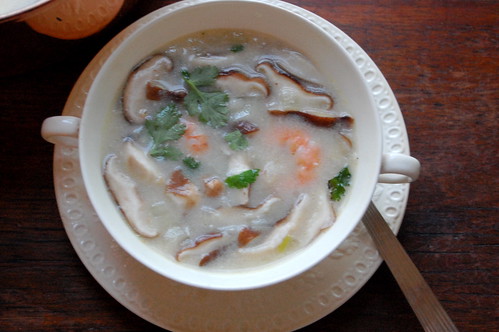
Sort of Tom Kha

When it comes to cooking, I know how to cook a lot of Middle Eastern food, a lot of American Southern food, a fair amount of Mediterranean food, and a bunch of one-off dishes from other cuisines around the world. I make a mean aloo ghobi, but I'd never claim to be proficient in Indian, I love making bao, but kung pao baffles me. This dish is one of my "one-offs," a Thai soup called tom kha gai.

I've made this version with shrimp, but it's more commonly made with chicken and can also be done with tofu. Tom kha, as we call it in my house, is one of our favorite appetizers when we go out for Thai, it's flavor packed with coconut, chiles, fish sauce, kaffir limes, and more.


It calls for a few unusual ingredients, but it won't be the end of the world if you can't find kaffir lime and galangal, though they're nice if you can. I like making it with shrimp because it's very easy to make a quick shrimp stock that gives a bright clean flavor to the soup, as opposed the powerful taste of canned stock. Also, unlike some soups that take lots of sauteeing and building of flavors, this soup comes together in minutes. There's a bit of prep work, but after that you're home free.

Tom Kha Gai
The word "tom" mean chicken, so I'm not sure what the proper recipe name would be using shrimp. No matter what you use, it should be tasty. If using chicken or tofu, substitute the appropriate stock and skip step one. Also, be warned the coconut milk separates out when the soup sits overnight, you can stir it back together and it tastes just the same, but it's not the prettiest thing in the world. Serves 4 as an appetizer.

6 cups water or stock
1 lb shrimp, or shredded cooked chicken or cubed tofu as desired
1 knob ginger, peeled and diced
1 1-inch cube galangal, thinly sliced
3-4 small pieces (about 2 inches each) lemongrass, bruised
2 kaffir lime leaves, or 3 tablespoon lime juice
2 tablespoons fish sauce
2 tablespoons brown sugar, or to taste
1-4 whole red chiles, your choice
a handful of shitake mushrooms, enoki mushrooms are also nice
1 1/2 cups coconut milk
cilantro leaves for serving

1. If using shrimp, peel shrimp, reserving the peels and setting aside shrimp. Heat a small amount of oil in a pot and toast the shell under thickened but not completely pink. Add the water and a pinch of salt, and let simmer for 15-20 minutes (no longer). Strain out the shells and any debris and discard.
2. Place the stock back in the pan and add the ginger, galangal, lemon grass, kaffir lime, and shitake mushrooms. Let simmer 5 minutes or until the ginger is softened (test one, no one wants crunchy ginger in their soup). Add the fish sauce, brown sugar, chile pepper, shrimp, and coconut milk. Simmer 2-3 minutes, until the shrimp are cooked through but not overcooked They should be plump and pink, but not curled into a tight little ball. Taste for seasoning.
3. Serve immediately, garnished with cilantro.

19 April 2008

Kubbe

If I could write a cookbook from the ground up, I'd want to travel all over the towns of Kurdistan, from the mountains of southern Turkey to the Tigris in Iraq to northern Iran, and collect their recipes. I want to know more about malthoum and kebab kishkash, about the wheat harvest in Mosul and mountain cheeses. This region is a great reminder that the borders of the modern Middle East were mainly drawn by arbitrary lines sketched on a map, and there are a lot of different ways to view the Middle East along ethnic, religious, and even culinary or linguistic lines.


My introduction to the diversity of this region came while living in Damascus, where I spent a good amount of time with a Christian family that hailed from Hasake and Qamishli, in the far northeastern corner of Syria. The Kurdish region stretches from it's western tip in Aleppo, Syria through Turkey, Iraq, and the it's eastern edge in Iran. Western media seems to paint this region simply as Kurdish, but in reality it's a fascinatingly beautiful part of the world that has long been home to a wide variety of ethnicities and religions: there's Armenians and Arabs, Yazidis and Zoroastrians, a large Christian population, including Assyrians and Chaldeans, and the region had a sizeable Jewish population before 1948. I had two Kurdish friends in Damascus who regularly conversed in Sorani and introduced me to colorful Kurdish textiles and fiercely flavored red pepper dip. We went to a concert of Kurdish music held at the French Embassy one evening (Kurdish music and gatherings are banned from public venues in Syria), and I saw old men cry at the joy of being able to share their beautiful songs.

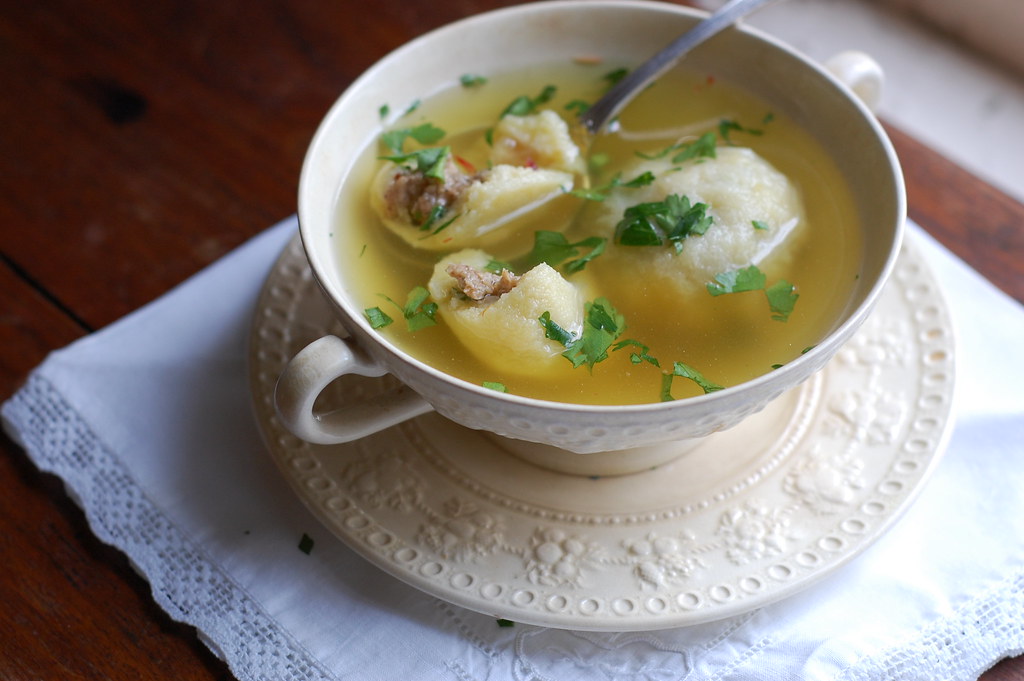
The cuisine of Kurdistan is rich with the influences of Arab, Armenian, and Persian cooking, and it's also terrifically unexplored. The most famous dish from this region is kubbe, a meat-stuffed dumpling poached in broth. As the name implies, kubbe is related to kibbe, the Middle Eastern meat and bulgur dumplings (or patties, or casserole, depending on the incarnation). Similarly, there are many variations of kubbe- some people make the dumpling shell with a mixture of bulgur and semolina, some use all semolina, others add some matzo meal or use ground rice. The broth always has a slight tart element to it but it can vary from a simple lemony chicken broth to a saffron broth to a tomato-tamarind broth favored in Iraq or even a plum-flavored soup in Iran.

Ever since I first made kubbe, kneading about 20 pounds of dough with two other women on the floor of a Damascene apartment, I've been collecting kubbe recipes and tips. These days I make an all semolina dough and stuff it with a lamb mixture brightly spiced with parsley, dried fruits and pine nuts. A homemade chicken stock with a good dose of fresh lemon juice and a pinch of saffron (if I'm feeling plush) makes the base of the soup. You don't have to have any interest in Kurdish cuisine to love kubbe, there's something universally appealing about these dumplings in warm lemony broth.

Kubbe is very popular in Israel, where it was brought by Jewish immigrants from northern Iraq, it's similarity to matzo ball soup makes it a popular choice for Passover, which begins tonight. If you want to make it for Passover, use matzo meal in the dough, as semolina is hametz.

Kubbe (Meat-Stuffed Semolina Dumplings in Broth)
Though the dough can seem difficult to work with at first, in reality it's quite forgiving, if it tears merely patch it with another bit of dough. I've made this for vegetarians using vegetarian sausage and vegetable broth (heresy, I know!) and even avowed carnivores couldn't tell the difference. Makes about 4 main-coarse servings.

for the dough:
2 cups fine semolina (semolina flour, often found in the pasta aisle, works perfectly)
1/4 cup flour
pinch salt
1 cup hot water
for the filling:
1 small onion or shallot, diced
1 lb lean ground lamb (you can also use beef)
1/4 teaspoon each cinnamon, allspice
1/4 cup chopped dried cherries, currants, or cranberries
1/2 cup chopped parsley
2 heaping tablespoons pine nuts or chopped slivered almonds
for the broth:
6 cups good homemade chicken stock
1/2 cup fresh lemon juice
a pinch of saffron
salt, a tiny bit of red pepper to taste
chopped parsley for serving

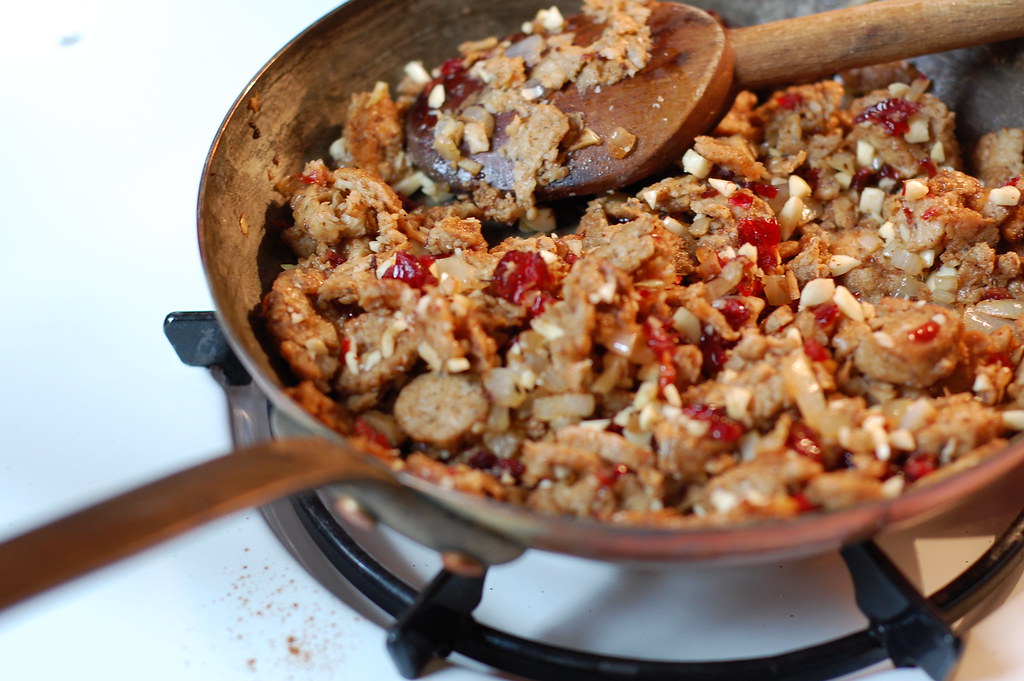
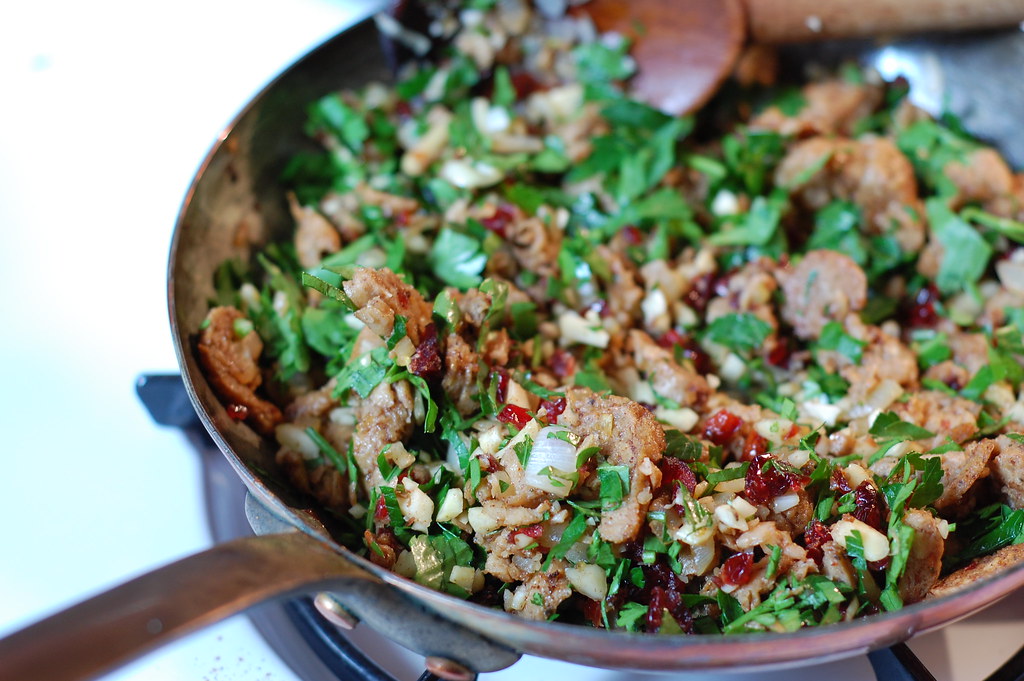
1. Make filling: Heat some olive oil in a saute pan. Add the onion and saute until softened, a few minutes. Add the ground lamb, season with salt and cook over medium heat, breaking up the pieces, until it is nicely browned, 10-15 minutes. Stir in the cherries and pine nuts in the last few minutes of cooking. Stir in the parsley to combine and then remove from the heat.
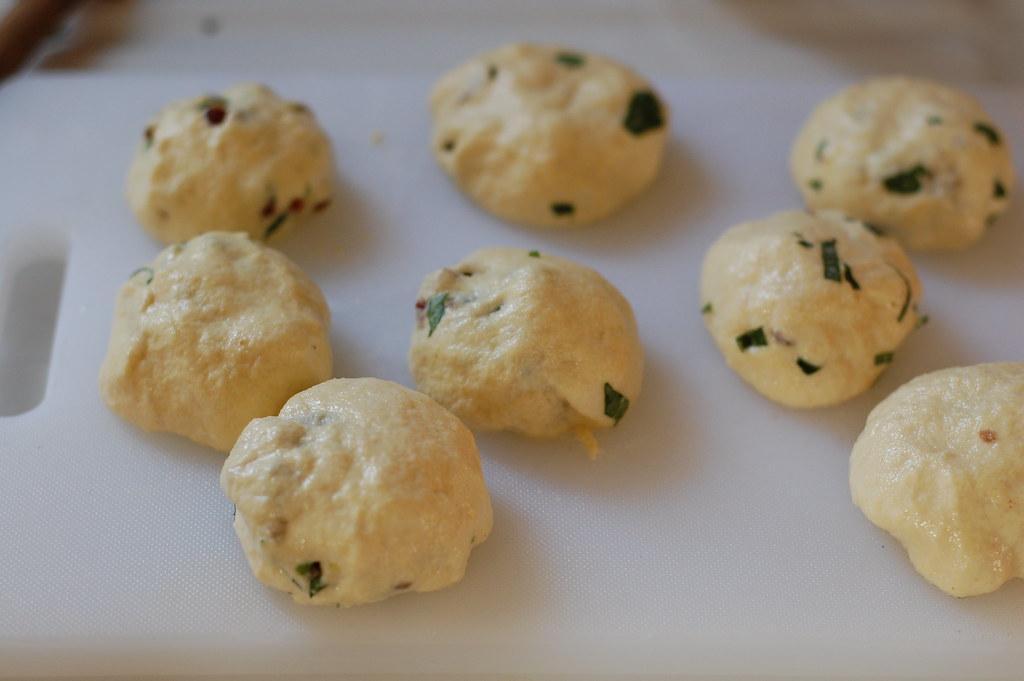
2. Make dough: mix together semolina, flour, and salt in a bowl. Gradually mix in hot water, stirring with a fork, until the consistency of playdough. Add a touch more water if necessary. Let rest 15 minutes. Knead the dough again (I do this by pressing it around with a silicone spatula) until pliable. Working with damp hands, take a walnut sized piece of dough and flatten it in your palm. Place a small spoonful of the meat mixture in the center, then close up the dumpling and roll it around between your palms. Your goal is to have a very thin shell encasing a good portion of meat, but this takes some practice. Continue forming dumplings, always keeping your hands damp to prevent sticking.
3. Bring a pot of water to boil, lower the heat so the water is just simmering. Poach the dumplings in the water (you may have to do this in batches) for 15 minutes. The dumplings may float before this, but they need the full 15 minutes for the semolina to cook. Remove with a slotted spoon.
4. While the kubbe are poaching, bring chicken broth to a simmer, add the saffron and season to taste. Stir in the lemon juice. Add as many kubbe as you are going to serve to the broth (reserve any extra dumplings separately), and let reheat for 1-2 minutes. Place a few kubbe in a bowl, ladle the broth over top. Sprinkle with parsley and serve.

27 November 2007

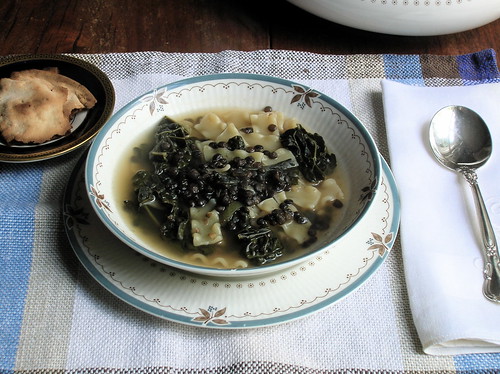
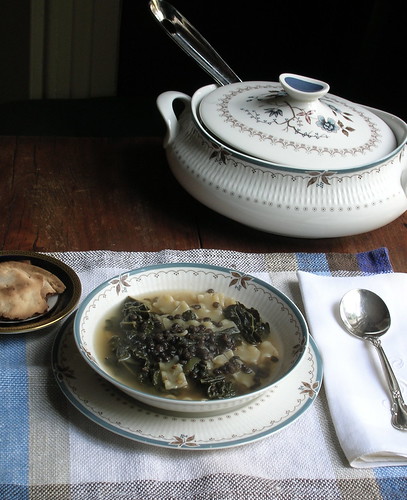
Tuscan Kale and Black Lentil Soup with Crispy Pita Chips

It's getting cold now. I have to put on gloves when I get up early in the morning, soon I'll need a scarf too. The dog is learning to walk on a leash, though it's a stop-and start process. She knows when we walk past the hardware store that Jeff will come out and give her a big bear hug and rub her belly. On Sundays when they're closed she pulls at the leash, ready to roll over at any moment, always a little disappointed. We've pretty much put the garden to bed now. The morning after the first frost we came out to find the elephant ears, previously six feet tall, slumped over like wrinkled old men. There's still hardy kale and broccoli growing. Maybe because I'm a procrastinator too, I've got a soft spot for those very last crops of the year. Other people rave about spring and asparagus or summer tomatoes, but there's something to be said about deep earthy greens, about hard round squashes. Solid. Things that don't emerge until the very end of the year and that sustain through the coldest months. I read somewhere that kale tastes sweeter after the first frost, you're supposed to pick some before and after the frost and compare them. I forgot.


I also haven't raked the leaves in the front yard, they fall bright yellow and red at first, slowly shriveling to brown. I like that I can hear the children walking by on their way to school in the morning, crunch, crunch, kicking up footfuls of leaves. It's the time for soups, for the fortification of dark leafy things and the warmth of broth. In these few weeks between Thanksgiving and Christmas, before the sweets and the presents and the snow, I like to keep things as simple as possible. Taking stock of what's in the pantry, cleaning out the closets for Goodwill, planting narcissus that will bloom for the holidays. Winter always seems to bring out the ascetic in me, as the rest of the world is ramping up the commercialism of the holidays, I need to burrow into the pantry for a moment. This soup, with winter greens and a smattering of lentils floating a lemony broth, is the perfect thing to burrow with. It's a good thing, because soon I'll have to get out a scarf and go rake the leaves.


Tuscan Kale and Black Lentil Soup with Pita Crisps
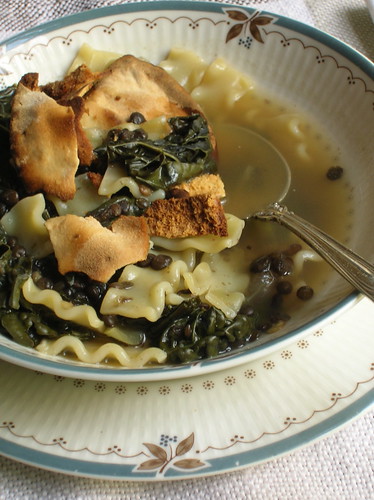
Umm Hana used to make this soup often, it was her take on a Syrian classic "adas bi hamud," but with the addition of pasta pieces it strikes me as the Syrian version of minestrone. My friend Michael, who lives on a diet of chicken, rice, and potatoes, loves this and it's about the only vegetal thing I've seen him eat with gusto. Don't skip the pita crisps, they're our favorite part.

2 tablespoons olive oil
6 garlic cloves, smashed
8 cups water*
1 cup black or brown lentils, like beluga or lentilles de puy
8 leaves cavolo nero (Tuscan kale) or 12 leaves Swiss chard, ribs removed and leaves roughly chopped
1 teaspoon mild vinegar
1/2 cup broken up egg noodles or small pasta shapes
juice of 2 lemons
for the pita chips: pita bread, 1 cup olive oil

1. In a large pot, heat the olive oil and saute the garlic cloves until softened but not browned. Add the water and the lentils and bring to a boil. Season with salt and pepper and add the kale leaves and vinegar (if using swiss chard, do not add until later). Lower the heat and simmer 30 minutes, until lentils are soft.
2. Meanwhile, make the pita chips. Break the pita into bite-size pieces. Heat the olive oil in a deep pot until hot. Add the pita chips and fry until golden brown, a few minutes. Remove with a slotted spoon to drain on paper towels. If frying the pita chips is not to your taste, you can brush them with olive oil and toast them in a hot oven until crisp.
3. After the soup has simmered, add the noodles (and swiss chard, if using) and simmer another ten minutes until noodles are soft. Add more water if the soup is too thick and taste for seasoning. Remove from the heat and add the lemon juice- don't skimp, it should be very lemony. Serve immediately, with pita chips.

* I am a strong believer that using water is usually better than using canned chicken stock. The Syrian way to do this would be to toss a few bones in the soup pot for flavor than fish them out before serving. If you have soup bones go ahead and use them, or use a homemade (not purchased) stock. I find the liquid gets body from the lentils and greens, and flavor from the lemon, so using water is just fine.

04 November 2007

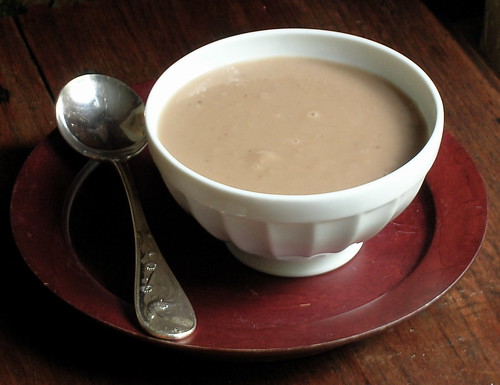
Creamy Autumn Chestnut Soup

With Thanksgiving around the corner, I thought it might be nice to talk about a recipe that could grace your table, as it will mine. I use the word grace because this recipe is elegant and satisfying, yet it's not at all pretentious or fancy.

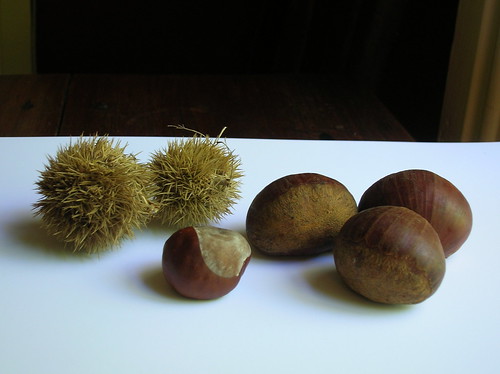
If you were me, growing up chestnuts were something you sang about in a song, and that was it. Sure, you knew they were supposed to be eaten (or at least roasted on an open fire), but mainly they just dropped their prickly shells from trees and never made it to your own table. It wasn't until I went to Italy when I was twenty that I actually realized what a chestnut was and how it was eaten. It was a bitter cold January and I bought some from one of the many of the streetside vendors, holding their hot roasted shells as hand warmers in my new Sermoneta gloves. And if you are expecting some sort of chestnut-epiphany, I'm afraid I was rather disappointed with that chestnut, and promptly disregarded whatever culinary merits it offered.
Later, on a different cold winter afternoon, I went to browse New York's Neue Gallerie, and then decided to treat myself to lunch in their cafe. Cafe Sabarsky is probably one of my favorite places for a sophisticated bite, and though I swoon over their Austrian pastries, this particular day I had a bowl of chestnut soup. And here, my friends, is where the chestnut-epihpany happened. Ever since then, I've made all sorts of chestnut soups, stuffings, ragouts, and cakes, determined to make up for lost time. New York Magazine even published the recipe for the cafe's chestnut soup, and I made that too. The soup was good, but it didn't quite capture the magic of that first one I had, and the recipe was terribly complicated- it even calls for making porcini foam.

Each autumn over the past four years I've fiddled and tweaked with that chestnut soup recipe, simplifying and adjusting the components. I think I've finally got it. The result is good enough to cause your own chestnut-epiphany, but it's also easy enough to make and eat during the week. I've made this both roasting the chestnuts myself and buying bottled-peeled chestnuts, and though I do think it is most flavorful with fresh-chestnuts, it's excellent with the prepared kind, and you'll save yourself the pain of peeling them yourself (is there a way to peel chestnuts without loosing a few fingernails?).


To call this simply chestnut soup would be to simplify it's other components- the mushroom broth, the sweet fennel, the hints of wine and nutmeg, so I called it creamy autumn chestnut soup, embodying the warmth of the season. It's just as good in winter, too. And whether you choose this for your Thanksgiving table, or simply for any afternoon, I'm sure you'll be thankful you made it.

P.S. If you subscribe to this blog via Bloglines, I know there's a problem with a feed and am working to fix it (advice, anyone?) In the meantime, I hope you'll be patient enough to click over here as I am still updating regularly.
Creamy Autumn Chestnut Soup
This is the soup I look forward to every autumn. If fennel is not to your taste, a thinly sliced celeriac bulb also works nicely. For a fancier presentation, serve garnished with creme fraiche or an Armagnac-soaked prune.

4 cups light vegetable stock or broth
12 oz button mushrooms, roughly chopped
3 tablespoons butter
1/2 a fennel bulb, cored and sliced
16 oz shelled roast chestnuts, roughly chopped (bottled or fresh-roasted, see below)
2 tablespoons sugar
1/2 cup white wine, preferably Riesling
salt, nutmeg, to taste
1/2 cup heavy cream

1. Put the stock and mushrooms in a saucepan, bring to a boil, and simmer for 15 minutes. Set aside and let cool completely. Strain the out mushrooms and discard or set aside for another use.
2. Melt the butter in a large pot. Add the fennel slices and saute for a few minutes, until beginning to soften. Add the chopped chestnuts, sprinkle the sugar over top, increase the heat to high for a couple minutes until the mixture begins to caramelize. Reduce the heat back to medium and deglaze the pan with the white wine. Stir the mixture for one minute, then add the mushroom stock. Season with salt, pepper, and nutmeg. Bring the mixture to a boil, then simmer the mixture over low heat for 20 minutes. Stir in the cream and remove the pot from the heat. Let cool slightly.
3. Blend the mixture with a blender until completely smooth. Strain the mixture through a fine sieve. Reheat, season to taste, and serve.
To prepare fresh chestnuts: Preheat oven to 375 degrees. With a sharp paring knife, cut an X into the flat side of each chestnut. Place the nuts in a single layer on a baking sheet, and roast in the middle of the oven for 10 to 12 minutes, until the shell curls. Remove from oven, and allow to cool. Peel and discard the shells, reserving the chestnuts.

06 September 2007

For Summer, Not Quite Gone, Already Missed


It seems another season is slipping away before I’ve had a chance to savour it fully. Summer, with your warm sun, your flip-flops, your sweaty brows, your picnics in the park, your corn and tomatoes, I just need a little more time. Yes, I know that the season lasts another three weeks, but just the word September is enough to send shivers down my spine. September says school and work and back to the daily grind. It’s enough to make me pack up my pencil boxes and Hello Kitty folders and head back to school.

How could it be that as someone who writes about food, I haven’t even gotten around to telling you about the vegetables I grew in pots this summer: the tiny sweet 100 tomatoes almost candy-like in their sweetness, the Brandywines and Mr. Stripeys, the Ichiban eggplants and peppers and purple basil. Oh sure, we ate our fill of corn and crabs and squash, but as the end of August approached, I realized I hadn’t even made my ajo blanco, my white gazpacho. I had talked frequently about this chilled garlic soup, telling friends about how I had to make it every summer, and yet I still hadn’t done it.


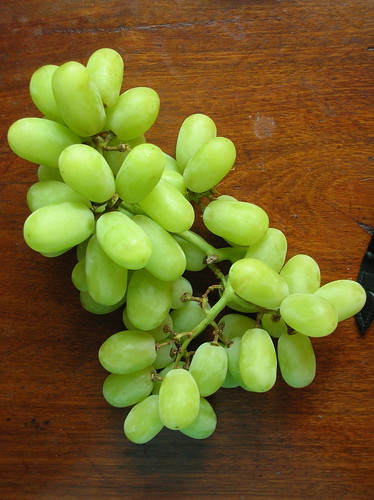
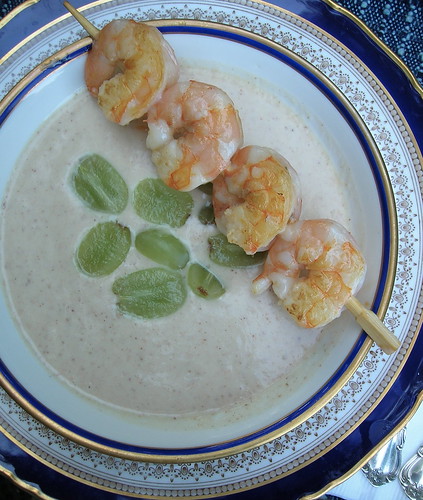
If you told someone that this beloved summer dish was a soup made from garlic, almonds, and stale bread, and served with green grapes, they might raise a skeptical eyebrow. However, ajo blanco is a traditional Spanish dish , one of the many varieties of gazpacho, or chilled smooth soups. It is creamy, redolent of garlic and accented by the bright pop of grapes, a combination of tastes and textures that make it one of the most refreshing things I can think of on a hot day. The first time I made it several years ago, I loved it so much I ate it for breakfast the next morning. Unfortunately, the garlic had intensified overnight to nearly dragon-breath strength and I went off to a 3 hour dance rehearsal with a taste in my mouth no mint or gum could mask.


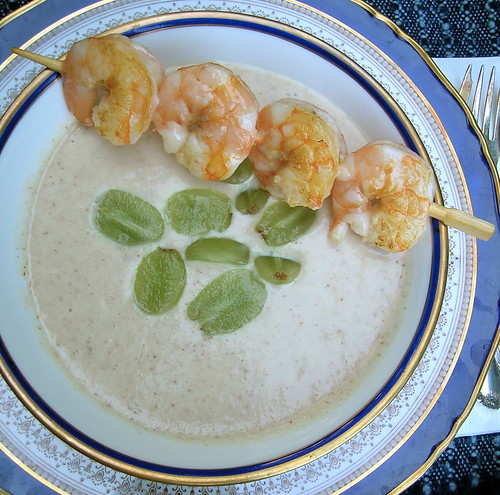
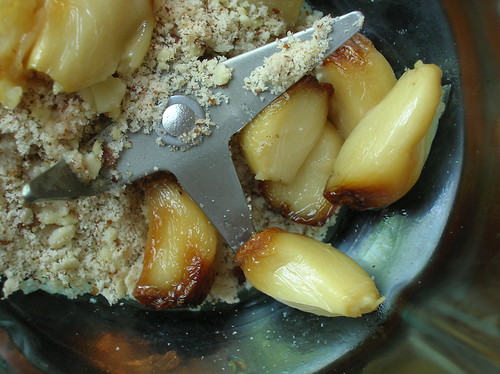
Since my unfortunate garlic-breath incident, I’ve come up with a solution that keeps all my favorite qualities of ajo blanco without the pungency: roasted garlic. Roasting the garlic imbues the dish with a mellow flavor, and enables you to use a lot more: one whole head per serving! In fact, if you make the soup with only roasted garlic, you won’t even taste the garlic at all, so I reserve one raw garlic clove for a bit of accent. And while I obviously think ajo blanco is good any time of day, I do have a favorite way of serving it: for a full menu, pair it with simple shrimp skewers and a green frisee salad.

In fact, it’s this entire meal that says summer to me, pulling the shrimp off the skewers, dipping them into the creamy soup, the pleasant crunch of lettuce. We still have a good few weeks of summer left, my sweet 100 tomato plant is still producing, the sun doesn’t set until after eight. So I’m holding on to what’s left, the last of the tomatoes and plums, a few more dinners with chilled soup and twilight in the background, I’m milking it for all it’s worth.


Ajo Blanco (White Gazpacho)
This chilled soup of almonds and garlic is a summer staple in my house. Don’t be alarmed by the amount of garlic, roasting tames any of it’s pungency. I like to serve ajo blanco with shrimp and a nice frisee salad.

1/4 cup olive oil
4 heads garlic
2 stale crusty rolls or one 5” hunk of baguette
1 cup whole almonds
3 tbl sherry vinegar or white wine vinegar
2 1/2 cups water
pinch salt
1/2 cup green grapes, halved

1. Preheat the oven to 375 F. Cut off the top third of the garlic heads, so the tips of the cloves are exposed. Separate one small garlic clove and set aside. Choose a small baking dish or oven-proof pot and pour in the olive oil, place the garlic heads cut side down and cover the dish tightly with foil. Bake 40-45 minutes, until the garlic is tender. Set aside to cool.
2. Tear the bread into chunks, place in a bowl and cover with cold water to soak. Place the almonds in a food processor and pulse until finely ground (I usually make this soup in my blender, in which case I grind the almonds in a coffee grinder first, then add them to the blender). Take the garlic heads (don’t discard the oil they were in) and squeeze the cloves out into the blender jar. Add the reserved raw garlic clove, squeeze the water from the bread, and add bread to the processor, pulse to combine. Add the vinegar and salt, then drizzle in some of the reserved olive oil and blend until a smooth paste forms. Thin the soup with the water to desired consistency.
3. Chill the soup for in the refrigerator until serving (if it thickens, thin it with more water before serving). Ladle the cold soup into bowls, and sprinkle with the green grapes.

Make a Meal of It: Serve the ajo blanco with shrimp skewers and a green salad. Thread shrimp onto skewers (leftover chopsticks also work) and rub with a little olive oil, salt, and red pepper. Sear the shrimp on a preheated grill/grill pan, until plump and pink. I like to make a frisee with an anchovy dressing on the side.
_________________________________

04 September 2007

August and It's Favorite Lunch

sunflowers
Whew, aren’t you glad that’s over? As much as I enjoyed exploring one item in depth, by dedicating August to ice cream, I unwittingly side-stepped all those other culinary joys of late summer. Contrary to popular belief, I do not subsist on sweets, and all through August I kept thinking about the other wonderful edible things I was enjoying and how I wished I could share them with you here. About the simple pleasures of August, the vase of sunflowers on your table, the late summer sun, the bowl of fresh-sliced fruit.

About how this was the absolute best peach of the summer:
best peach of 2007

Or about the watermelon that was so sweet and juicy, it was tender all the way to the rind:
baby watermelonbaby watermelon

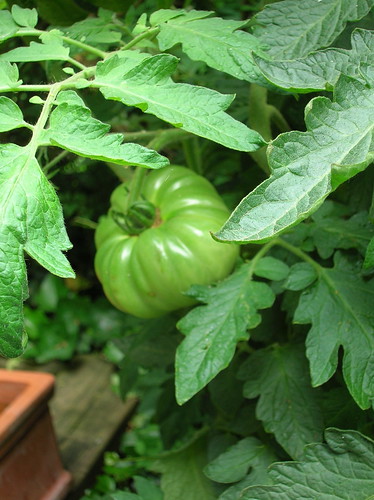
Or the thousands of heirloom tomatoes consumed. One perfect Sunday we went on a picnic with friends and brought along an assortment of seven different types and had a tomato tasting. The large green heirloom won, and I’ve been loving the small Green zebra tomatoes. Somehow the green-when-fully-ripe varieties taste the most like tomatoes, perhaps because they are more vegetal and less sweet.

tomato tastingtomatoeszebra tomatoes

And of course, there are the tomatoes I grew in pots, four different varieties, along with eggplants and peppers and herbs. Speaking of which, I didn’t get to tell you about the conversation I had with the guy at the market about lovage (a celery-like herb), and how it’s often used in Romanian cuisine, and the differences between marjorum and thyme.

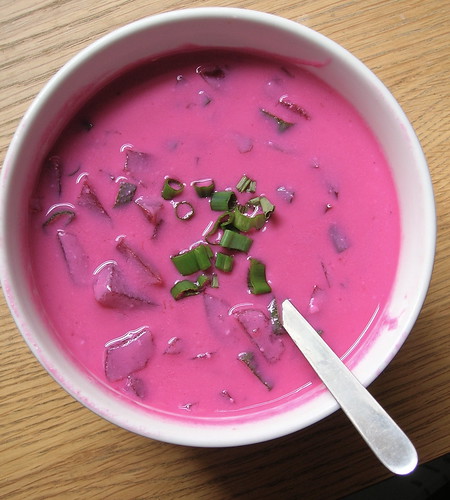
The good thing about all of this produce is there’s almost no cooking required. Summer food generally goes something like this: shop (preferably at a farmer’s market), slice, and enjoy. And true to form, I’ve barely done any cooking over the past month, and yet I’ve been eating fabulously. There has been, however, one dish that’s been making repeated visits to my lunch hour, when it’s not usurped by those tomatoes. Summer borscht, a twist on that Russian classic in the form of chilled beet and yogurt soup. I actually first made this soup back in the winter (it’s good in any season), and loved it, and since then I’ve made it at least six times, a near miracle around here.

It should be no surprise that I like this, since one of my favorite appetizers/mezzes is a beet and yogurt dip (to make it: combine grated cooked beets, plain yogurt, with garlic, lemon, and mint or dill to taste). This soup is full of crunchy cucumbers and beets and creamy yogurt, and though it has lots of ingredients, it will still be good should you happen to be out of sour cream, or accidentally omit the vinegar. Because you stir everything together and let it sit overnight, it’s perfect for your lunchbox, and I can attest to the fact that it travels well. It would also be a good make-ahead dish for company, with some salmon and nice slices of pumpernickel bread. Just don’t be alarmed by it’s shockingly pink color, which I have to say, brings me a bit of child-like glee.

So here’s to August. I’ve planted beets for fall and they’re already growing like crazy, so I have a feeling summer’s favorite lunch is here to stay.

Summer Borscht
I love this cool, creamy soup enough for any season. Please note that this is a large recipe and you'd be well-advised to halve it. Also, I usually use non-fat or low-fat yogurt and sour cream and find there's no harm done. Adapted from Ina Garten.

4 large or 5 medium beets
12 oz (1 1/2 cups) plain yogurt
8 oz (1 cup) sour cream
1 tbl sugar
2 tsp mild vinegar or lemon juice
water or chicken stock
salt and pepper
2 cups seeded and diced cucumber
1/2 cup diced scallions
2 tsp chopped fresh dill

1. Scrub your beets well to remove any traces of dirt from them. Place the beets in a large pot of boiling salted water and cook uncovered until the beets are tender, 30 to 40 minutes. Remove the beets to a bowl with a slotted spoon and set aside to cool. Strain the cooking liquid through a fine sieve and also set aside to cool.
2. Peel the cooled beets with a small paring knife or rub the skins off with your hands. Cut the beets in small to medium dice.
3. In a large bowl, whisk together 1 1/2 cups of the beet cooking liquid, yogurt, sour cream, sugar, vinegar, a pinch of salt and pepper. Add enough water or stock to the soup base to reach a thick-but-pourable consistency (you may not need any, or you may need up to 1 cup). Add the beets, cucumber, scallions, and dill to the soup. Cover with plastic wrap and chill for at least 4 hours or overnight. Season, to taste, and serve cold with an extra sprig of fresh dill.
________________________________________________

03 August 2007

A Soup Made of Ladies

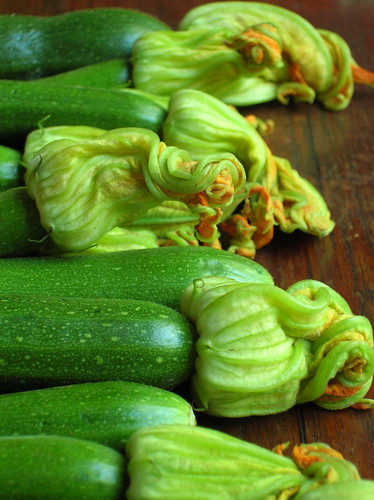
female zucchinis
Title IX: We are female zucchinis, we demand equal rights!

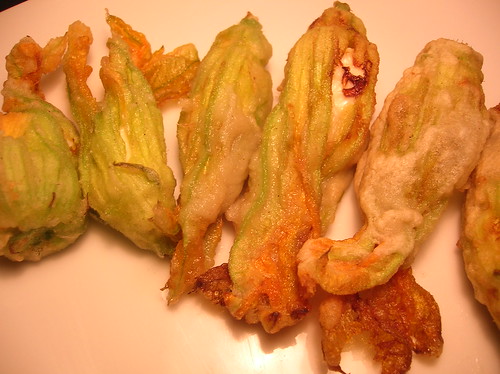
I’ve been pining away for weeks now for a good squash blossom fritter. It’s one of the things I love this time of year, when everyone else is going zucchini-crazy, I’m foraging for the blossoms. Since I don’t grow my own squash, I don’t have my own blossoms to pick, and I haven’t found any at the market yet that look viable (like this). I always stuff them with a little cheese-egg mixture (Boursin cheese works well), then batter and fry them.

Dear M., who’s been hearing me go on about the squash blossoms I cannot find, sweetly brought me some squash from the market the other day. They were beautiful, but I quickly recognized they weren’t the kind I use for stuffing. Then I remembered: squash are male and female. The large male blossoms are the ones used for stuffing, while the female blossoms grow attached to the little squashes. Today’s anatomy lesson.


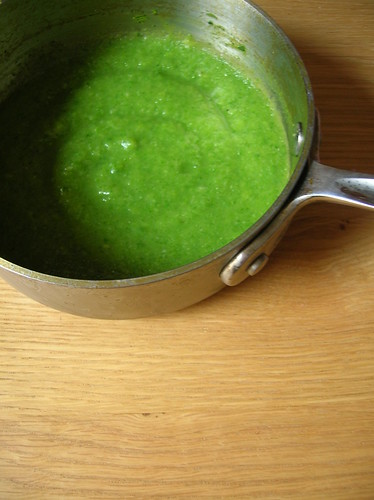
Here’s a tip from our farmer: start picking your zucchini as soon as possible. Picking your zucchini early will prevent the glut of baseball-bat-sized zucchini later in the season. And not only will you have fewer zucchini to deal with, but the tiny zucchini are the most flavorful, tender, and beautifully green. Small squash with their flowers still attached are often used in cooking, in Greece they might be folded whole into an omelet, or used in Mexico as a filling for quesadillas. I made simple soup that is really just a purée of baby (female) zucchinis and their flowers. It’s simple in the way that summer food can be: bursting with flavor and color. I like to call this a soup made of ladies, or a soup for ladies, but I think both sexes will enjoy it.

After making the soup, I finally got hold of those blossoms I was coveting, so I made a little composed dish: purée of (female) zucchinis topped with (male) blossom fritters. Both components are delicious on their own, but they also go together perfectly. Equality of the sexes and all.

Eeek, I know, horrible picture, but check out that oozy cheese.

Purée of Female Zucchini
Squash blossoms are both male and female, the females produce fruits, while the male do not. Whole female zucchini, with both squash and blossoms, are puréed together in this simple but wonderful summer soup. Adding a few fresh basil leaves is also a nice touch.

10-12 baby female zucchini with their blossoms still attached
2 tbl olive oil
water or stock
salt to taste

1. Slice the zucchini, discard the nubby top piece, and dice the flowers. Heat the olive oil in a wide saucepan and sauté the zucchini rounds over medium heat, until they begin the soften and have some brown spots. Add the zucchini flowers and toss just to combine. Immediately add just enough water or stock to cover the bottom of the pan by about one inch and season with salt. Bring the mixture to a boil, then simmer until everything is soft and combined, only about 3-5 minutes. Let the mixture cool slightly, then purée in a blender until smooth.

Male and Female: Purée of Zucchini Topped with Squash Blossom Fritters
Whole female squash are used in the purée, while male squash blossoms are used to make delectable fritters.

purée of female zucchini, as above
for the fritters:
4 large male squash blossoms
1/4 cup Boursin cheese
1 egg
1 cup flour
1 cup very cold mineral water
oil, for deep frying

1. Prepare the zucchini purée as directed above.
2. Heat the oil in a deep pot. In a small bowl, beat together the egg and the Boursin cheese. Stuff each blossom with about a tablespoon of cheese mixture. In another bowl, combine the flour and the cold water in a few swift strokes (it’s ok if it’s lumpy). Dredge the flowers in the batter, then fry in the hot oil for a few minutes until crisp and browned. Drain fritters on paper towels.
3. Ladle the purée in four shallow bowls. Top each bowl with a squash blossom fritter, serve immediately.
________________________________________

19 July 2007

An Answer, in Soup Form


My mother has a tendency to ask rather odd questions at random moments. This may be endearing to her friends, but in the unique position of a daughter, I have the special ability to turn just about anything into an embarassment. The other night she mused, "I think I'll give up electricity. I'll buy a house without power." Umm, "Mom, this is the part where I roll my eyes at you." When traveling on our recent vacation there were plenty of opportunities for random observations and quotable quotes, including, "if you were the first colonist to sail up the Chesapeake Bay, what do you think you'd eat?" Out of nowhere, I kid you not.

"Well," I said, "crabs. And corn." I tried to channel Rachel Carson and think of the bounty of the Chesapeake several hundred years ago, before the menhaden all died. But my mother's question had also sparked another inspiration, albeit a more trivial one. I'd been puzzling around an idea for a Thai-style curry in my head, some kind of coconut milk stew, but I couldn't figure out what components I wanted. Aha, I thought, why not take those traditional Maryland ingredients, corn and crab, with coconut they'd be perfect together.

My instincts were right, and the marriage of ingredients are sweet, creamy, with a hint of spice. This is the perfect use for sweet summer corn, and though it takes a little bit of prep-work, the flavor is worth it (I do, however, give a shortcut version below that's good in a pinch). I know crab meat is expensive, but it stands out here, whether ladled into deep bowls or draped luxuriously over rice. If you want, I imagine some halved cherry tomatoes or sautéed red peppers would also be good, and add some acidity to balance the sweetness. In the end, I decided this is more summer-time stew than Thai-style curry, but no matter what you call it, it's sure good, so maybe mom's questions are useful afterall.


Corn, Crab, and Coconut Stew
Don't be fooled by the use of the word stew, though this dish is thick and satisfying, the sweetness of coconut and corn and wonderful lumps of crab mean it's perfect for summer. If you have access to good fresh corn, it's worth it to make the full-scale version, but if you're in a pinch check out the cheat's version below. Serve in bowls with a green salad on the side or serve over rice.

1 teaspoon butter
1/2 a large sweet white onion (such as Vidalia), diced
1 tablespoon minced lemongrass (optional)
1 1/2 cups coconut milk
6 large ears sweet white corn, or 4 cups corn
2 cups (12 oz) lump crab meat
salt, to taste
Aleppo pepper, red pepper, or chile sauce, to taste
1 tsp lime juice

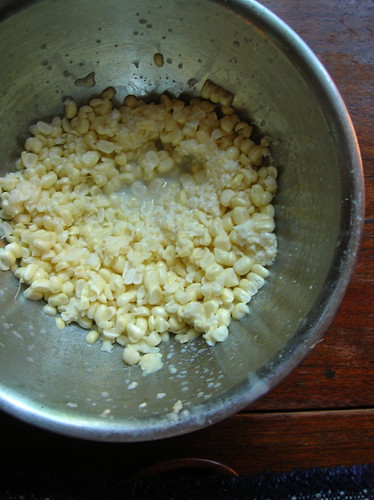
1. Shuck the corn. Working over a deep bowl, cut the kernels from the cobs, then scrape the cobs with the back of your knife to get the remaining corn juices. You should have about ~4 cups corn. Transfer half the corn kernels to a food processor and pulse until you have a chunky puree. Add the puree back to the bowl with the corn kernels.
2. Melt the butter in a saucepan, add the onion and lemongrass and sauté until softened, about 5 minutes. Add 1/2 cup water to the pan, stir to deglaze the bottom of the pan, then add the coconut milk. Stir in the corn mixture and season with salt. You may want to add some more water to adjust the consistency of the soup. Bring to a boil, then lower the heat and simmer until thickened and combined, about 5 minutes. Stir in 1 1/2 cups of the crab meat and season with red pepper and lime juice. Ladle into bowls, then mound reserved crab in the center of each bowl. Put a few drops of hot sauce on each bowl if desired. Serve immediately.

Optional Additions: Try adding some halved cherry tomatoes or diced sautéed red peppers or minced basil leaves.

Cheater's Version:
1/2 an onion, diced, 1 can coconut milk, 1 can cream-style corn, 1 cup corn (preferably cut fresh from the cob), 1 1/2 cups lump crab meat, hot pepper and lime juice to taste

Sauté the onion in a little butter or oil until softened. Add the coconut milk, cream-style corn, and corn kernels and season with salt. You may want to add a touch of water to adjust the consistency of the soup. Simmer about 5 minutes to combine. Stir in the crab and season with red pepper and lime. Serve.
_______________

11 July 2007

Housekeeping

A few housekeeping things around the Desert Candy abode today: It was only through some nice reader comments that I even knew I was a 'Blog of Note,' and I want to express my sincere gratitude to whoever has been reading along and making note. It's nice to know there's someone out there other than my mother. I want to welcome all the new readers and I hope you'll stick around and keep sharing your brilliant insights and random thoughts, I'm flattered to hear from all of you. Due to the uptick in comments, I had to enable the 'moderate comments' feature in order to prevent spam, but I hope that won't deter anyone from commenting in the future!

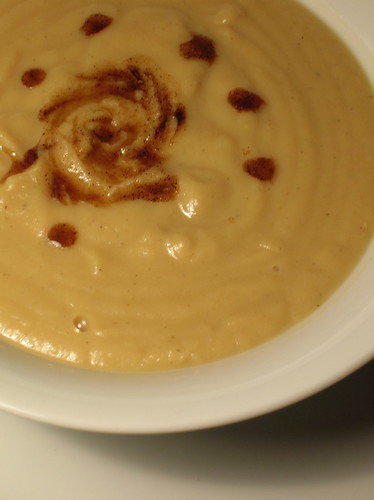
I also noticed when I was doing some cleanup in the recipe section that Desert Candy is seriosuly lacking in the soup section. How could this be, since I adore soups and make them often?! I love smooth pureed soups and I usually make them with whatever I have on hand, carrot ginger is a favorite, or a chilled vichyssoise or tomato bisque. Since I wouldn't dare leave you without a recipe, I did a little cleaning of my own, and found this chickpea soup I made back in the winter, topped with cumin oil. This soup is easy as can be (in keeping with today's clean out the pantry theme) and absolutely delicious. And now back to regularly-scheduled programming...

Creamy Chickpea Soup with Cumin Oil
This soup is best when made with fresh-cooked chickpeas, but you can use canned also.

3 1/2 cups cooked chickpeas with their liquid
half a medium onion, chopped
1 garlic clove, smashed
1/2 cup cream or milk, optional

1 teaspoon cumin seeds
3 tablespoons extra virgin olive oil

1. Place the chickpeas with some of their liquid in a pot with the onion and garlic. There should be enough liquid to cover the chickpeas, add water or chickpea liquid as necessary. Bring the mixture to a boil and season with salt and pepper. Lower the heat and simmer for 15-20 minutes, replenishing water as necessary.
2. Meanwhile, make the cumin oil. In a dry skillet, lightly toast the cumin seeds until just fragrant. Remove from the heat and grind in a coffee grinder or crush with a mortar and pestle. Heat the olive oil in a skillet until shimmering, add the ground cumin, swirling to combine, and remove from the heat.
3. Puree the chickpea soup in a blender until smooth. Add more water or some vegetable broth to thin the soup to your desired consistency. (If you are really picky, you can also press the soup through a sieve or tamis to ensure it is super-smooth). Stir in the cream, if using. Taste for seasoning, add salt or pepper if needed. Ladle the warm soup into bowls, swirl the cumin oil over top.
_____________