Showing posts with label Christmas. Show all posts

01 January 2009

Bourbon Buttercreams

Mom: Do you have my buttercream recipe?

Me: No.

Mom: I can't find it. Are you sure you don't have it?

Me: No mom, I don't have it. But I know the recipe, do you want me to tell it to you?

Mom: I'm sure you have it.

Me: No, I don't. But listen, it's one box of powdered sugar, one-

Mom: No I want my recipe, you know, the one George Beechner wrote out.

Me: I know mom, I don't have it. It's probably in that cabinet of yours. But it's really easy, it's just...

Mom: I looked all through the cabinet, it's not there, and we have to have the bourbon buttercreams for Christmas...

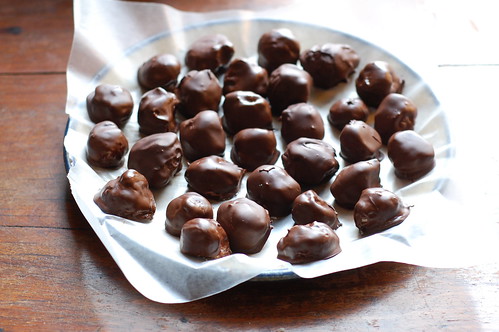
Well, the original recipe was never found, but I've made these so many times I really know the recipe by heart. This makes about 40 buttercreams, and we almost always end up making a second batch. I brought some to my office last week and they were gone in under an hour.
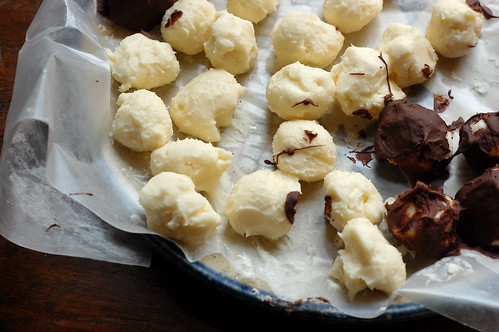
An attempt by a less experienced buttercream maker- the buttercream balls should be rolled until smooth.

Bourbon Buttercreams
In my opinion, there are few things better than a bourbon buttercream. And I generally dislike bourbon (heresy for someone with a Tennessean mother). But you can also flavor them with lemon, orange, vanilla beans, and a myriad of other flavors. The mixture will seem dry at first but do not be tempted to add more butter- if you do they will be too soft at room temperature.

1 1/4 sticks (10 tbl) butter
1 box (1 lb) powdered sugar
3 tbl bourbon
10 ounces bittersweet chocolate

1. Cream the butter until smooth. Cream in the powdered sugar until the mixture is crumbly. Add the bourbon, then continue to cream the mixture until it comes together in a ball. It may seem like the mixture is too dry but don't worry, it will come together eventually. The mixture should be somewhat stiff and fluffy, you should be able to knead it with your hands. If it is too wet, add some more powdered sugar. Taste it to see if the bourbon is to you liking. I almost always add more :-)
2. Pinch off small pieces of the buttercream and roll into balls, about 1/2 tablespoon size (they are rich, so the size of about two small nibbles). Place on wax-paper lined baking sheets. Refrigerate the balls until firm and dry.
3. Meanwhile, prepare a double boiler. Place the chocolate in the top of the double boiler and melt, stirring until smooth. When the chocolate is melted, turn the heat to the lowest setting, so the chocolate just stays warm. Coat the chilled buttercreams in the chocolate. I use a spatula and a fork for this- drop a buttercream in the chocolate, use the spatula to turn the buttercream in the chocolate to coat, then lift the buttercream out with a fork and transfer to wax paper.
4. Transfer to the fridge to chill until firm. Buttercreams are best stored in the fridge and served chilled.

20 December 2008

Scenes from the Holiday Party Kitchen

Assorted Caviar, Creme Fraiche, Blini and Rye

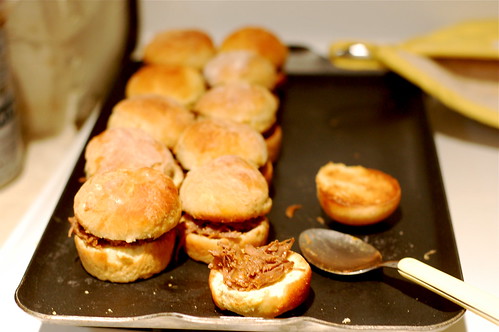
Pulled Beef Barbeque, Homemade Brioche


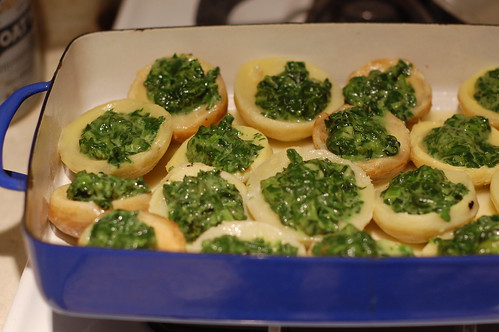
Spinach Stuffed Artichoke Bottoms, before being topped with buttered breadcrumbs and baked (recipe in the comments section)

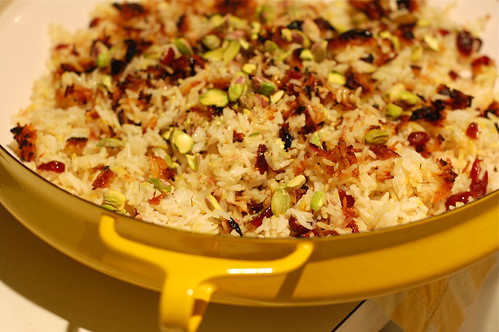
Persian-style jeweled rice


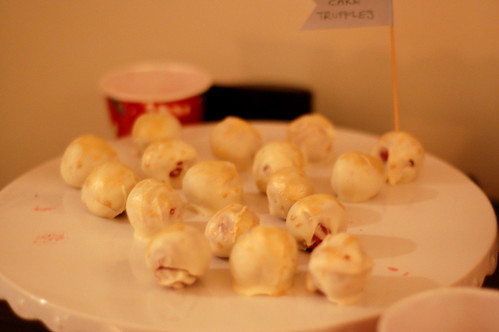
Red Velvet Cake Truffles dusted with edible gold


also on the menu but not pictured:
Devils on Horseback
Curry Deviled Eggs
Homemade Mango Salsa and Homemade Tortilla Chips
Endives filled with Pears and Nuts
Crudites with Pomegranate-Sour Cream Dip
Beet, Goat Cheese, and Olive Tart
Apple, Muenster, and Pecan Butter Squares
Vegetarian Sausage Biscuits
Lamb Meatballs in Prune-Apricot Sauce
Homemade Christmas Cookies
Homemade Eggnog (Craig Claiborne's recipe)
Mulled Wine

Please excuse the lack of posting, obviously I've been busy. Hope you're all having a lovely holiday season!

19 December 2007

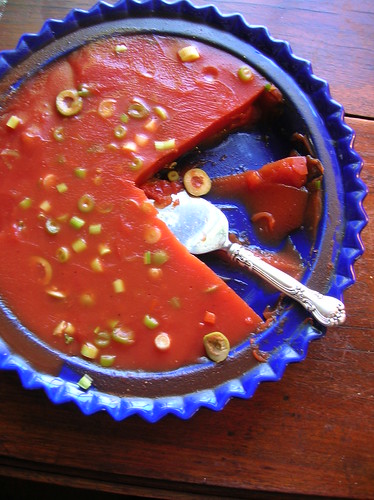
Why I Love Tomato Aspic

I love tomato aspic. It only took me twenty years to figure it out.

You see, as much as I've lauded the cooking of the American South, the culinary traditions of my mother's family and many others stretching across Tennessee, the Carolinas, and Texas, I'm afraid it's easy to romanticize things. Somewhere in the past half century the ease of open-a-can-of-this-and-combine-with-a-can-of-that has crept into the vernacular. Like kudzu vine, culinary traditions have been entangled in processed cheese and smothered in creamed soup. Sometimes it's scary.

Don't get me wrong, the barbeque's still great, there's real cornbread and fresh shucked oysters and plenty of pie. But one year we were in Tennessee for the holidays, doing the usual rounds of Christmas parties and visiting. Everywhere people were pressing little cheese biscuits and pecan tassies in your hand, all of them delicious, but after awhile I was starting to crave a vegetable. Or just something, anything, that resembled its fresh natural state. At the dreaded bank Christmas party, amid the ladies in their Christmas sweaters, I looked in desperation for something not slathered in mayonnaise or cream cheese. Finding nothing, I resigned myself to another ham biscuit.

This is how I came to discover tomato aspic. Aspic is just a fancy word for a savory gelatin; aspics were popular in the fifties (think of those molded salads), but in my family and many others' across the South aspic never went out of style. Specifically, tomato aspic. There is no family gathering to be had without tomato aspic, my family is so passionate about it. It was always on every dinner and buffet table growing up but I had never actually eaten it. Few things could be less appealing to a child than a wobbly block of solidified tomato juice.


Then came the holiday of vegetable depletion, and as I surveyed the buffet I saw the tomato aspics my aunt had made, perfectly shaped in Christmas tree molds and decorated with green olives for the season. I took one, along with a heaping salad, and promptly fell in love. It's hard to describe what's so wonderful about tomato aspic, even now I can't really put words to something which sounds, on paper, so unappealing. Maybe you have to be born into the tomato aspic tradition, but I didn't discover it for the first twenty years of my life, so I think there's hope for you too.

Today, tomato aspic is one of my favorite foods. As often as fresh sliced tomatoes make up my lunch in the summer, a wedge of tomato aspic is sure to be on my plate in the winter. I've even packed a whole tray of it in ice to take to the refrigerator at work so I can have it all week long. But more than that, those funny red blocks remind me of home and the holidays, my mom always has a plate of aspic in the fridge when I'm coming to visit. Sometimes it's decorated with green olives or scallions, other times it's plain, simply tomato juice spiced with a bit of Worcestershire and spice. We're headed to Tennessee next week where I'll be eating ham biscuits and bourbon balls and where my aunt is already getting out the molds, so that when the need for a vegetable strikes, the aspic will be ready. In my family, it wouldn't be the holidays without it.


Tomato Aspic
I've made this with both 2 and 3 packages of gelatin and I prefer the firm yet melting aspic that comes from using 2 packages. However, if your aspic will be part of a buffet or sitting out at room temperature for a while, I'd recommend using 3 packages for a very firm gel.

4 cups tomato juice, preferably low-sodium
1 tablespoon lemon juice
1 bay leaf
1 cup chopped onion and celery
1 tablespoon Worcestershire sauce
dash of Tabasco or other hot sauce, optional
1/2 teaspoon salt (omit if not using low-sodium tomato juice and use your judgement)
2 packages (1/2 oz.) gelatin
2 tablespoons mild vinegar, like apple cider vinegar
optional: chopped scallions or sliced pitted green olives
for serving: butter lettuce leaves, homemade mayonnaise

1. In a large bowl, combine 1/2 cup of the tomato juice with the gelatin and the vinegar, stir to combine and set aside.
2. Place the remaining tomato juice, lemon juice, bay leaf, onion, celery, worcestershire sauce, and salt (to taste) in a sauce pan. Bring the mixture to a boil, then let simmer for 20 minutes.
3. Pour the tomato juice through a sieve into the bowl with the gelatin, discard the vegetables. Stir the tomato-gelatin mixture well so that the gelatin is completely dissolved. Transfer the mixture to a 9 inch pie plate or decorative molds and place in the refrigerator to set. If using olives or scallions, press them into the aspic after about 30-45 minutes (when the gelatin is half-way set), so that they are suspended in the aspic. Refrigerate the aspic at least 4 hours before serving.
4. Serve the aspic chilled, on a bed of lettuce leaves, with mayonnaise on the side. Aspic keeps well in the refrigerator.

16 December 2007

Pistachio-Cranberry Cookie Sticks


A lot of people say that bakers, because they follow recipes that rely on precise weights and measures, are the more precise (dare we say rigid) of the kitchen staff, while cooks have the liberty to be more free spirits and daredevils in the kitchen. While I do think cooking and baking are different arts, I don't think this classification is at all true. When I read a baking recipe, I read it for the bones of its structure: the proportions of ingredients, the technique, the temperatures. But when it comes to flavor, I say it's open season on experimentation and creativity. You can take a good base cookie or cake or cheesecake recipe and extrapolate it into a million different flavor variations.

I am saying this because experimentation is how I discovered one of my favorite cookie recipes. I came across a recipe one day for Almond-Cocoa Nib Cookies from the lovely Alice Medrich, whose recipes always come out brilliantly. But I had neither almonds nor nibs, and somehow an almond cookie wasn't really tickling my fancy anyway. I do, however, always keep a good supply of pistachios around, and when brainstorming what to combine them with, dried cranberries seemed like an obvious good choice.

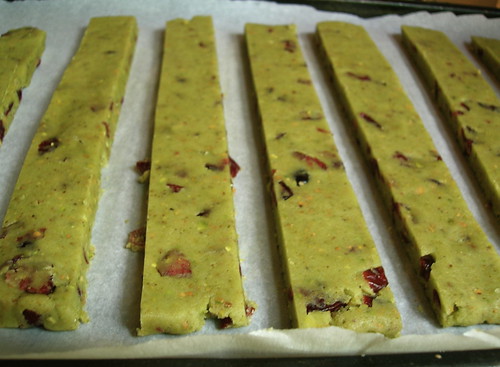
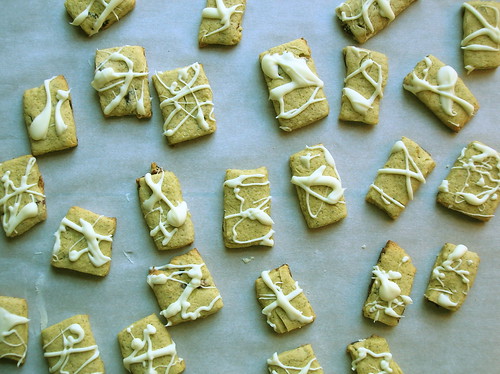
When I first made them, back in the summer, I immediately knew they were destined for my holiday cookie box. First of all, they are red and green colored, and I love the long cookie sticks, I can just see them sticking up out of a cup, waiting for Santa. Second, they are supremely easy to make, just blitz in a food processor and cut with a pizza cutter. I've rarely had a cookie so full of flavor and perfectly crisp, there are plenty of pistachio cookies out there, but few made with pistachio meal (ground pistachios). When I was making these for holiday packages, I ended up cutting them into bite size pieces, and then drizzling the cookies with some white chocolate to make them even more festive. My friend joked they were no longer cookie sticks but cookie stubs, but I think anyone who tastes them will simply call them yum.


Pistachio-Cranberry Cookie Sticks
These colorful cookie sticks are perfect for dipping in a glass of milk. For an extra festive touch drizzle with melted white chocolate.

3/4 cup whole pistachios
1 cup+ 2 tablespoons all purpose flour
2/3 cup sugar
1/4 teaspoon salt
6 tablespoons unsalted butter, cut into chunks
2 tablespoons water
1 teaspoon vanilla extract
1/8 teaspoon almond extract (optional)
1/3 cup chopped dried cranberries or dried cherries

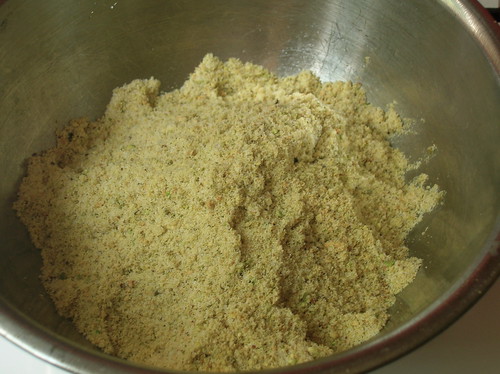
1. Combine the pistachios, flour, sugar, and salt in a food processor and pulse until it is a fine meal. Add the butter and pulse until the dough looks crumbly. Combine the water, vanilla, and almond extract and add it to the bowl, pulsing until it just looks damp. Add the dried cranberries and pulse until evenly distributed.
2. On a piece of parchment paper, roll out the dough into a 6x9 in rectangle that's 1/2 inch thick. Refrigerate for 2 hours or overnight. Preheat the oven to 350 F. Using a pizza cutter or a long knife, cut 3/8 in thick slices and place them on parchment lined cookie sheets, about 1 inch apart. Bake 12-14 minutes, until golden at the edges. Do not over bake, they will continue to firm as they cool.

13 December 2007

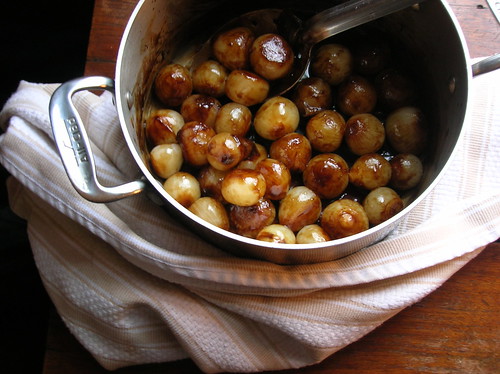
Tamarind-Glazed Pearl Onions

Tamarind is a sweet-tart fruit that comes from the pods of tamarind trees. Though native to Africa, tamarind is used in Middle Eastern cuisine, most commonly in the form of a tamarind drink. Aleppo, in northern Syria, is famous for its highly developped cuisine which is quite distinct from other parts of the region. The Arab name for Aleppo is Halab, derived from the word for milk (haleeb) on account of its excellent dairy products, it seems Aleppo has always been associated with great food. There are several key ingredients that are hallmarks of Aleppian cuisine: smoky-hot spices in the form of Aleppo pepper, plenty of red peppers, tart tangy pomegranate molasses, and the use of tamarind concentrate. These aspects of Aleppian cuisine developped as a result of many factors: Aleppo was a major city on ancient trade routes like the Silk Road, also the presence of Armenian immigrants, nearby Kurds and a strong Jewish community (though no longer extent) have all contributed to a unique repertoire of dishes.


Tamarind came to the Middle East by way of India, where it is popular, hence its name in Arabic tamr hindi, or Indian date. In Aleppo, the tamarind concentrate made by extracting the thick viscuous syrup from the fruit’s pulp is known as ou. Ou is an important ingredient in everything from soup broths to tomato sauces to bulgur salads. In a uniquely Aleppian dish called mehshi basal, onions are formed into rolls stuffed with a meat mixture, and then simmered in a tamarind sauce. A simpler version involves small baby onions simmered in that sweet-sour sauce.

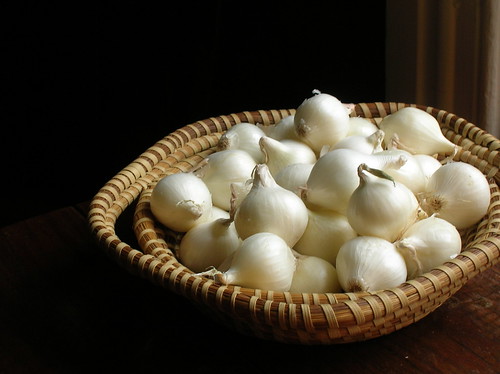
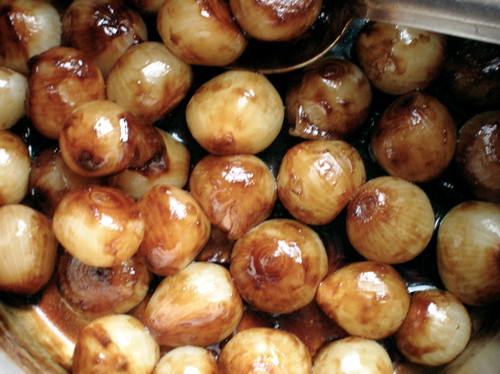
I prefer this second (albeit less traditional) version, not only because it’s easier, but mainly because I love pearl onions. We always have little baby onions at the holidays, and the poor person who volunteers to help me in the kitchen usually gets stuck with the task of peeling them (and I wonder why they stop asking?). These tamarind glazed onions are quite similar to the popular Italian cippoline in agrodolce but I like the way the sauce is even thicker and tangier than those made with balsamic vinegar. The recipe’s provenance may be far away, but spearing them with a fork as they slippery-slither across the plate, crashing into the potatoes, the onion layers bursting from inside each other, and finally using the last bit of sauce to coat your entree, it tastes like the holidays to me.


Tamarind-Glazed Pearl Onions
Tamarind concentrate is available at Whole Foods and international markets, it keeps well and has many uses so it's a great addition to your pantry. This Syrian version of sweet-and-sour onions has a great thick and tangy sauce.

2 pounds white pearl onions (about 30)
3 tablespoons extra-virgin olive oil
3 tablespoons tamarind concentrate
1 tablespoon lemon juice
3-4 tablespoons sugar, to taste
pinch of salt

1. Heat a large pot of water to boiling. Trim off the base and tips of the onions. Submerge the onions in the water and let boil 7 minutes. Drain the onions into a colander and rinse with cold water. Slip the peels off the onions.
2. Heat the olive oil in a saucepan. Add the peeled onions and saute over medium heat for 5 minutes, until just browned. Add the tamarind, lemon, sugar and salt and cook until the mixture caramelizes and turns sticky, 3-5 more minutes. Taste for seasoning. Serve at room temperature.

P.S. If you don't have tamarind concentrate on hand, the recipe works perfectly well using balsamic vinegar instead.
____________________________________